Template Method

An algorithm runs the same sequence of steps every time, and some of those steps differ from one use to the next. A Template Method sets the sequence and lets you supply the steps that vary.
An application framework lets you build a new application by reusing its existing classes and overriding methods to customize behavior. At the heart of a framework is the Template Method of GoF Design Patterns: a base-class method that drives the application by calling other base-class methods, some of which you override.
Python’s own unittest
is this kind of application framework. You subclass
TestCase and supply setUp(), your
test_* methods, and tearDown().
TestCase.run() is the template method. It calls
setUp(), then your test method, then
tearDown(). Constructing a TestCase
runs nothing. The test runner calls run() on the
finished object.
The Anchored Algorithm
A Template Method anchors the shape of the algorithm in the base class. Subclasses provide the individual steps.
Making
a Class Final puts the typing.final decorator
on a class. The decorator also works on a single method. On a
method, it declares that no subclass may override that method.
In framework.py,
run() is the template method. @final
on run() makes the type checker reject any subclass
that overrides it:
# framework.py
from typing import final

class ApplicationFramework:
    @final
    def run(self) -> None:
        for _ in range(2):
            self.customize1()
            self.customize2()

    def customize1(self) -> None: ...
    def customize2(self) -> None: ...
MyApp imports the framework and supplies the two
steps:
# template_method.py
from typing import override
from framework import ApplicationFramework

# Create an application by filling in the steps:
class MyApp(ApplicationFramework):
    @override
    def customize1(self) -> None:
        print("Nudge, nudge, wink, wink!")

    @override
    def customize2(self) -> None:
        print("Say no more, say no more!")

MyApp().run()
#: Nudge, nudge, wink, wink!
#: Say no more, say no more!
#: Nudge, nudge, wink, wink!
#: Say no more, say no more!
MyApp inherits run() from the base
class. That inherited run() holds the loop and
calls the steps MyApp supplies, so
MyApp().run() starts the engine that drives the
application.
A test supplies steps that record their calls, confirms that
the record stays empty after construction, then checks the order
in which run() makes them:
# test_template_method.py
from typing import override
from framework import ApplicationFramework

def test_template_method_runs_steps_in_order() -> None:
    calls: list[str] = []

    class Recorder(ApplicationFramework):
        @override
        def customize1(self) -> None:
            calls.append("one")

        @override
        def customize2(self) -> None:
            calls.append("two")

    app = Recorder()
    assert calls == []
    app.run()
    assert calls == ["one", "two", "one", "two"]
The base class calls code written later, sometimes years later. Framework authors call this the Hollywood Principle: “don’t call us, we’ll call you.” The general name for this reversal is Inversion of Control: the framework defines the flow of control and calls your code, rather than your code calling into a library.
Only the type checker enforces
@final. At runtime the decorator sets
__final__ = True on the function. Nothing in the
interpreter reads that attribute. Your own code can read it. If
you want an override to fail at runtime, the __init_subclass__()
technique also works with methods. near_miss.py in the next
section includes that check. The check raises a
TypeError when a subclass replaces a function that
carries __final__.
Hooks and the Misspelled Override
The step methods default to ..., so a subclass
overrides only the steps that matter to it. This kind of
optional step is a hook. The setUp() and
tearDown() in the opening example are hooks.
TestCase supplies empty versions, so a test class
overrides setUp() only when it has setup work to
do.
A forgotten step silently does
nothing. The do-nothing default also hides a misspelling.
def customise1() (‘s’ instead of ‘z’) adds a new
method and leaves the base’s do-nothing version in place. So
every step override in these listings carries @override.
The type checker then rejects a method that overrides
nothing.
That check depends on the
decorator. If you leave @override off the
misspelled method, the checker accepts it as a new method,
because the typing rules let a subclass add any method. A
runtime check can reject the misspelled method. In near_miss.py,
CheckedFramework inherits from
ApplicationFramework and adds that check. Its
__init_subclass__() runs at each subclass’s
class statement, and uses the standard library’s
difflib to find names that nearly match:
# near_miss.py
from difflib import get_close_matches
from typing import override
from exceptions import expected
from framework import ApplicationFramework

class CheckedFramework(ApplicationFramework):
    def __init_subclass__(cls) -> None:
        super().__init_subclass__()
        inherited = {
            name
            for base in cls.__mro__[1:]
            for name in vars(base)
            if not name.startswith("__")
        }
        for name in vars(cls):
            if name.startswith("__"):
                continue
            replaced = getattr(super(cls, cls), name, None)
            if getattr(replaced, "__final__", False):
                raise TypeError(
                    f"{cls.__name__}.{name} "
                    "overrides a @final method"
                )
            if name in inherited:
                continue
            if near := get_close_matches(name, inherited):
                raise TypeError(
                    f"{cls.__name__}.{name}: "
                    f"did you mean {near[0]}?"
                )

class MyApp(CheckedFramework):
    @override
    def customize1(self) -> None:
        print("one")

    def report(self) -> None: ...

with expected(TypeError):
    class Typo(CheckedFramework):
        def customise1(self) -> None:
            print("never runs")
#: [TypeError] Typo.customise1: did you mean customize1?

with expected(TypeError):
    class Hijack(CheckedFramework):
        def run(self) -> None:  # type: ignore
            print("never runs")
#: [TypeError] Hijack.run overrides a @final method

with expected(TypeError):
    class Weird(CheckedFramework):
        def customer(self) -> None: ...
#: [TypeError] Weird.customer: did you mean customize2?
inherited collects
every non-dunder name the base classes define. For
MyApp those bases are
CheckedFramework, which adds no such name, and
ApplicationFramework, which supplies
run and the two steps. For each name the subclass
defines, getattr(super(cls, cls), name, None) finds
the attribute that the name replaces, searching the classes that
follow cls in its method
resolution order. If that attribute carries
__final__, __init_subclass__() raises
a TypeError. class Hijack fails that
check, because the run() it replaces carries
__final__.
The __final__ check
exists because a subclass that replaces run() moves
the algorithm out of the base class, and @final
stops that replacement only when the type checker runs.
The __final__ check
reads a flag rather than a method name. A second
@final instance method in
ApplicationFramework therefore gets the same
protection from the same __init_subclass__(). The
check misses a @final on a @property,
and a @final written above
@classmethod or @staticmethod. For
those, getattr() on the class returns the property
object, a bound method, or the bare function. None of them
carries __final__. Written below
@classmethod or @staticmethod,
@final marks the function, which
getattr() returns as the bare function or through a
bound method. The check then catches the override.
Reading the attribute through getattr() also
passes the type checker, because getattr() with a
default accepts any name. A function’s type declares no
__final__, so ty reports a direct read
such as ApplicationFramework.run.__final__ as an
unresolved attribute.
A name that matches a step, such as customize1,
is an ordinary override. A name far from every inherited name,
such as report(), is an ordinary new method. Both
pass the check. A name that nearly matches an inherited name
produces a TypeError, and the message names the
method the author probably meant. customise1 comes
close to customize1, so the class Typo
statement raises a TypeError. The misspelling fails
at import time, before the framework runs and calls the empty
default in place of the step.
Rejecting every new method also catches the typo, but it
forbids report() too. A framework that bans helper
methods in its subclasses is too restrictive.
The close-match check also rejects
legitimate names. class Weird fails, although its
author meant customer(). customer and
customize2 share the six letters
custom and an e, a similarity of 0.78.
get_close_matches() flags any name that scores 0.6
or higher. A team that adopts this check should expect to catch
typos and to rename an occasional legitimate method.
If every subclass must supply a
step, inherit from ABC and declare that step with
@abstractmethod.
Instantiating a subclass that leaves the step abstract then
raises a TypeError, and the type checker reports
the attempt. The older convention gives the step a body that
raises NotImplementedError. Under that convention,
Python instantiates the same subclass and the type checker
accepts it. The step raises NotImplementedError
when run() calls it, after any earlier steps have
run.
Don’t Start the Engine in the Constructor
The client starts the engine, not
ApplicationFramework. A framework can call
run() from its own constructor, but that constrains
any subclass with its own __init__(). Because
run() calls methods the subclass supplies, the
subclass must finish its own setup before it calls
super().__init__(). Calling
super().__init__() first, in the usual style, runs
the engine on a half-initialized object:
# premature_engine.py
from typing import final, override
from exceptions import expect

class Framework:
    def __init__(self) -> None:
        self.run()

    @final
    def run(self) -> None:
        self.step()

    def step(self) -> None: ...

class Greeter(Framework):
    def __init__(self, name: str) -> None:
        # In the usual order, this call runs the engine
        super().__init__()
        self.name = name  # ...before this line runs

    @override
    def step(self) -> None:
        print(f"Hello, {self.name}!")

expect(AttributeError, Greeter, "Robin")
#: [AttributeError] 'Greeter' object has no attribute 'name'
Greeter("Robin") fails with an
AttributeError. super().__init__()
calls run(), run() calls
step(), and step() reads
self.name before the constructor assigns it.
The quick repair is reordering. Assign self.name
first, then call super().__init__(). That works,
but it inverts the convention Python programmers expect. The
next subclass author might restore the usual order out of habit.
The reliable repair changes the framework. Separate construction
from starting, and have the client call run()
explicitly on a fully built object. So
ApplicationFramework has no
__init__(), and the client calls
MyApp().run().
Substitutability
The Template Method
depends on the Liskov
Substitution Principle: when code expects a base-class
instance, an instance of a subclass must work in its place. The
base run() calls customize1() and
customize2(). The algorithm works only if each step
the subclass supplies does its part on every call. A subclass
can break that requirement in three ways and still pass the type
checker: it raises an exception where the base does not, leaves
a step empty when the anchored algorithm depends on it, or
performs the step on one pass and skips the next. faithless_step.py shows
the third failure:
# faithless_step.py
from typing import override
from framework import ApplicationFramework

class OnlyOnce(ApplicationFramework):
    def __init__(self) -> None:
        self._ran = False

    @override
    def customize1(self) -> None:
        if not self._ran:  # The second pass does nothing
            self._ran = True
            print("Nudge, nudge, wink, wink!")

    @override
    def customize2(self) -> None:
        print("Say no more, say no more!")

OnlyOnce().run()
#: Nudge, nudge, wink, wink!
#: Say no more, say no more!
#: Say no more, say no more!
run() calls
customize1() twice. OnlyOnce performs
the step once. The name, the parameters, and the return type all
match the base, so the type checker accepts
@override and reports nothing. The base states its
algorithm in the loop, not in any type. Each pass calls the
step, so each pass must perform it.
An unexpected exception, an empty step the flow needs, and a
skipped pass each change what the anchored algorithm does.
Because the ... defaults make a step optional, a
step left empty on purpose looks identical to a forgotten one.
The Template Method works only when every subclass is a
faithful substitute for its base.
Passing the Steps as Functions
A subclass is one way to supply the varying steps. Because Python functions are first-class, you can also pass the steps as arguments:
# template_function.py
from collections.abc import Callable

type Step = Callable[[], None]

def run_framework(customize1: Step,
                  customize2: Step = lambda: None) -> None:
    for _ in range(2):  # The anchored algorithm
        customize1()
        customize2()

run_framework(
    lambda: print("Nudge, nudge, wink, wink!"),
    lambda: print("Say no more, say no more!"),
)
#: Nudge, nudge, wink, wink!
#: Say no more, say no more!
#: Nudge, nudge, wink, wink!
#: Say no more, say no more!

run_framework(lambda: print("one"))
#: one
#: one
The figure lays the subclass form and the function form side by side, starting from the base class with its empty hooks:
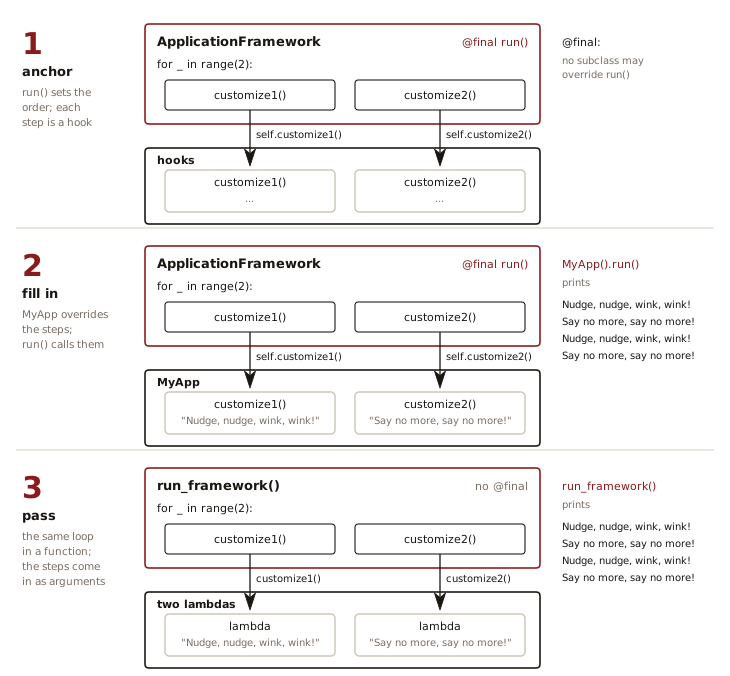
The loop and its two step slots stay the same in all three
frames. The box beneath them changes from empty hooks to
MyApp to two lambdas. In frame 3 a function,
run_framework(), holds the loop in place of
ApplicationFramework. In the first two frames each
arrow is a call through self, and in frame 2 those
calls reach the subclass’s methods. In frame 3 the arrow labels
read customize1() and customize2(),
with no self. run_framework() calls
its own parameters. The output column shows that the lambdas
print the same four lines as MyApp.
Both the Template Method and the function version have an anchored algorithm and varying steps. If the steps share state, build on each other, or come as a coherent group, the subclass is clearer. If each step is independent, passing functions takes fewer lines and needs no class hierarchy.
The subclass form also makes each step optional, since the
base supplies the ... default. The function form
makes a step optional by giving its parameter a default. In template_function.py,
customize2 defaults to the do-nothing
lambda: None, so the closing
run_framework() call passes one step and the loop
prints one twice. With a do-nothing default, the
loop calls both steps on every pass. customize1 is
a required parameter, so the type checker reports a call that
omits it.
The function version also needs no
@final. That decorator stops an override only when
the type checker runs. Here a caller passes the steps in as
arguments. The loop stays in the body of
run_framework(), out of the caller’s reach.
Structure anchors the algorithm, and that anchor holds at
runtime as well as under the type checker.
Passing functions is not the
Strategy pattern, although the two look alike at the
call site. A Strategy swaps out a whole algorithm
behind a single interface. In template_function.py the
algorithm stays in run_framework(), and the caller
supplies the steps.
A stateless step is usually better as a function than as an overridden method. You make the same choice between a class and a function when you write a Strategy.
What Anchors the Algorithm
An anchored algorithm is only as secure as its anchor. Each of this chapter’s four anchors guards against a different way of breaking the anchored algorithm:
- Structure, in
template_function.py. The loop lives in a function body, out of every caller’s reach. This anchor works only when you can pass functions instead of subclassing. - The type checker, via
@final. It reports an overriddenrun()before the program runs. - The interpreter, via
__init_subclass__(). It raises aTypeErrorat an offending subclass’sclassstatement, whether the subclass overridesrun()or misspells a hook. This anchor holds at runtime, whereas the type checker alone enforces@final. - Discipline, via the Liskov
Substitution Principle. The principle governs whether each step
is a faithful substitute.
@abstractmethodchecks that a required step exists. No tool checks what the step does.
Ask how the algorithm might break, and choose the mechanism that protects it.
Exercises
Try each exercise before opening its solution.
Create a framework that takes a list of file names. It opens every file but the last for reading, and the last one for writing. It processes each input file by a step the subclass or the function supplies, and writes the output to the last file. Supply each of these steps twice, once by subclassing and once by passing a function:
- Convert all the letters in each file to uppercase.
- Treat the first file as a list of search words, one per line, and report which of those words appear in each remaining input file.
Repair
premature_engine.pyboth ways: first reorder the two lines inGreeter.__init__(), then redesignFrameworkinstead, so clients construct the object and callrun()explicitly. Which repair still protects a second subclass author who has not read this chapter?Subclass
ApplicationFrameworkand overriderun()with a version that callscustomize2()beforecustomize1(). Run it, then runtyover it. Which of the two, Python or the type checker, objects to the change? What does that tell you about the source of the anchored algorithm’s guarantee?Write two subclasses of
ApplicationFrameworkthat both type-check but break the anchored algorithm: one whosecustomize1()raises an exception the base does not raise, and one that leavescustomize2()at its...default when the anchored algorithm depends on it. The type checker reports neither. What must be true of the base class for the type checker to catch either one?In
near_miss.py, subclassMyAppwith a class that adds a method namedreports(). Predict what theclassstatement does, then run it. Against which names does__init_subclass__()compare a new method? Change the check so it compares a new method only against the namesApplicationFrameworkdefines. What does the narrower check no longer catch?