Iterators

A loop needs the next item, wherever that item is stored. An Iterator supplies the item and hides the storage.
Code written against an iterator works the same whether the data comes from a list, a file, a database cursor, or a computation. It asks only for the next item. Design Patterns calls this approach designing the communication, not the parts. The caller states what it needs and leaves the container’s type unnamed.
Python builds iterators into the
language. Any object that follows the iterator protocol
works with for, comprehensions, sum(),
sorted(), unpacking, and every function that takes
an iterable.
Iteration Comes Built In
Two methods make up the protocol.
An iterable has __iter__(), which returns
an iterator. An iterator has __next__(),
which returns the next item or raises
StopIteration. An iterator is also iterable. Its
__iter__() returns itself, so an iterator works
anywhere code expects an iterable. The for loop
calls these methods, so you rarely call them. Every container
uses this protocol, so a function written against an iterable
stays decoupled from the container.
# basic_iteration.py
nums = [1, 2]
it = iter(nums)  # Called by a for loop
print(iter(nums) is iter(nums))  # [1]
#: False
print(iter(it) is it)  # [2]
#: True
print(next(it), next(it))  # What the loop calls per step
#: 1 2
try:
    next(it)
except StopIteration:
    print("StopIteration ends the loop")
#: StopIteration ends the loop
The is at
[1] shows that calling iter() on a
list creates a new iterator each time. The is at
[2] shows that calling iter() on an
iterator returns that iterator. The tempting call is
next(nums), and it fails. next()
requires an iterator, and a list has no __next__(),
so next(nums) raises a TypeError at
runtime. The type checker rejects next(nums) before
the program runs.
A for loop makes one iter() call,
then calls next() until the iterator raises
StopIteration. A loop absorbs
StopIteration as the normal end rather than an
error. Written out, for x in nums: is this
loop:
it = iter(nums)          # Once, before the loop
while True:
    try:
        x = next(it)     # Once per step
    except StopIteration:
        break
    ...                  # The loop body
One legacy path bypasses
__iter__(). A class is still iterable if it defines
__getitem__() in place of __iter__(),
with __getitem__() taking integers from zero.
iter() builds an iterator that calls
__getitem__() with 0, 1, 2, and so on, until
IndexError. Such a class works with
for, yet isinstance(obj, Iterable)
returns False and a parameter annotated
Iterable[T] rejects it. This legacy path is the one
case where a for loop accepts an object that fails
an Iterable annotation. Write
__iter__() in new code.
Generators
You rarely write
__iter__()/__next__() by hand. A
generator writes them. A function with a
yield statement returns an iterator that produces
each yielded value in turn. The generator pauses after each
value and resumes with its local variables intact.
The generators in this chapter produce values without
receiving any, so Iterator[T] annotates them. That
annotation is the short form of a three-part type that also
describes what a generator receives and what it returns. Generators
covers the full form, which an Effect system needs.
iterators.py holds a
generator function, fibonacci(), and a class,
Countdown, that becomes iterable because its
__iter__() is a generator:
# iterators.py
from collections.abc import Iterable, Iterator
from record import record

def fibonacci(n: int) -> Iterator[int]:
    a, b = 0, 1
    for _ in range(n):
        yield a
        a, b = b, a + b

@record
class Countdown:
    start: int

    def __iter__(self) -> Iterator[int]:
        n = self.start
        while n > 0:
            yield n
            n -= 1

def total(numbers: Iterable[int]) -> int:
    return sum(numbers)
iterators_demo.py builds
each source and passes it to total():
# iterators_demo.py
from iterators import Countdown, fibonacci, total

print(list(fibonacci(8)))
#: [0, 1, 1, 2, 3, 5, 8, 13]
print(list(Countdown(5)))
#: [5, 4, 3, 2, 1]
print(total(fibonacci(8)))  # Works on a generator
#: 33
print(total([1, 2, 3, 4]))  # and a list
#: 10
print(total(Countdown(5)))  # and a custom iterable
#: 15
total(numbers: Iterable[int]) -> int accepts
any Iterable, so it works on the generator, the
list, and the custom Countdown. The figure follows
one loop over nums through the protocol, then puts
total() in the loop’s place:
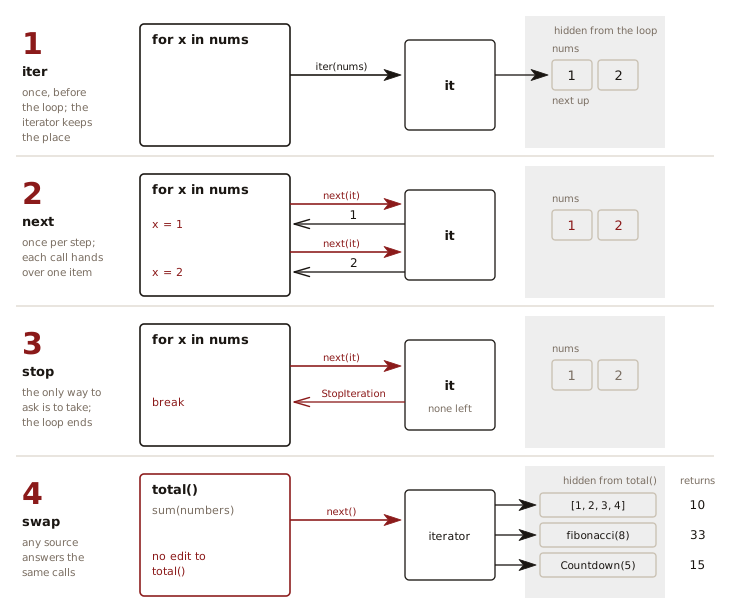
The shaded region in each frame
holds what the iterator hides from its caller. Inside
total(), sum() makes the same
iter() and next() calls as the
written-out for loop, so a new source needs no
change to total().
The third frame shows a limit of the protocol. A caller learns that the items have run out by asking for one more.
fibonacci(8) returns an iterator, which one pass
exhausts. Countdown(5) is an iterable whose
__iter__() builds a fresh generator for every pass,
so you can iterate over it repeatedly.
The test file confirms that:
fibonacci()produces the expected sequence, including the empty and one-item cases.Countdowncounts down to 1, andCountdown(0)produces nothing.- A
Countdownproduces the same values on a second pass. total()sums a list, a generator, and aCountdown.
# test_iterators.py
import pytest
from iterators import Countdown, fibonacci, total

@pytest.mark.parametrize("n, expected", [
    (8, [0, 1, 1, 2, 3, 5, 8, 13]),
    (0, []),
    (1, [0]),
])
def test_fibonacci_sequence(
    n: int, expected: list[int]
) -> None:
    assert list(fibonacci(n)) == expected

def test_countdown_sequence() -> None:
    assert list(Countdown(5)) == [5, 4, 3, 2, 1]
    assert list(Countdown(0)) == []

def test_countdown_is_reiterable() -> None:
    c = Countdown(3)
    assert list(c) == [3, 2, 1]
    assert iter(c) is not iter(c)
    assert list(c) == [3, 2, 1]

def test_total_over_any_iterable() -> None:
    assert total([1, 2, 3, 4]) == 10
    assert total(fibonacci(8)) == 33
    assert total(Countdown(5)) == 15
Generators are lazy.
fibonacci(1_000_000) computes nothing until you
iterate over it, then produces one value at a time, so a
generator works on streams too large to hold in memory.
Iterating over a generator keeps one value alive at a time,
while collecting the same million values into a list keeps all
of them alive at once. In Performance,
lazy_pipeline.py measures
the difference with tracemalloc. The generator
pipeline’s peak stays under one percent of the list version’s
peak.
A generator
expression such as (i * i for i in range(n)) is
the one-line form of a generator, and it is lazy in the same
way.
A generator can be
infinite. A while True loop that yields
forever, or itertools.count(), produces values on
demand with no end. You take as many as you need with itertools.islice(),
while a list must hold every value first.
What Laziness Hides
Laziness has two surprising consequences, and both are silent:
# generator_lifecycle.py
from collections.abc import Iterator

def squares(n: int) -> Iterator[int]:
    print("first next() reached the body")
    for i in range(n):
        yield i * i

sq = squares(6)  # Body not executed
print("created")
#: created
print(next(sq))
#: first next() reached the body
#: 0
print(list(sq))  # The values that are left
#: [1, 4, 9, 16, 25]
print(list(sq))  # Exhausted: empty, and no error
#: []
The Body Waits for
the First next()
Calling squares(6)
runs none of its body. The print() at the top runs
once, when the first next() call requests a value.
Each later next() resumes the body just after the
yield instead of restarting it.
Any validation at the top of a
generator also waits for the first next(). A check
meant to reject a bad argument raises its exception at the first
next(), far from the call that caused the
problem.
In eager_validation.py,
lazy_squares() shows the delay.
squares() removes the delay by being a plain
function. It checks its argument, then returns an inner
generator.
# eager_validation.py
from collections.abc import Iterator
from exceptions import expect

def lazy_squares(n: int) -> Iterator[int]:
    if n < 0:
        raise ValueError(f"n must not be negative: {n}")
    for i in range(n):
        yield i * i

gen = lazy_squares(-1)
print("no error yet")
#: no error yet
expect(ValueError, next, gen)
#: [ValueError] n must not be negative: -1

def squares(n: int) -> Iterator[int]:
    if n < 0:
        raise ValueError(f"n must not be negative: {n}")
    def produce() -> Iterator[int]:
        for i in range(n):
            yield i * i
    return produce()

# The check runs now, not at first next():
expect(ValueError, squares, -1)
#: [ValueError] n must not be negative: -1
lazy_squares() contains a yield, so
the call lazy_squares(-1) runs none of its body.
The check waits for next(). squares()
has no yield, so calling it runs the check
immediately. Only produce() waits.
An Exhausted Generator Is Silently Empty
The second surprise in generator_lifecycle.py is
its second call to list(sq). An exhausted generator
answers every next() with
StopIteration, which list() absorbs as
the normal end. The second list(sq) therefore
returns []. No exception reports the bug.
When you must walk data twice,
collect it into a list once, or hand out an iterable like
Countdown in iterators.py, whose
__iter__() builds a fresh generator for every
pass.
Laziness and single use are
separate properties. Countdown is as lazy as the
generator its __iter__() builds, yet it supports
repeated passes, because each pass gets a fresh iterator.
range() works the same way. One range
object can drive loop after loop. The iterator runs out, not the
iterable that made it.
An Iterable[T] annotation gives no warning,
because it describes a list and a half-spent generator equally
well. A function that walks its argument twice therefore
type-checks and then returns a wrong answer on the second
pass:
# walked_twice.py
from collections.abc import Collection, Iterable, Iterator

def gen(n: int) -> Iterator[int]:
    yield from range(n)

def twice_iterable(xs: Iterable[int]) -> tuple[int, int]:
    return sum(xs), sum(xs)

def twice_collection(
    xs: Collection[int]
) -> tuple[int, int]:
    return sum(xs), sum(xs)

# Type checker sees nothing wrong
print(twice_iterable(gen(3)))
#: (3, 0)
# The same values, in a list
print(twice_iterable([0, 1, 2]))
#: (3, 3)
The two calls differ in the argument alone, so the
(3, 0) comes from the spent generator.
When a function iterates over its
argument more than once, say so in the signature.
Collection[T] and Sequence[T] also
require __len__() and __contains__(),
which no generator has. The type checker therefore flags the
generator at the call, before the function runs and returns a
wrong answer. On twice_collection(gen(3)) it
reports an invalid-argument-type: expected
Collection[int], found Iterator[int].
The listing leaves that call out, because every chapter listing
must type-check. total() in iterators.py stays
Iterable[int] because it sums once.
Collection[T] also rejects
Countdown, which supports any number of passes.
Countdown defines __iter__(), while a
Collection also requires __len__() and
__contains__(). A reiterable class passes
Collection[T] by adding those two methods.
collections.abc has no protocol for “iterable more
than once,” so Collection[T] is the closest
annotation.
What tee() Buffers
itertools.tee(it, 2)
splits one iterator into two independent ones.
tee() looks like a third way to walk data twice,
but it saves memory over a list only when the two branches
advance together:
# tee.py
from itertools import tee
from typing import Final
from benchmark import report, traced

# Two independent branches, one source
a, b = tee(i * i for i in range(5))
print(list(a), list(b))
#: [0, 1, 4, 9, 16] [0, 1, 4, 9, 16]

N: Final[int] = 100_000
first, second = tee(i * i for i in range(N))
with traced() as buffered:
    for _ in first:  # Drain first; second waits
        pass
with traced() as listed:
    collected = [i * i for i in range(N)]
report(tee_bytes=buffered.current,
       list_bytes=listed.current)
print(f"tee held as much as the list: "
      f"{buffered.current > listed.current * 0.9}")
#: tee held as much as the list: True

# Same N, but both branches advance together:
first2, second2 = tee(i * i for i in range(N))
with traced() as lockstep:
    for _ in zip(first2, second2, strict=True):
        pass
report(lockstep_bytes=lockstep.peak)
print(f"lockstep buffered far less: "
      f"{lockstep.peak < listed.current * 0.1}")
#: lockstep buffered far less: True
Both branches see all five
squares, so tee() delivers the second pass the
generator could not. Each with traced() block
measures the memory its body allocates, using the helper from Numbers
on Your Machine. current is what the block
leaves allocated, and peak is the most it held at
once. tee() buffers every item the leading branch
consumes until the trailing branch catches up. When
first drains while second waits, the
buffer therefore holds the whole stream. That buffer uses as
much memory as a list, and the
buffered.current > listed.current * 0.9
comparison confirms it (one machine measured 4,096,992 bytes
buffered against 3,999,904 for the list). The last block
advances first2 and second2 together
instead, one zip() step at a time, so
tee() buffers at most the gap between them. That
gap stays near zero, and the
lockstep.peak < listed.current * 0.1 comparison
confirms it. Use tee() when two branches advance
together, not when one finishes before the other starts.
The branches of one
tee() call also belong in a single thread. They
share one buffer with no lock, so two threads advancing them at
the same time can raise a RuntimeError. Concurrency
covers threading.concurrent_tee(), the thread-safe
version, along with what goes wrong when two threads call
next() on the same iterator.
Delegating with
yield from
A generator can delegate part of
its work to another iterator using yield from.
yield from yields every value that iterator
produces, in turn, as if the outer generator had written the
loop:
# yield_from.py
from collections.abc import Iterator, Sequence

type Nested = int | Sequence[Nested]

def flatten_loop(nested: Sequence[Nested]) -> Iterator[int]:
    for item in nested:
        if isinstance(item, int):
            yield item
        else:
            # Spelled out
            for x in flatten_loop(item):  # noqa: UP028
                yield x

def flatten(nested: Sequence[Nested]) -> Iterator[int]:
    for item in nested:
        if isinstance(item, int):
            yield item
        else:
            # The same loop, delegated
            yield from flatten(item)
yield_from_demo.py
flattens one nested list, then checks that both functions agree
on it:
# yield_from_demo.py
from collections.abc import Sequence
from yield_from import Nested, flatten, flatten_loop

data: Sequence[Nested] = [1, [2, 3], [4, [5, 6]], 7]
print(list(flatten(data)))
#: [1, 2, 3, 4, 5, 6, 7]
print(list(flatten_loop(data)) == list(flatten(data)))
#: True
Both functions call themselves on each nested sequence, and
both pass each value from the recursive call out to the caller.
flatten_loop() passes the values out by hand. It
starts the recursive call, then re-yields each value that call
produces. flatten() replaces those two lines with
yield from.
flatten_loop() carries a # noqa
because of ruff’s UP028 rule. That rule reports a
for loop whose body is a lone yield of
the loop variable, and tells you to write
yield from instead.
The two forms agree for a
generator that yields values and returns None, as
flatten() does. The yield from
expression, however, has a value.
result = yield from inner() binds whatever
inner() returned when it stopped. The hand-written
loop drops that value. yield from also forwards
send() and throw() into the inner
generator. The hand-written loop forwards neither. Generators
uses all three channels: the yielded values, the return value,
and send().
test_flatten() runs flatten() and
flatten_loop() over the same inputs and expects the
same flat list from each:
# test_yield_from.py
from collections.abc import Callable, Iterator, Sequence
import pytest
from yield_from import Nested, flatten, flatten_loop

type Flattener = Callable[[Sequence[Nested]], Iterator[int]]

@pytest.mark.parametrize("flatten_with",
                         [flatten, flatten_loop])
@pytest.mark.parametrize("nested, expected", [
    ([1, [2, 3], [4, [5, 6]], 7], [1, 2, 3, 4, 5, 6, 7]),
    ([1, 2, 3], [1, 2, 3]),
])
def test_flatten(
    flatten_with: Flattener,
    nested: Sequence[Nested], expected: list[int]
) -> None:
    assert list(flatten_with(nested)) == expected
Reusable Algorithms
The standard library’s
itertools module contains the generic iterator
algorithms chain(), islice(),
groupby(), takewhile(), and more. Each
of these consumes and produces iterators. Combine them with generator
expressions such as
(x * x for x in data if x > 0) to build
pipelines that stay lazy end to end. Each stage pulls one item
at a time, so an infinite source is fine as long as something
downstream stops it:
# reusable_algorithms.py
from itertools import count, islice, takewhile

numbers = count(1)  # Infinite: 1, 2, 3, ...
# The generator expression squares the odd numbers, lazily:
odd_squares = (n * n for n in numbers if n % 2)
print(list(islice(odd_squares, 5)))  # Take the first five
#: [1, 9, 25, 49, 81]

# takewhile() stops when its condition fails:
print(list(takewhile(lambda s: s < 50,
                     (n * n for n in count(1)))))
#: [1, 4, 9, 16, 25, 36, 49]
Each stage runs when list() pulls a value.
islice() and takewhile() decide when
to stop, so the infinite count(1) produces as many
values as they pull.
islice() is also how
you slice an iterator. A generator defines no
__getitem__(), so the list habit
odd_squares[:5] raises a TypeError
instead.
Functional
Toolkits covers chain() and
groupby() in full, including why
groupby() needs sorted input.
Choose takewhile()
deliberately. Its lookalike is the if clause of a
generator expression (or filter()). The two behave
differently with an infinite source. The if version
skips nonmatching values but keeps looking, so once values stop
matching, a list() around it runs forever.
takewhile() stops at the first failure. On finite
data whose values stop matching for good, as the rising squares
do, skipping and stopping give the same result. On infinite data
of that kind, takewhile() finishes. The
if clause runs forever.
A test can demonstrate that
difference, but not by writing list(count(1)). That
call runs forever, and so does the test. In test_endless.py,
counter() stands in for count(1). It
counts up the same way, then raises an exception once something
has pulled LIMIT values:
# test_endless.py
from collections.abc import Iterator
from itertools import count, islice, takewhile
from typing import Final
import pytest

LIMIT: Final[int] = 1000

class Tripwire(Exception):
    pass

def counter(limit: int) -> Iterator[int]:
    for n in count(1):
        if n > limit:
            raise Tripwire(
                f"pulled {limit} values and kept asking")
        yield n

def test_list_keeps_pulling_from_an_infinite_source(
) -> None:
    with pytest.raises(Tripwire):
        list(counter(LIMIT))

def test_the_if_clause_skips_but_never_stops() -> None:
    small = (n for n in counter(LIMIT) if n < 3)
    with pytest.raises(Tripwire):
        list(small)

def test_takewhile_stops_at_the_first_failure() -> None:
    assert list(takewhile(lambda n: n < 3,
                          counter(LIMIT))) == [1, 2]

def test_islice_stops_after_its_count() -> None:
    assert list(islice(counter(LIMIT), 3)) == [1, 2, 3]
test_list_keeps_pulling_from_an_infinite_source()
is list(count(1)) with a stopping point built into
the source. In
test_the_if_clause_skips_but_never_stops(), nothing
after 2 satisfies n < 3, yet the
generator expression keeps pulling from counter()
to find another match, until counter() raises the
same Tripwire. The takewhile() and
islice() tests stop on their own, before
counter() reaches its limit.
Failing at 1,000 values stands in for how a real program fails. A real program hangs, or it dies when it exhausts memory.
No tool in the toolchain reports
list(count(1)). The type checker accepts it,
because no type checker can read the code and decide whether an
iterator ever ends. A generator built from
while True has the same type as a finite one,
Iterator[T]. ruff accepts it too, with
every one of its rules enabled. The one rule that applies here
is C416, a comprehension check. It offers to
rewrite [n for n in count(1)] as
list(count(1)), the same problem with fewer
characters.
A Type-Checking Iterator
Applied to an iterator, the Decorator
Pattern wraps the existing iterator and produces a new one
with the same interface and added behavior. Here, the wrapper
checks every item against an expected type and raises a
TypeError on a mismatch:
# typed_iterator.py
from collections.abc import Iterator
from dataclasses import dataclass, field
from typing import override

@dataclass(eq=False)
class TypedIterator[T](Iterator[T]):
    source: Iterator[object]
    expected: type[T]
    # State a generator cannot expose
    accepted: int = field(default=0, init=False)

    @override
    def __next__(self) -> T:
        item = next(self.source)
        if not isinstance(item, self.expected):
            raise TypeError(
                f"TypedIterator for {self.expected} "
                f"encountered {type(item).__name__}")
        self.accepted += 1
        return item
collections.abc.Iterator
supplies __iter__() to its subclasses, so
TypedIterator defines __next__() and
inherits __iter__().
The dataclass
decoration carries eq=False. A data class that
generates __eq__() sets __hash__ to
None, so the wrapper can no longer go in a set or
serve as a dict key, as a built-in iterator or a generator can.
Field-by-field comparison is also the wrong question to ask
about an iterator. Two wrappers over one source compare equal as
soon as their counts agree, though each has delivered different
items. Two wrappers over separate iterators of the same list
compare unequal. With eq=False, the wrapper keeps
object’s identity-based __eq__() and
__hash__(), as other iterators do.
A generator wraps an iterator just as well, and in fewer lines:
# typed_generator.py
from collections.abc import Iterable, Iterator

def typed[T](
    items: Iterable[object], expected: type[T]
) -> Iterator[T]:
    for item in items:
        if not isinstance(item, expected):
            raise TypeError(
                f"expected {expected}, "
                f"got {type(item).__name__}")
        yield item
typed_demo.py runs both
wrappers, then hands typed() a str
where it expects an int:
# typed_demo.py
from exceptions import expect
from typed_generator import typed
from typed_iterator import TypedIterator

checked = TypedIterator(iter([1, 2, 3]), int)
print(next(checked), next(checked))
#: 1 2
print(checked.accepted)  # Read mid-stream
#: 2
print(list(typed([1, 2, 3], int)))
#: [1, 2, 3]
expect(TypeError, list, typed([1, "two"], int))
#: [TypeError] expected <class 'int'>, got str
Use the class when the wrapper needs its own state or extra
methods, such as accepted in typed_iterator.py, and use
the generator otherwise. typed_demo.py reads
accepted mid-stream, while a generator’s local
variables stay hidden from its caller. Either way, the wrapper
works with every function that takes an iterator, because every
such function calls the same protocol methods.
The two wrappers’ inputs differ, though. typed()
takes an Iterable[object], so a list is fine.
TypedIterator calls next() on what it
stores, so it needs an Iterator[object]. Write
TypedIterator(iter(items), int), not
TypedIterator(items, int). The type checker rejects
the second form.
Both take expected: type[T], so the type checker
infers the element type from the expected argument.
typed(items, int) is an Iterator[int],
not an Iterator[Any].
expected must be a class such as
list. The type checker also accepts a parameterized
generic such as list[int], but
isinstance() raises a TypeError when
it receives one, so either wrapper fails at the first item.
Each test passes a list of int through one
wrapper and gets it back unchanged, then expects a
TypeError once a str appears:
# test_typed.py
import pytest
from typed_generator import typed
from typed_iterator import TypedIterator

def test_typed_generator_passes_and_rejects() -> None:
    assert list(typed([1, 2, 3], int)) == [1, 2, 3]
    with pytest.raises(TypeError):
        list(typed([1, "two", 3], int))

def test_typed_iterator_passes_and_rejects() -> None:
    assert list(TypedIterator(iter([1, 2, 3]),
                              int)) == [1, 2, 3]
    with pytest.raises(TypeError):
        list(TypedIterator(iter([1, "two", 3]), int))
The Pattern That Disappeared
GoF Design Patterns gives
Iterator a class of its own, with separate methods to
start a traversal, advance it, test whether it has finished, and
read the current item. It names them First(),
Next(), IsDone(), and
CurrentItem(). Nothing in this chapter looks like
that. Those four methods dissolved
into two: __iter__() and __next__().
The language calls both on your behalf.
first()
and current_item() Rebuild the List
Written in Python, the four GoF
Iterator methods show what first() and
current_item() require from a source. The listing
renames GoF’s Next() to advance(), to
keep the name distinct from Python’s next(). Over a
list the four are unremarkable: first() resets an
index, is_done() compares it to len(),
and current_item() reads at the index and leaves
the index where it is. Over a generator, writing all four means
keeping everything the traversal has seen:
# gof_iterator.py
from collections.abc import Iterable, Iterator
from typing import Protocol

DONE = sentinel("DONE")

class GoFIterator[T](Protocol):
    def first(self) -> None: ...
    def advance(self) -> None: ...
    def is_done(self) -> bool: ...
    def current_item(self) -> T: ...

class OverStream[T]:
    def __init__(self, source: Iterable[T]) -> None:
        self.source: Iterator[T] = iter(source)
        # Every item the traversal has read
        self.seen: list[T] = []
        self.index = 0

    def first(self) -> None:
        self.index = 0  # Rewinds into seen, not into source

    def advance(self) -> None:
        self.index += 1

    def is_done(self) -> bool:
        while len(self.seen) <= self.index:
            item = next(self.source, DONE)
            if item is DONE:
                return True
            self.seen.append(item)
        return False

    def current_item(self) -> T:
        return self.seen[self.index]

def traverse(it: GoFIterator[int]) -> list[int]:
    out: list[int] = []
    while not it.is_done():
        out.append(it.current_item())
        it.advance()
    return out

stream = OverStream(x * 2 for x in [1, 2, 3])
print(traverse(stream))
#: [2, 4, 6]
stream.first()
# A second pass, from a spent generator
print(traverse(stream))
#: [2, 4, 6]
print(stream.seen)
#: [2, 4, 6]
traverse() is the loop a GoF caller writes. It
drives any type with those four methods, because
GoFIterator is a protocol
rather than a base class. The first pass spends the generator,
yet first() rewinds and traverse()
produces the same three values.
The seen list makes
that rewind possible. is_done() pulls from the
source when the current index lies past the end of
seen, and keeps every item it reads. It pulls with
next(self.source, DONE). Given a second argument,
next() returns that argument when the source runs
out, in place of raising StopIteration.
current_item() then indexes seen
instead of calling next() on the source, so reading
a value leaves the position where it was.
print(stream.seen) shows that seen
holds every item the source produced. Supporting the four
methods takes more than a small lookahead buffer.
OverStream rebuilds the list.
The GoF interface hides that
rebuild. first() and current_item()
require a collection you can re-read and inspect in place, so
implementing them over a stream means recreating one, item by
item. The same rebuild appears twice more: in
tee()’s buffer, and in the list you collect when
you must walk data twice. Python dropped first()
and current_item() rather than make every iterator
buffer its stream. With those two gone, advance()
returns the value it reached. That method is
__next__().
Asking Consumes an Item
A GoF iterator’s
is_done() reports whether the traversal has
finished and leaves the position where it was, however often you
call it. Python puts that test inside __next__(),
so finding out whether the iterator has finished means
requesting the next item. __next__() reports the
end by raising StopIteration, which the
for loop absorbs on your behalf. You can catch that
exception yourself, or hand next() a default to
return at the end. Either way, the call that tests for the end
consumes an item, where the GoF Iterator’s
is_done() consumes nothing:
# asking_consumes.py
DONE = sentinel("DONE")

numbers = iter([1, 2])
print(next(numbers, DONE), next(numbers, DONE),
      next(numbers, DONE))
#: 1 2 DONE
letters = iter("abcd")
# A membership test consumes too:
print("c" in letters, list(letters))
#: True ['d']
A membership test consumes items the same way.
"c" in letters pulls items until it finds a match,
and consumes the match along with every item before it.
Every protocol operation that
looks ahead also advances the iterator. That is why a peekable
iterator must buffer, and why tee() buffers the
whole stream in tee.py when one branch
drains first.
DONE is a sentinel,
because the default must differ from every value the source
could yield. With None as the default, an exhausted
source and a source that yields None produce the
same return value. The built-in iter() uses a
sentinel the same way in its two-argument form.
iter(callable, DONE) calls callable
until callable returns DONE.
escaped_stop.py doubles
the items of a stream in two ways, once calling a bare
next() and once letting a for loop
call it:
# escaped_stop.py
from collections.abc import Iterator
from exceptions import expect

def doubled(source: Iterator[int]) -> Iterator[int]:
    # The exception escapes when the source runs out:
    while True:
        yield next(source) * 2

expect(RuntimeError, list, doubled(iter([1, 2])))
#: [RuntimeError] generator raised StopIteration

def doubled_ok(source: Iterator[int]) -> Iterator[int]:
    for n in source:  # The loop absorbs the exception
        yield n * 2

print(list(doubled_ok(iter([1, 2]))))
#: [2, 4]
A StopIteration that escapes a generator body
becomes a RuntimeError (PEP 479), so the
ordinary end of the source propagates out of list()
as an error. Only a bare next() raises
StopIteration into your code. With a default,
next() returns the default. Every other construct
here absorbs the exception.
yield from source stops delegating when the
source runs out. It passes each value through unchanged, though,
so per-item work such as doubling needs a loop. That is why
doubled_ok() uses for. The loop
absorbs the exception as every for loop in this
chapter does. The fix is rarely a try. Let a
for loop call next().
The Protocol Answers Nothing
Both surprises in What Laziness Hides come from
the same rule. The only way to find out whether the body accepts
its arguments is to pull a value and let the body run. The only
way to find out whether the source has run out is to pull and
receive StopIteration. for and
list() catch that second answer and report nothing,
so an exhausted source and an empty one produce identical
output. The protocol buffers nothing and reports nothing in
advance. Each tool in this chapter that answers in advance holds
a buffer to give that answer: tee(),
OverStream, and a peekable wrapper.
Exercises
Try each exercise before opening its solution.
- Write a generator
evens(n)that yields the firstneven numbers, and confirmtotal()fromiterators.pysums them without modification. - Rewrite
Countdownto also supportlen(), then explain why a generator cannot. - Use
itertools.islice()to take the first 10 values offibonacci(1_000_000)without computing the rest. generator_lifecycle.pyreturns an empty list on its second pass. Fix the caller two ways: collect into a list once and reuse it, then instead convertsquares()into aCountdown-style iterable class whose__iter__()builds a fresh generator. Which fix would you choose for a stream of a million items, and why?tee.pymeasures two extremes: one branch drained before the other starts, and both branches in lockstep. Measure what lies between them. Advance one branchkitems ahead of the other, then walk both together so the leading branch stayskitems ahead. Predict how the buffer grows withkbefore you measure it, then measure it for two values ofkwithtraced(), astee.pydoes, and explain the result using the rule in Whattee()Buffers.- The prose pairs the generator expression’s
ifclause withfilter(), but no test coversfilter(). Add one totest_endless.py, and say which existing test it should resemble. gof_iterator.pyshows only the stream version. WriteOverSequenceover aSequence[T], confirmtraverse()drives it with no changes totraverse(), and explain why it needs noseenlist. Then build anOverStreamoveritertools.count(1).traverse()runs forever on an infinite source, so drive the four methods yourself for 50,000 steps and reportlen(stream.seen). What hasfirst()cost you on an infinite source?- Write
peek(it)that reports an iterator’s next value without consuming it. You cannot, so write aPeekablewrapper that can, and name what it stores that a bare iterator does not. flatten()recurses on anything that is not anint. Call it on[1, "ab", 2]and explain theRecursionErroryou get, given that a one-character string is still aSequence. Then fixflatten()so astryields as one item, and say what the same fix looks like inflatten_loop().typed()raises aTypeErroron the first item of the wrong type, which ends the stream. Writetyped_skipping(), which drops mismatched items and keeps going, then say which of the two you would want wrapping a parsed log file, and why. Which one is easier to write asTypedIterator?