Decorators

Logging, timing, retrying, and validating arguments are cross-cutting concerns: they show up in unrelated functions, not just one. Writing them into each function’s own body spreads the same few lines everywhere they apply, and a change to that logic means editing every copy. A decorator factors that behavior out once and reapplies it wherever needed, without changing the function’s own code.
A decorator is a callable that you apply to a function or a class. The decorator receives the thing it decorates, does something with it, then returns a result, which Python binds to the original name. Most decorators apply to functions, so this chapter starts there.
To apply a decorator, put @ followed by the
decorator name on the line above the definition. For simplicity,
this first example uses an untyped Callable:
# simple_decoration.py
from collections.abc import Callable

def hijack(func: Callable) -> Callable:
    def doesnt_matter() -> None:
        print("Replacement behavior")

    return doesnt_matter

@hijack
def cheese() -> None:
    print("Wensleydale")

cheese()
#: Replacement behavior
Later, Maintaining the Wrapped Interface shows decorators with types.
The @hijack above cheese()
means:
cheese = hijack(cheese)hijack returns doesnt_matter, which
Python assigns to the name cheese, so
cheese now refers to doesnt_matter.
Calling cheese() runs doesnt_matter,
which never calls func and prints its own message
instead. The original body of cheese() never
runs.
Since Python binds the returned function to the name
cheese, the local name
(doesnt_matter()) can be anything. Convention calls
it wrapper().
A typical decorator returns a wrapper that does some work, calls the original function, then does some more work:
# typical_decorator.py
from collections.abc import Callable

def add_behavior(func: Callable) -> Callable:
    def wrapper() -> None:
        print("Some work")
        func()
        print("Some more work")

    return wrapper

@add_behavior
def cheese() -> None:
    print("Wensleydale")

cheese()
#: Some work
#: Wensleydale
#: Some more work
A decorator that forgets its return wrapper
returns None instead, so Python binds
cheese to None. The failure surfaces
at the next call to cheese(), not at the decoration
that caused it.
The decorator runs when Python executes the def,
not when you call the decorated function:
# decoration_time.py
from collections.abc import Callable

def announce(func: Callable) -> Callable:
    print("Decorating")
    def wrapper() -> None:
        print("Calling")
        func()
    return wrapper

@announce
def cheese() -> None:
    print("Wensleydale")

print("Definitions done")
cheese()
#: Decorating
#: Definitions done
#: Calling
#: Wensleydale
Decorating prints before
Definitions done, so announce runs
while Python is still executing the def above
cheese. Only the body of wrapper()
waits for the call.
wrapper() is a closure. Defined inside
its decorator, it refers to func, a variable from
the enclosing scope, not one of its own parameters. Python keeps
func alive for as long as wrapper()
exists, even after the decorator has returned. That lets
cheese(), called long after decoration finished,
still reach the original cheese function through
func. Closures
covers the general mechanism.
Decoration is a simple kind of metaprogramming. The same idea appears in design patterns as the Decorator pattern: wrap an object to add responsibilities to it, while keeping the wrapped object’s interface so the wrapping stays invisible to the code that uses it.
Maintaining the Wrapped Interface
The wrappers so far declare no parameters, so
add_behavior only works on functions that take
none. With add_behavior on a
def add(a, b), the call add(2, 3)
raises a TypeError: the wrapper takes zero
positional arguments, and the call passes two. A wrapper that
must handle any function collects the call with
*args, **kwargs and forwards it unchanged, the
pattern from Unpacking
Arguments. This decorator traces calls, and its
wrapper() takes that shape:
# tracer.py
from collections.abc import Callable
from functools import wraps

def trace[**P, R](func: Callable[P, R]) -> Callable[P, R]:
    @wraps(func)
    def wrapper(*args: P.args, **kwargs: P.kwargs) -> R:
        positional = [repr(a) for a in args]
        named = [f"{k}={v!r}" for k, v in kwargs.items()]
        arglist = ", ".join(positional + named)
        print(f"-> {func.__name__}({arglist})")  # type: ignore
        result = func(*args, **kwargs)
        print(f"<- {func.__name__} = {result!r}")  # type: ignore
        return result
    return wrapper

@trace
def add(a: int, b: int) -> int:
    return a + b

if __name__ == "__main__":
    add(2, b=3)
#: -> add(2, b=3)
#: <- add = 5
functools.wraps copies the original function’s
metadata onto the wrapper: its name, docstring, and other
attributes. Without it, the decorated add reports
its name as wrapper and loses its docstring,
misleading debuggers, help(), and documentation
tools. wraps is optional, and reasons to omit it
are rare. wraps also sets __wrapped__
on the wrapper, pointing at the original, so
add.__wrapped__(2, 3) calls the function without
the tracing, and inspect.signature() follows that
chain automatically.
wraps keeps the runtime interface. The type
parameters (introduced in Static
Types) keep the static one. trace[**P, R]
declares two of them. R is the wrapped function’s
return type. **P is a parameter
specification (ParamSpec). It captures the
whole parameter list of the wrapped function as a single unit,
names and types included. func: Callable[P, R]
reads as “a function whose parameters are P and
whose result is R,” and returning
Callable[P, R] declares that the wrapper has that
same signature.
Inside the wrapper, *args: P.args and
**kwargs: P.kwargs are the two halves of that
captured list. P.args is the positional part and
P.kwargs the keyword part. You may only use them
together, as the *args and **kwargs of
a function typed with P. They bind the wrapper’s
arguments to the parameters captured by **P, so the
type checker accepts add(2, 3) but rejects
add("x") or add(2, 3, 4), even though
the body of wrapper() forwards anything. Without
**P you fall back to
*args: Any, **kwargs: Any, and the wrapper swallows
any arguments, discarding the signature the decorator should
preserve.
The # type: ignore comments mark where
ty cannot follow: a Callable need not
have a __name__ attribute, though every function
does. Pyright and mypy both accept the attribute here.
trace assumes func runs to
completion inside the call that invokes it, which is true of an
ordinary function and false of an async def
function. Decorating a coroutine function raises no exception.
func(*args, **kwargs) returns a coroutine object
immediately, without running the coroutine’s body, so
result holds that coroutine object rather than the
value the coroutine will eventually produce. The trace line then
prints
<- add = <coroutine object add at 0x...>.
A wrapper over a coroutine function must itself be
async def and
await func(*args, **kwargs), the shape covered in
async def,
await, and the Event Loop.
The tests verify two things: the wrapper reports the original function’s name, and it still returns the original result:
# test_tracer.py
from tracer import trace

def test_trace_preserves_name() -> None:
    @trace
    def add(a: int, b: int) -> int:
        return a + b

    assert add.__name__ == "add"

def test_trace_returns_original_result() -> None:
    @trace
    def add(a: int, b: int) -> int:
        return a + b

    assert add(2, 3) == 5
Decorators That Take Arguments
To pass arguments to a decorator, add another layer. A decorator with arguments is a function that returns a decorator:
# repeat.py
from collections.abc import Callable
from functools import wraps

def repeat[**P, R](
        times: int
) -> Callable[[Callable[P, R]], Callable[P, R]]:
    if times < 1:
        raise ValueError(f"times must be >= 1, got {times}")
    def decorate(func: Callable[P, R]) -> Callable[P, R]:
        @wraps(func)
        def wrapper(*args: P.args, **kwargs: P.kwargs) -> R:
            for _ in range(times):
                result = func(*args, **kwargs)
            return result
        return wrapper
    return decorate

@repeat(times=3)
def greet(name: str) -> str:
    print(f"Hello, {name}")
    return name

if __name__ == "__main__":
    greet("Bob")
#: Hello, Bob
#: Hello, Bob
#: Hello, Bob
Take the return type apart:
Callable[[Callable[P, R]], Callable[P, R]].
Callable[[A, B], X] reads as “a callable that takes
A and B and returns X”
(see the summary in Static
Types). The first bracket group is a list holding the
parameter types, so [Callable[P, R]] is a parameter
list of length one, not a list of callables. That single
parameter type is Callable[P, R], the wrapped
function’s type. So the whole annotation reads as “a callable
that takes a Callable[P, R] and returns a
Callable[P, R].” That describes
decorate, which takes func and returns
wrapper, both typed
Callable[P, R].
@repeat(times=3) first evaluates
repeat(times=3). That returns
decorate, the real decorator, and Python then calls
decorate(greet). Only now does
decorate’s own body run, including its
@wraps(func) line. @wraps(func) is the
same two-step pattern one level down: call
wraps(func) to get a decorator, then apply it to
wrapper. The inner decoration runs inside the outer
one, so @repeat(times=3) and
@wraps(func) are two separate applications of the
same two-step pattern, not one recursive call. The nesting stops
at two levels, matching the two nested defs in the
source.
Forgetting the parentheses is the common mistake here.
@repeat without them calls
repeat(greet), passing the function where
repeat expects times. The
times < 1 check turns that into a
TypeError at decoration, since a function does not
support < 1, though the message says nothing
about parentheses. A repeat without that comparison
would fail silently. Python would bind greet to
decorate. Calling greet("Bob") would
then pass "Bob" where decorate expects
a function and hand back a wrapper, and the only symptom would
be missing output. The annotations catch the mistake either way,
at the decoration rather than at the call: ty
reports that repeat expected an int
for times and got a function. A second diagnostic
follows at greet("Bob"), but that one is harder to
read back to the missing ().
repeat() rejects times below one
rather than quietly rounding it up to one. The check runs at
decoration, so the failure appears at the @ line
rather than at some later call. Because that check already
guarantees times >= 1, wrapper()’s
loop always runs at least once, so result always
holds a value of type R to return. test_repeat.py
parametrizes over times and covers the
rejection:
# test_repeat.py
import pytest
from repeat import repeat

@pytest.mark.parametrize("times, expected", [
    (3, 3),
    (1, 1),
])
def test_repeat_call_count(times: int,
                           expected: int) -> None:
    calls: list[str] = []

    @repeat(times=times)
    def record() -> None:
        calls.append("call")

    record()
    assert len(calls) == expected

@pytest.mark.parametrize("times", [0, -1])
def test_repeat_rejects_times_below_one(times: int) -> None:
    with pytest.raises(ValueError):
        repeat(times=times)
Decorators With Optional Parentheses
trace never takes arguments; repeat
always does. A decorator can support both conventions at once,
@name and @name(...), letting a caller
add arguments only when the defaults don’t fit.
pytest.fixture and click.command both
work this way.
The two forms differ in what Python passes first.
@label calls label(one): a function
arrives as the only argument. @label(prefix="TAG")
calls label(prefix="TAG") first, with no function,
then applies the result to two. Checking whether
that first argument is callable tells the two calls apart:
# optional_parens.py
from collections.abc import Callable
from functools import wraps
from typing import Any, overload

@overload
def label[**P, R](
        func: Callable[P, R],
) -> Callable[P, R]: ...
@overload
def label[**P, R](
        func: None = None, *, prefix: str = "LOG"
) -> Callable[[Callable[P, R]], Callable[P, R]]: ...

def label[**P, R](
        func: Callable[P, R] | None = None,
        *, prefix: str = "LOG",
) -> Any:
    def decorate(
            f: Callable[P, R]
    ) -> Callable[P, R]:
        @wraps(f)
        def wrapper(
                *args: P.args, **kwargs: P.kwargs
        ) -> R:
            print(f"[{prefix}] {f.__name__}")  # type: ignore
            return f(*args, **kwargs)
        return wrapper
    return decorate(func) if callable(func) else decorate

@label
def one() -> None: ...

@label(prefix="TAG")
def two() -> None: ...

if __name__ == "__main__":
    one()
    two()
#: [LOG] one
#: [TAG] two
func defaults to None, and the body
branches on callable(func). Called bare,
func is one itself,
callable(func) is True, so
label decorates it immediately by calling
decorate(func). Called with arguments,
func stays None,
callable(func) is False, so
label returns decorate for Python to
apply to two. The two @overload
declarations tell the type checker the same story the runtime
branch tells: given a function, label returns a
function of the same signature; given only keyword arguments, it
returns a decorator. The implementation must satisfy both
overloads, so it declares the widest return type,
Any, and the overloads narrow that back down at
every call site.
This idiom assumes that only the decorated function can
arrive in that first position. Where a decorator’s own argument
could itself be callable, checking func is None
instead of callable(func) removes the
ambiguity.
# test_optional_parens.py
from optional_parens import label

def test_bare_decoration() -> None:
    @label
    def greet() -> str:
        return "hi"

    assert greet() == "hi"
    assert greet.__name__ == "greet"

def test_decoration_with_arguments() -> None:
    @label(prefix="TAG")
    def greet() -> str:
        return "hi"

    assert greet() == "hi"
    assert greet.__name__ == "greet"
Stacking Decorators
A decorator can wrap the wrapper another decorator produced. Decorators stack, nesting from the bottom up:
# stacking.py
from repeat import repeat
from tracer import trace

@trace
@repeat(times=2)
def greet(name: str) -> str:
    print(f"Hello, {name}")
    return name

if __name__ == "__main__":
    greet("Bob")
#: -> greet('Bob')
#: Hello, Bob
#: Hello, Bob
#: <- greet = 'Bob'
The two @ lines mean
greet = trace(repeat(times=2)(greet)).
@repeat(times=2) wraps greet() first,
then @trace wraps that result, so a single
greet("Bob") traces one call whose body runs twice.
Each decorator wraps the result of the one below it. Stacking
works because each wrapper preserves the interface of what it
wraps: every layer looks like the original function, so the
layers compose to any depth.
test_stacking.py confirms
both claims: the name survives two layers of wrapping, and the
inner decorator still repeats the body once per outer call:
# test_stacking.py
from repeat import repeat
from tracer import trace

def test_stacked_decorators_preserve_name() -> None:
    @trace
    @repeat(times=2)
    def greet(name: str) -> str:
        return name

    assert greet.__name__ == "greet"

def test_stacked_decorators_repeat_the_call() -> None:
    calls: list[str] = []

    @trace
    @repeat(times=2)
    def record() -> None:
        calls.append("call")

    record()
    assert calls == ["call", "call"]
Decorators as Classes
A decorator is any callable that accepts one argument. A
class with __call__() is a callable, so a decorator
can be a class instead of a function. The class form separates
the two phases cleanly: the constructor runs once, at
decoration, and __call__() runs on every call to
the decorated function.
These classes take lowercase names, against the usual
PascalCase rule, because a decorator reads like a
function at the call site. property,
staticmethod, and functools.partial
are all lowercase classes for that reason.
A Stateless Class Decorator
The class version of trace:
# trace_class.py
from collections.abc import Callable
from functools import update_wrapper

class trace[**P, R]:
    __name__: str  # Set by update_wrapper(), not __init__

    def __init__(self, func: Callable[P, R]) -> None:
        self.func = func
        # Copy __name__, __doc__, etc
        update_wrapper(self, func)

    def __call__(self, *args: P.args,
                 **kwargs: P.kwargs) -> R:
        positional = [repr(a) for a in args]
        named = [f"{k}={v!r}" for k, v in kwargs.items()]
        arglist = ", ".join(positional + named)
        print(f"-> {self.func.__name__}({arglist})")  # type: ignore
        result = self.func(*args, **kwargs)
        print(f"<- {self.func.__name__} = {result!r}")  # type: ignore
        return result

@trace
def add(a: int, b: int) -> int:
    return a + b

if __name__ == "__main__":
    add(2, b=3)
#: -> add(2, b=3)
#: <- add = 5
@trace runs add = trace(add), so
the constructor receives the function and stores it. The name
add now refers to a trace instance,
and calling add(2, 3) invokes
__call__().
functools.update_wrapper(self, func) copies
func’s metadata onto an existing object.
wraps is the decorator form of that same call:
@wraps(func) above def wrapper runs
update_wrapper(wrapper, func). The class form has
no inner function to decorate, only self, so it
calls update_wrapper() directly.
Like the function form, the class is generic in
**P and R, so __call__()
keeps the wrapped signature and add(2, 3) still
type-checks as an int.
# test_trace_class.py
from trace_class import trace

def test_trace_preserves_name() -> None:
    @trace
    def add(a: int, b: int) -> int:
        return a + b

    assert add.__name__ == "add"

def test_trace_returns_original_result() -> None:
    @trace
    def add(a: int, b: int) -> int:
        return a + b

    assert add(2, 3) == 5
A Class Decorator with State
Because the instance can hold attributes, it can carry state between calls. This decorator counts calls and keeps the count on the instance:
# count_calls.py
from collections.abc import Callable
from functools import update_wrapper

class count_calls[**P, R]:
    def __init__(self, func: Callable[P, R]) -> None:
        self.func = func
        self.count = 0
        update_wrapper(self, func)

    def __call__(self, *args: P.args,
                 **kwargs: P.kwargs) -> R:
        self.count += 1
        print(f"call {self.count} of {self.func.__name__}")  # type: ignore
        return self.func(*args, **kwargs)

@count_calls
def hello() -> None:
    print("hello")

if __name__ == "__main__":
    hello()
    hello()
    # The state lives on the decorator instance
    print(hello.count)
#: call 1 of hello
#: hello
#: call 2 of hello
#: hello
#: 2
Each @count_calls creates its own instance, so
the count on one decorated function never leaks into
another:
# test_count_calls.py
from count_calls import count_calls

def test_counts_are_independent_per_function() -> None:
    @count_calls
    def greet() -> None:
        pass

    @count_calls
    def farewell() -> None:
        pass

    greet()
    greet()
    farewell()

    assert greet.count == 2
    assert farewell.count == 1
A Class Decorator with Arguments
The class form pays off when the decorator takes arguments.
Without arguments, the constructor receives the function. With
arguments, the constructor receives the arguments, and
__call__() receives the function and returns the
wrapper:
# repeat_class.py
from collections.abc import Callable
from functools import wraps

class repeat:
    def __init__(self, times: int) -> None:
        if times < 1:
            raise ValueError(
                f"times must be >= 1, got {times}")
        self.times = times  # The decoration arguments

    def __call__[**P, R](
        self, func: Callable[P, R]) -> Callable[P, R]:
        @wraps(func)
        def wrapper(*args: P.args, **kwargs: P.kwargs) -> R:
            result = func(*args, **kwargs)
            for _ in range(self.times - 1):
                result = func(*args, **kwargs)
            return result
        return wrapper

@repeat(times=3)
def greet(name: str) -> None:
    print(f"Hello, {name}")

if __name__ == "__main__":
    greet("Bob")
#: Hello, Bob
#: Hello, Bob
#: Hello, Bob
repeat here validates times the
same way repeat.py does, in the
constructor rather than in the outer function. With decorator
arguments, the class form is typically easier to reason about
than the function
form. test_repeat_class.py
checks the same cases:
# test_repeat_class.py
import pytest
from repeat_class import repeat

@pytest.mark.parametrize("times, expected", [
    (3, 3),
    (1, 1),
])
def test_repeat_call_count(times: int,
                           expected: int) -> None:
    calls: list[str] = []

    @repeat(times=times)
    def record() -> None:
        calls.append("call")

    record()
    assert len(calls) == expected

@pytest.mark.parametrize("times", [0, -1])
def test_repeat_rejects_times_below_one(times: int) -> None:
    with pytest.raises(ValueError):
        repeat(times=times)
A Limitation: Methods Need a Descriptor
The class form has one limitation: a method decorated this
way becomes an instance rather than a function, and the call
then fails. trace and count_calls
above decorated bare functions on purpose:
# method_decoration.py
from collections.abc import Callable
from exceptions import expect

class logged:
    def __init__(self, func: Callable) -> None:
        self.func = func

    def __call__(self, *args: object,
                 **kwargs: object) -> object:
        return self.func(*args, **kwargs)

class Ex:
    @logged
    def method(self, x: int) -> int:
        return x

ex = Ex()
expect(TypeError, ex.method, 5)
#: [TypeError] Ex.method() missing 1 required positional
#: argument: 'x'
Ex.method is a logged instance,
stored as a class attribute. Python binds a class attribute to
the instance only when that attribute is a descriptor,
an object with a __get__() method, and every
ordinary function is one. A logged instance has no
__get__(), so ex.method hands back the
instance unbound, and ex.method(5) really calls
logged.__call__(logged_instance, 5).
self.func runs with 5 as its only
argument, so 5 fills method’s own
self parameter and leaves nothing for
x. The Ex instance never arrives. The
TypeError blames a missing x, with no
hint that the real cause is a missing __get__(). Metaprogramming
shows the descriptor protocol, which a class-based decorator
must implement to work on methods.
A function is already a descriptor, so wrapper()
in the function form binds to an instance like any other
method:
# method_function_form.py
from tracer import trace

class Ex:
    @trace
    def method(self, x: int) -> int:
        return x

    def __repr__(self) -> str:
        return "Ex()"

ex = Ex()
print(ex.method(5))
#: -> method(Ex(), 5)
#: <- method = 5
#: 5
self arrives as the first traced argument, and
the __repr__() the class defines prints it as
Ex(), so the same decoration that failed as a class
works here with no descriptor of your own. For the same reason,
repeat_class.repeat escapes the limitation: its
__call__() returns wrapper, an
ordinary function, so a method decorated with
@repeat(times=3) is still a function. A fully typed
class-based decorator, like trace_class.trace, gets
the type checker involved: ty reports a missing
argument and a type mismatch on a call like
ex.method(5), catching the same problem.
Function Form or Class Form?
Compare the two class-form cases. @trace with no
arguments calls trace(add). The function goes
straight to the constructor. @repeat(times=3) calls
repeat(times=3) first, producing an instance, then
applies that instance to greet. The arguments go to
the constructor, and the function arrives later, at
__call__(). Gaining arguments moves the function’s
arrival from __init__() to __call__().
The function form hides this shift inside an extra nested
def. The class form makes it visible.
Outside of methods, the form you choose is mostly a matter of
taste. Both forms preserve the wrapped function’s exact
signature for the type checker, using the same **P
and R type parameters, and both stack, the way stacking.py stacks two
function-form decorators. The function form is more compact. The
class form reads better when the decorator carries state or
grows complicated, because the phases are separate methods
instead of nested closures.
The class form with arguments scales up to small frameworks.
A build tool can offer a @rule(target, *deps)
decorator whose constructor records the target and its
dependencies, and whose __call__() registers the
decorated function in a class-level table with that metadata. A
driver walks the table later and runs the rules in order, so the
decorator becomes the registration mechanism for the whole
system.
The descriptor limitation is the one hard reason to choose
the function form. A decorator meant for methods either returns
a function, as the function form and
repeat_class.repeat both do, or implements
__get__().
A context manager can also decorate a function, bracketing
every call with its setup and cleanup code. Context
Managers shows contextlib.ContextDecorator.
Decorating Classes
Everything so far decorated a function. A class
statement takes a decorator the same way, and the decorator
receives the class object. Decorating a class differs from Decorators as Classes, where
the class is the decorator. Here the decorator is an ordinary
function, and the class is the thing decorated. This one
registers every class it decorates in registry:
# register.py

registry: dict[str, type] = {}

def register[T](cls: type[T]) -> type[T]:
    registry[cls.__name__] = cls
    return cls

@register
class Espresso:
    ...

@register
class Latte:
    ...

if __name__ == "__main__":
    print(sorted(registry))
#: ['Espresso', 'Latte']
register() returns cls unchanged,
so this decoration adds no wrapper. register()
exists for the side effect of recording the class. The type
parameter T does for a class decorator what
**P and R do for a function decorator.
If register’s annotation were
(cls: type) -> type, it would hand back a bare
type, and ty and Pyright would see
Espresso() as an Any. A class
decorator can also return a replacement class, just as a
function decorator returns a replacement function.
A registry filled this way is as complete as the imports that
ran: a class in a module nobody imported never registers. Keying
on cls.__name__ also means two same-named classes
from different modules overwrite each other. Factory
returns to both.
Metaprogramming
shows __init_subclass__(), which builds a registry
like this without a decorator.
# test_register.py
from register import Espresso, Latte, register, registry

def test_register_returns_same_class() -> None:
    assert register(Espresso) is Espresso

def test_registry_looks_up_by_name() -> None:
    assert registry["Espresso"] is Espresso
    assert registry["Latte"] is Latte
What @ Does Not
Require
@ constrains the statement below it and nothing
else. A decorator line must sit directly above a
def or a class.
@decorator above a bare assignment, or above a
type alias, is a syntax error rather than a
decorator applied to something unusual. Past that,
@ places no requirement on the callable it hands
over. The callable you decorate can come from somewhere other
than a def:
# lambda_decoration.py
from collections.abc import Callable

def report(
        func: Callable[[int], int]) -> Callable[[int], int]:
    def wrapper(n: int) -> int:
        print(f"Calling {func.__name__} with {n}")  # type: ignore
        return func(n)
    return wrapper

double = report(lambda n: n * 2)

@report
def triple(n: int) -> int:
    return n * 3

if __name__ == "__main__":
    print(double(21))
    print(triple(21))
#: Calling <lambda> with 21
#: 42
#: Calling triple with 21
#: 63
report requires a callable; where
func came from does not matter. Calling it
directly, instead of through @, decorates the
lambda in place. @ is convenient sugar
for the common case of decorating a fresh def, not
a requirement. The same call decorates a
functools.partial, a bound method, or an instance
of a class with __call__(), since all a decorator
receives is a callable. Calling the result is another matter:
report’s wrapper reads func.__name__,
which a partial and a callable instance lack, so
those two raise an AttributeError at the call,
while the function and the bound method run.
The return side is equally unconstrained. This chapter opened by saying a decorator “returns a result, which Python binds to the original name.” That result need not be callable:
# run_once.py
from collections.abc import Callable

def run_once[T](func: Callable[[], T]) -> T:
    return func()

@run_once
def greeting() -> str:
    return "Hello, world"

if __name__ == "__main__":
    print(greeting)
    print(type(greeting).__name__)
#: Hello, world
#: str
run_once calls greeting
immediately, at decoration time, and hands back whatever
greeting() returned. After decoration the name
greeting refers to that str, so
greeting() raises a TypeError: a
str is not callable. This idiom pays off for a
value that needs one-time setup logic but stays constant
afterward. For anything simpler, a module-level constant
computed the ordinary way reads better.
Classes collapse the same way. Singleton
replaces a class with a callable object that stands in for it:
the first call constructs one instance, and every later call
returns that same instance. The name that follows
class then refers to an object, not a type.
The Decorator Pattern
The @ syntax decorates a function or class once,
at definition, so every call or every instance gets the
wrapping. Sometimes you want to choose later: add
responsibilities to individual objects at runtime, and let each
caller decide which responsibilities to add. That is the
object-oriented Decorator pattern.
Consider a pizza shop. A class for every pizza-and-topping combination explodes: Margherita, Margherita with olives, Margherita with olives and feta, and so on. Each new topping doubles the menu.
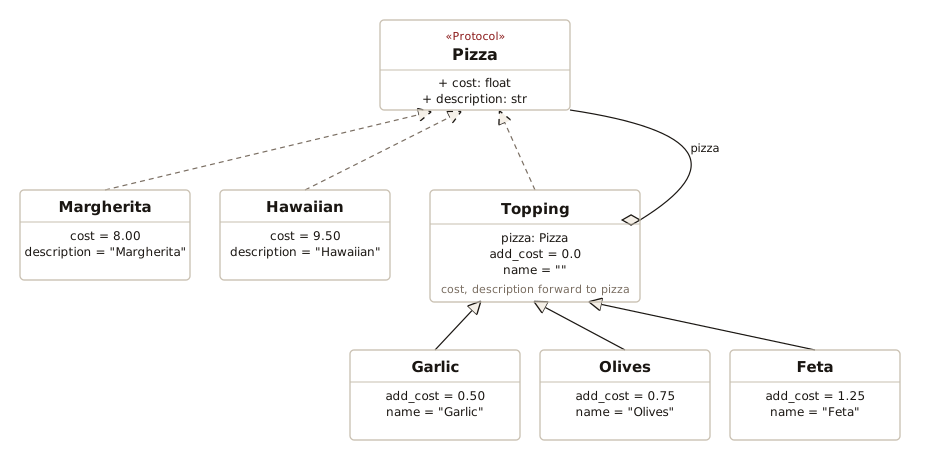
Instead, model the toppings as decorators. A plain pizza knows its own cost and description. A topping dynamically wraps a pizza, adds to the cost, and adds to the description. Because a topping is a pizza, you can wrap a topping in another topping.
# pizza_decorator.py
from typing import ClassVar, Protocol

class Pizza(Protocol):
    @property
    def cost(self) -> float: ...
    @property
    def description(self) -> str: ...

class Margherita:
    cost = 8.00
    description = "Margherita"

class Hawaiian:
    cost = 9.50
    description = "Hawaiian"

class Topping:
    add_cost: ClassVar[float] = 0.0

    def __init__(self, pizza: Pizza) -> None:
        self.pizza = pizza
        self.name = type(self).__name__

    @property
    def cost(self) -> float:
        return self.pizza.cost + self.add_cost

    @property
    def description(self) -> str:
        return f"{self.pizza.description} + {self.name}"

class Garlic(Topping):
    add_cost = 0.50

class Olives(Topping):
    add_cost = 0.75

class Feta(Topping):
    add_cost = 1.25

if __name__ == "__main__":
    order = Feta(Olives(Margherita()))
    print(f"{order.description}: ${order.cost:.2f}")

    haw = Garlic(Feta(Hawaiian()))
    print(f"{haw.description}: ${haw.cost:.2f}")
#: Margherita + Olives + Feta: $10.00
#: Hawaiian + Feta + Garlic: $11.25
Feta(Olives(Margherita())) is the object version
of stacked @ decorators. Each topping wraps the
pizza inside it and forwards through the same two-property
interface, cost and description. The
Pizza Protocol describes that
interface. Both the plain pizzas and the toppings satisfy it
structurally, with no shared base class required. This is structural
typing. A read-only @property in a
Protocol requires that reading the name produce
that type, and says nothing about how. Margherita
supplies cost as a class attribute and
Topping computes it in a property. Both read as a
float, so both match.
Topping.__init__() sets
self.name = type(self).__name__, reading each
subclass’s own name at construction time instead of repeating it
as a string. Garlic, Olives, and
Feta never mention their own names. The class name
is the topping name.
Adding a new topping means adding one class with one line,
add_cost. Changing the price of a topping means
changing one number, in one place. Compare that to a class per
combination, where a price change touches every class that
includes that topping.
A Pizza with a
toppings: list[Topping] field, summing each
topping’s add_cost and joining its name, solves the
same combinatorial problem, with no wrapping and no
Protocol. Here, where a topping only contributes a
number and a name, that list is the simpler design. The
Decorator pattern earns its structure when a topping needs
behavior, not just data: one that changes how cost
rounds, adds a description only under some condition, or must
itself be handed elsewhere as a Pizza. The list
stores toppings; the decorator chain is one, each layer
still satisfying the same interface the plain pizzas do.
Factory has
its own Pizza, a frozen data class that a
PizzaBuilder assembles, to illustrate the unrelated
Builder pattern. The two examples share a topic, not a type.
A Decorator keeps the wrapped object’s interface and adds behavior. Proxy, Adapter, and Façade wrap the same way and differ in intent. Telling the Wrappers Apart sorts the four.
# test_pizza_decorator.py
import pytest
from pizza_decorator import Feta, Garlic, Margherita, Olives

def test_stacked_toppings() -> None:
    order = Feta(Olives(Margherita()))
    assert order.cost == pytest.approx(10.00)
    assert order.description == (
        "Margherita + Olives + Feta")

def test_single_topping() -> None:
    order = Garlic(Margherita())
    assert order.cost == pytest.approx(8.50)
    assert order.description == "Margherita + Garlic"
Decorators You Already Know
Several decorators elsewhere in this book use this mechanism.
@property, @cached_property,
@staticmethod, and @classmethod (see
Properties
and Static
and Class Methods) each wrap a function the same way
trace does, but return a descriptor instead of a
plain wrapper. That lets them change how attribute access
behaves, and makes them work on methods, where a
__call__-based class like logged
fails. @dataclass (see Data
Classes as Types) is a class decorator like
register, except it mutates the class instead of
leaving it unchanged, adding a generated
__init__(), __repr__(), and
__eq__() to the same object it received.
@functools.cache and
@functools.lru_cache (see Performance)
wrap a function in the same closure-plus-func shape
as add_behavior, storing results in a memo
dictionary instead of printing around the call. Understanding
any of these needs no new syntax. They are ordinary decorators.
The one piece of machinery left for later is the descriptor
protocol those first four return; Metaprogramming
takes it up.
Every decorator costs two things wraps does not
remove, since wraps copies metadata, not the call
itself. A traceback through a decorated function shows
wrapper, one more frame than the caller and the
original body alone would show. Each call also pays for an extra
Python-level function call, the wrapper’s own, before the real
body runs. Neither matters for a function called occasionally;
both add up for one called in a tight loop, and stacking
decorators multiplies both by the number of layers.
Exercises
- Write a class decorator
announcethat prints the name of each class it decorates and returns it unchanged, then apply it to two small classes. Compare what it can do to whatregisterdoes. - Write a
timingdecorator that prints how long the wrapped function took, usingtime.perf_counter(). Apply it together with@traceand predict the order of the output. - Implement the object-oriented Decorator pattern for a coffee shop: plain drinks (Espresso, Cappuccino) and extra decorators (Whipped cream, Decaf, Extra shot). Build an espresso decorated with an extra shot and whipped cream, then print its cost and description.
- Write
traceas a class-based decorator that also keeps a class-level counter shared across every decorated function, and report the total number of traced calls in the program. Note where the shared state lives compared to the per-instancecountincount_calls. - Write a
memodecorator that works both with and without parentheses, so@memoand@memo(maxsize=10)both decorate a function. Cache each result in a dictionary keyed by the arguments, and drop the oldest entry once the cache holds more thanmaxsizeof them. Distinguish the two forms by checking whether the first argument arrived at all. - Write a
retry(times)decorator in the function form that calls the wrapped function again when it raises an exception, up totimesattempts, and re-raises the last exception when they all fail. Check that__name__survives.