Simulation

A simulation models a set of objects that act on their own and interact through shared state. This chapter builds three, each giving its agents less to work with than the last. A pack of rats coordinates through a shared blackboard, a single robot walks a maze where each object it meets decides what happens, and a plate of vibrating sand runs on grains that know nothing. The first two confirm a design you can predict from the code. The third produces a pattern no one wrote down as a picture: the formula fixes its shape, and the grains find it.
The chapter works the first example, the pack of rats, from
end to end. It puts asyncio tasks, a shared coordination object,
and structural typing together in one small program. Concurrency
introduces the asyncio mechanics
(async def, await,
gather, run).
Rats & Mazes
The problem has three types.
A maze knows its own layout. Given a coordinate, it reports whether each neighboring cell is a wall or an opening, and it hands out an entry point. The maze never decides anything. It only answers questions.
A blackboard is the shared surface on which every
rat writes. Blackboard is a classic coordination pattern.
Independent agents read from and write to one common data
structure instead of talking to each other directly. Here the
blackboard owns the maze, records which cells the rats have
explored, hands out rat numbers, and launches new rats. The rats
run as cooperative asyncio tasks. They take turns
instead of running at the same instant, so the blackboard needs
no lock. Nothing interrupts a rat partway through an update.
A rat explores. Each rat runs as its own task. From its current cell it looks at the four neighbors and tries to claim the open ones. Claiming a cell both marks it visited and reserves it, so no two rats cover the same ground. When a rat finds more than one open neighbor, it keeps the first for itself and spawns a new rat down each of the others, then yields so its siblings can run. When it can claim nothing, it has reached a dead end and its task ends. When the last rat dies, the pack has mapped every cell reachable from the entry.
The Rat and the Blackboard
The rat never imports the blackboard. It needs only an object
with matching methods, so a Protocol describes what
it expects. That Protocol is structural typing from
Static
Types. The rat works with anything that can claim a cell,
spawn a rat, record a message, and hand out a number.
# rats_and_mazes/rat.py
import asyncio
from dataclasses import dataclass, field
from typing import Final, Protocol

# South, north, west, east
DIRECTIONS: Final[list[tuple[int, int]]] = [
    (0, 1), (0, -1), (-1, 0), (1, 0)]

class Recorder(Protocol):
    def claim(self, x: int, y: int) -> bool: ...
    def spawn(self, x: int, y: int) -> None: ...
    def log(self, message: str) -> None: ...
    def next_number(self) -> int: ...

@dataclass
class Rat:
    blackboard: Recorder
    x: int
    y: int
    number: int = field(init=False)

    def __post_init__(self) -> None:
        self.number = self.blackboard.next_number()
        self.blackboard.log(
            f"Rat {self.number} starts at "
            f"{(self.x, self.y)}.")

    async def run(self) -> None:
        while True:
            neighbors = [
                (self.x + dx, self.y + dy)
                for dx, dy in DIRECTIONS]
            moves = [pos for pos in neighbors
                     if self.blackboard.claim(*pos)]
            if not moves:
                self.blackboard.log(
                    f"Rat {self.number} dead-ends "
                    f"at {(self.x, self.y)}.")
                return
            for branch in moves[1:]:
                self.blackboard.spawn(*branch)
            self.x, self.y = moves[0]
            # Yield so sibling rats can run
            await asyncio.sleep(0)
number comes from a call to
blackboard.next_number(), which advances a counter,
so no static default can supply it.
field(init=False) leaves number out of
the generated __init__. The generated
__init__ calls __post_init__ as its
last step, when blackboard, x, and
y already hold their values, so
__post_init__ fills in number and logs
the rat’s start.
The maze is a grid of characters. A * is a wall
and a space is an opening. Out-of-bounds coordinates count as
walls, so the rats stay inside.
# rats_and_mazes/maze.py
from enum import StrEnum
from pathlib import Path
from typing import Self

type Coord = tuple[int, int]  # (column, row)

class Maze:
    class Cell(StrEnum):
        WALL = "*"
        OPEN = " "

    def __init__(self, rows: list[str]) -> None:
        self.height = len(rows)
        self.width = max((len(r) for r in rows), default=0)
        self.rows = [
            r.ljust(self.width, self.Cell.WALL)
            for r in rows]

    @classmethod
    def from_text(cls, text: str) -> Self:
        rows = [
            line for line in text.splitlines()
            if line and not line.lstrip().startswith("#")]
        return cls(rows)

    @classmethod
    def from_file(cls, filename: str) -> Self:
        return cls.from_text(
            Path(filename).read_text(encoding="utf-8"))

    def is_open(self, x: int, y: int) -> bool:
        return (0 <= y < self.height and 0 <= x < self.width
                and self.rows[y][x] == self.Cell.OPEN)

    def entry(self) -> Coord:
        for y in range(self.height):
            for x in range(self.width):
                if self.is_open(x, y):
                    return x, y
        raise ValueError("the maze has no open cell")
Cell nests inside Maze because it
names concepts only Maze uses, and it is a
StrEnum rather than an Enum so its
members keep acting like real strings. WALL still
works as the fill character for ljust(), and
comparing self.rows[y][x] against
Cell.OPEN still works, because a
StrEnum member is its string value.
The blackboard holds everything the rats share.
claim() is the heart of the program. It tests and
marks a cell in one step with no await in between,
so a single rat gets each cell even when several reach it. It
sidesteps the read-modify-write race from Concurrency.
That race needs a suspension point inside the update, and
claim() contains none, so the atomicity comes from
the shape of the code rather than from a lock (exercise 3
inserts a suspension point and looks at what breaks).
next_number() hands out rat numbers from
itertools.count(), the endless counter from Iterators.
explore() claims the entry and releases the first
rat inside an asyncio.TaskGroup:
# rats_and_mazes/blackboard.py
import asyncio
import itertools
from collections.abc import Iterator
from dataclasses import dataclass, field
from maze import Coord, Maze
from rat import Rat

@dataclass
class Blackboard:
    maze: Maze
    visited: set[Coord] = field(
        init=False, default_factory=set)
    tasks: list[asyncio.Task[None]] = field(
        init=False, default_factory=list)
    messages: list[str] = field(
        init=False, default_factory=list)
    _numbers: Iterator[int] = field(
        init=False,
        default_factory=lambda: itertools.count(1))
    group: asyncio.TaskGroup = field(init=False)

    def claim(self, x: int, y: int) -> bool:
        # No await between test and add, so it is atomic
        if (self.maze.is_open(x, y)
            and (x, y) not in self.visited):
            self.visited.add((x, y))
            return True
        return False

    def spawn(self, x: int, y: int) -> None:
        rat = Rat(self, x, y)
        self.tasks.append(self.group.create_task(rat.run()))

    def next_number(self) -> int:
        return next(self._numbers)

    def log(self, message: str) -> None:
        self.messages.append(message)

    async def explore(self) -> None:
        start = self.maze.entry()
        self.claim(*start)
        async with asyncio.TaskGroup() as group:
            self.group = group
            self.spawn(*start)

    def render(self) -> str:
        lines = []
        for y in range(self.maze.height):
            row = []
            for x in range(self.maze.width):
                if not self.maze.is_open(x, y):
                    row.append("#")
                elif (x, y) in self.visited:
                    row.append(".")
                else:
                    row.append(" ")
            lines.append("".join(row))
        return "\n".join(lines)
A TaskGroup stays open until every task inside
it has finished, including tasks created after the block began.
That is the shape of this problem: each rat can create more
rats. A single asyncio.gather(*self.tasks) would
miss most of them, because gather() fixes its
argument list at the moment of the call, before those rats
exist.
group’s declaration is
field(init=False), and only explore()
assigns it, the same declaration-without-assignment the robot
example later in this chapter uses for Robot.room.
The other four fields are internal bookkeeping rather than
constructor arguments: init=False keeps them out of
the generated signature, and each default_factory
builds a fresh object per blackboard.
The maze layout lives in a text file. The loader drops blank
lines and any line beginning with #, so the first
line, naming the file’s path, drops out and the rest is the
maze.
# rats_and_mazes/amaze.txt
*********************
* *           *     *
* * * ******* *** * *
* * *       *     * *
* ***** *** ******* *
*     * *   *     * *
***** *** ***** *** *
*   *     *     *   *
* * ******* *** * ***
* *         *   *   *
* ***** * ********* *
*     * * *         *
***** * *** *********
*     *             *
*********************
Running the demo turns the rats loose, then prints the first eight log messages and the mapped maze. The log shows what the map cannot: rat 1 spawns rat 2 and then dies before rat 2 does, and numbers arrive in spawn order rather than completion order. The full log runs to eighteen messages, two per rat.
# rats_and_mazes/rats_and_mazes.py
import asyncio
from blackboard import Blackboard
from maze import Maze

async def main() -> None:
    maze = Maze.from_file("amaze.txt")
    blackboard = Blackboard(maze)
    await blackboard.explore()
    for message in blackboard.messages[:8]:
        print(message)
    print("Mapped maze (# wall, . visited):")
    print(blackboard.render())
    print(f"{len(blackboard.tasks)} rats mapped "
          f"{len(blackboard.visited)} cells.")

asyncio.run(main())
#: Rat 1 starts at (1, 1).
#: Rat 2 starts at (6, 3).
#: Rat 1 dead-ends at (7, 5).
#: Rat 3 starts at (6, 1).
#: Rat 2 dead-ends at (3, 3).
#: Rat 4 starts at (18, 1).
#: Rat 3 dead-ends at (15, 1).
#: Rat 5 starts at (12, 13).
#: Mapped maze (# wall, . visited):
#: #####################
#: #.#...........#.....#
#: #.#.#.#######.###.#.#
#: #.#.#.......#.....#.#
#: #.#####.###.#######.#
#: #.....#.#...#.....#.#
#: #####.###.#####.###.#
#: #...#.....#.....#...#
#: #.#.#######.###.#.###
#: #.#.........#...#...#
#: #.#####.#.#########.#
#: #.....#.#.#.........#
#: #####.#.###.#########
#: #.....#.............#
#: #####################
#: 9 rats mapped 139 cells.
amaze.txt has no loop: every open cell connects
to the rest of the maze by exactly one path. Every
claim() the run above rejects on an open cell is a
rat looking back at the cell it came from, never two rats
reaching for the same open cell. On this maze,
claim()’s atomicity is never tested against two
rats competing for new ground, only against cells the rats have
walked: one rat’s own trail, or the cell a parent still occupies
when its new rat looks back.
Contention on a Loop
A maze with a loop closes a second path between two cells, so two different rats can approach the same open cell from opposite directions. Eight open cells around one wall block, with one loop, are enough to force it:
# rats_and_mazes/ring_contention.py
import asyncio
from typing import override
from blackboard import Blackboard
from maze import Maze

RING = """\
*****
*   *
* * *
*   *
*****
"""

class CountingBlackboard(Blackboard):
    def __init__(self, maze: Maze) -> None:
        super().__init__(maze)
        self.taken = 0

    @override
    def claim(self, x: int, y: int) -> bool:
        won = super().claim(x, y)
        if not won and self.maze.is_open(x, y):
            self.taken += 1
        return won

async def main() -> None:
    maze = Maze.from_text(RING)
    blackboard = CountingBlackboard(maze)
    await blackboard.explore()
    for message in blackboard.messages:
        print(message)
    backtracks = len(blackboard.visited) - 1
    print(f"{blackboard.taken} rejections, "
          f"{backtracks} from backtracking alone.")

asyncio.run(main())
#: Rat 1 starts at (1, 1).
#: Rat 2 starts at (2, 1).
#: Rat 1 dead-ends at (2, 3).
#: Rat 2 dead-ends at (3, 3).
#: 9 rejections, 7 from backtracking alone.
The entry has two open neighbors, so rat 1 keeps one arm and
spawns rat 2 down the other. CountingBlackboard
tallies every claim() rejected on an open cell.
Seven of the nine rejections are backtracking,
len(blackboard.visited) - 1, one per non-entry cell
looking back at the cell it came from. The other two belong to
the loop’s closing edge, examined from both ends: rat 1
dead-ends wanting (3, 3), already claimed by rat 2,
and rat 2 dead-ends wanting (2, 3), already claimed
by rat 1. Each rat loses a cell to the other, not to itself.
That is the race claim()’s atomicity exists to
resolve, and a perfect maze like amaze.txt never
puts it to the test.
Testing Full Coverage
Because claiming is atomic, the rats always cover every cell reachable from the entry, no matter how the tasks interleave. The test verifies this by comparing the cells the rats visited against a flood fill of the same maze.
# rats_and_mazes/test_rats_and_mazes.py
import asyncio
from typing import Final
from blackboard import Blackboard
from maze import Coord, Maze

LAYOUT: Final[str] = """\
*********
*       *
*** *** *
*   *   *
* ***** *
*       *
*********
"""

def flood(maze: Maze, start: Coord) -> set[Coord]:
    seen: set[Coord] = set()
    stack = [start]
    while stack:
        x, y = stack.pop()
        if (x, y) in seen or not maze.is_open(x, y):
            continue
        seen.add((x, y))
        stack += [(x + 1, y), (x - 1, y),
                  (x, y + 1), (x, y - 1)]
    return seen

def test_rats_map_every_reachable_cell() -> None:
    maze = Maze.from_text(LAYOUT)
    blackboard = Blackboard(maze)
    asyncio.run(blackboard.explore())
    assert blackboard.visited == flood(maze, maze.entry())
Watching the Pack
The same model drives a GUI demonstration. rats_view.py lets the rats
finish exploring, records the order in which they claimed cells,
and replays that order on a tkinter canvas: walls
in gray, then each claimed cell turning green one after another,
so you watch the pack move through the maze from the entry
outward. Each of this chapter’s three views is a separate file
holding all the display code, the model-view split of Observer.
The missing piece is the subscription: no model in this chapter
notifies anybody, so each view drives or replays its model
instead of waiting for a notification. rats_view.py records that
order by subclassing Blackboard and overriding
claim(), so the model needs no change. The harness
skips it, like every windowed view in this book.
# rats_and_mazes/rats_view.py
import asyncio
import tkinter as tk
from typing import Final, override
from blackboard import Blackboard
from maze import Coord, Maze

CELL: Final[int] = 26

class RecordingBlackboard(Blackboard):
    def __init__(self, maze: Maze) -> None:
        super().__init__(maze)
        self.order: list[Coord] = []

    @override
    def claim(self, x: int, y: int) -> bool:
        claimed = super().claim(x, y)
        if claimed:
            self.order.append((x, y))
        return claimed

def show(layout: str = "amaze.txt",
         step_ms: int = 60) -> None:
    maze = Maze.from_file(layout)
    board = RecordingBlackboard(maze)
    asyncio.run(board.explore())

    root = tk.Tk()
    root.title("Rats and Mazes")
    canvas = tk.Canvas(root, highlightthickness=0,
                       width=maze.width * CELL,
                       height=maze.height * CELL)
    canvas.pack()

    def box(x: int, y: int, color: str) -> None:
        canvas.create_rectangle(
            x * CELL, y * CELL,
            (x + 1) * CELL, (y + 1) * CELL,
            fill=color, outline="gray")

    for y in range(maze.height):
        for x in range(maze.width):
            box(x, y,
                "white" if maze.is_open(x, y)
                else "dimgray")

    cells = iter(board.order)

    def step() -> None:
        cell = next(cells, None)
        if cell is not None:
            box(cell[0], cell[1], "palegreen")
            root.after(step_ms, step)

    step()
    root.mainloop()

if __name__ == "__main__":
    show()
Concurrency here is a shape for the code, not a source of
speed. Every rat awaits asyncio.sleep(0) at the
same point, so the tasks take turns in round robin and the run
stays deterministic. Nothing runs at the same instant as
anything else, and no thread or process ever overlaps another,
so the design buys no speed over a single-threaded worklist. A
plain stack of frontiers, popped and pushed in a loop, visits
the same 139 cells. What asyncio buys is control
flow: each rat’s own path through the maze stays one
while loop in run(), instead of a
stack of pending frontiers threaded through one function by
hand. The cost is the runtime itself, one more moving part for a
program that never overlaps anything.
Jeremy Meyer wrote the original Java version of this example.
A Robot in a Maze
Concurrency is one way to build a simulation. Object-oriented
design is another. This second example, adapted from my
Atomic Kotlin book, walks a single robot through a
maze. It shows how polymorphism removes conditionals. A
Room asks its occupant what to do, and each type of
occupant answers for itself.
Rooms, Robots, and the Item Factory
The occupants are Items.
Room.enter() calls occupant.interact()
and returns the room in which the robot ends up. A wall keeps
the robot where it is, food feeds the robot and lets it in, a
teleport returns a distant room. No if or
elif on the type of occupant appears in the
movement code:
# robot_explorer/items.py
from enum import Enum, auto
from typing import TYPE_CHECKING, ClassVar, override

if TYPE_CHECKING:
    from world import Room

class Urge(Enum):
    NORTH = auto()
    SOUTH = auto()
    EAST = auto()
    WEST = auto()

class Item:
    symbol: ClassVar[str] = ""

    def interact(self, robot: Robot, room: Room) -> Room:
        return room  # Default: the robot enters the room

    def __str__(self) -> str:
        return self.symbol

class Robot(Item):
    symbol = "R"
    # Set by the builder when the robot is placed
    room: Room

    def __init__(self) -> None:
        # Set when the robot reaches the end
        self.finished = False

    def move(self, urge: Urge) -> None:
        self.room = self.room.doors.open(urge).enter(self)

class Wall(Item):
    symbol = "#"

    @override
    def interact(self, robot: Robot, room: Room) -> Room:
        return robot.room  # Cannot pass: stay put

class Food(Item):
    symbol = "."

    @override
    def interact(self, robot: Robot, room: Room) -> Room:
        room.occupant = Empty()  # Eaten
        return room

class Teleport(Item):
    symbol = ""  # Set per target letter
    target_room: Room  # Paired up by the builder

    def __init__(self, target: str) -> None:
        self.target = target

    @override
    def interact(self, robot: Robot, room: Room) -> Room:
        return self.target_room

    @override
    def __str__(self) -> str:
        return self.target

class Empty(Item):
    symbol = "_"

    @override
    def interact(self, robot: Robot, room: Room) -> Room:
        return room

class Edge(Item):
    symbol = "/"

    @override
    def interact(self, robot: Robot, room: Room) -> Room:
        # The void outside the maze: stay put
        return robot.room

class EndGame(Item):
    symbol = "!"

    @override
    def interact(self, robot: Robot, room: Room) -> Room:
        robot.finished = True  # Recorded, not printed
        return room

def item_factory(symbol: str) -> Item:
    for item_type in Item.__subclasses__():
        if symbol == item_type.symbol:
            return item_type()
    # Anything else is a teleport target
    return Teleport(symbol)
world.py imports
Edge, Item, Robot, and
Urge from items.py, so
from world import Room here is circular.
TYPE_CHECKING is True only for a type
checker reading the file and False at runtime, so
that import never runs and no cycle forms. Every use of
Room below is an annotation
(room: Room, -> Room), never a
runtime lookup.
Robot holds its two pieces of state in different
ways. __init__ assigns finished, so
each robot owns its own flag from the start. room
gets only a declaration, room: Room with no value.
That line tells the type checker a Room belongs
there and stores nothing at runtime. GameBuilder
creates the attribute when it places the robot and sets
robot.room. Reading room before then
raises an AttributeError, and the builder runs
first, so every read comes after. Declaring it this way keeps
the type Room instead of Room | None,
so code that reads room skips the None
check.
item_factory() turns a maze character into an
Item. It searches
Item.__subclasses__() for a matching
symbol, so adding a new kind of item needs no
change here. If you define the subclass with its symbol, the
factory finds it. This is the registry idea from Factory,
using the class hierarchy as the registry.
__subclasses__() reports only direct subclasses
(that chapter’s Simple
Factory Method describes the recursion for deeper
hierarchies, and its exercise 9 writes it), so a new item must
inherit from Item itself. Deriving from
Food to borrow its behavior hides the class from
the factory, which falls through to the last line and builds a
Teleport instead.
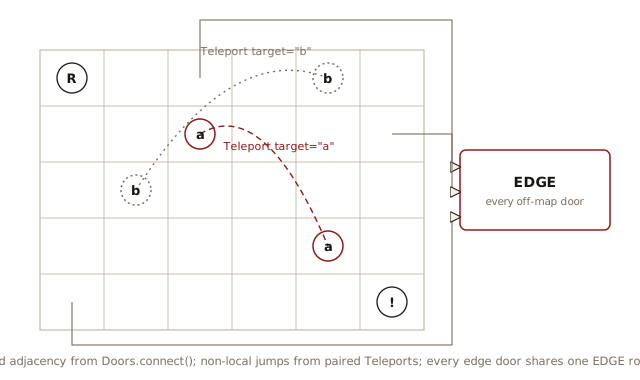
A Room holds one item and connects to its
neighbors through a Doors object. Doors that lead
nowhere point at one shared EDGE room, the void
outside the maze, so the robot can try any direction without a
special case. EDGE is a Null
Object: it answers like any other room and sends the robot
back where it started:
# robot_explorer/world.py
from typing import Final
from items import Edge, Item, Robot, Urge

type Coord = tuple[int, int]  # (row, col)
type RoomMap = dict[Coord, Room]

class Room:
    def __init__(self, occupant: Item) -> None:
        self.occupant = occupant
        self.doors = Doors()

    def enter(self, robot: Robot) -> Room:
        return self.occupant.interact(robot, self)

    def __repr__(self) -> str:
        return f"Room({self.occupant})"

class Doors:
    def __init__(self) -> None:
        self.neighbors: dict[Urge, Room] = {}

    def connect(self, row: int, col: int,
                rooms: RoomMap) -> None:
        for urge, coord in {
            Urge.NORTH: (row - 1, col),
            Urge.SOUTH: (row + 1, col),
            Urge.EAST: (row, col + 1),
            Urge.WEST: (row, col - 1),
        }.items():
            if coord in rooms:
                self.neighbors[urge] = rooms[coord]

    def open(self, urge: Urge) -> Room:
        return self.neighbors.get(urge, EDGE)

# Created once both classes exist; its own doors stay unset
EDGE: Final[Room] = Room(Edge())
The Coord here counts (row, col),
the opposite order from the rats example’s
(column, row), because GameBuilder
walks the maze text line by line.
One move is one chain. Robot.move() asks
doors.open(urge) for the neighboring room,
EDGE when no door leads that way.
enter() hands the robot to that room, and whatever
room its occupant’s interact() returns becomes
robot.room. Every rule of the game lives in some
interact().
Building the Maze in Stages
GameBuilder assembles the maze in three stages:
a room for every character, then the connections between rooms,
then the teleport pairs. Each stage depends on the one before
it, so splitting them into labeled passes keeps the construction
readable instead of tangling it into one loop. Factory counts this
as one of the cases where Builder survives in Python, because
construction here is genuinely a process rather than a single
call. run() walks a string of moves, and
show_maze() renders the current state:
# robot_explorer/game.py
# Build the maze in three stages, then run it.

from itertools import groupby
from items import Empty, Robot, Teleport, Urge, item_factory
from world import Room, RoomMap

class GameBuilder:
    def __init__(self, maze: str) -> None:
        self.rooms: RoomMap = {}
        teleports: list[Room] = []
        # Stage 1: a Room for every character
        for row, line in enumerate(maze.splitlines()):
            for col, char in enumerate(line):
                occupant = item_factory(char)
                if isinstance(occupant, Robot):
                    room = Room(Empty())
                    self.robot = occupant
                    self.robot.room = room
                else:
                    room = Room(occupant)
                self.rooms[row, col] = room
                if isinstance(occupant, Teleport):
                    teleports.append(room)
        # Stage 2: connect each room to its neighbors
        for (row, col), room in self.rooms.items():
            room.doors.connect(row, col, self.rooms)
        # Stage 3: pair teleports sharing a target letter
        def target(room: Room) -> str:
            assert isinstance(room.occupant, Teleport)
            return room.occupant.target

        teleports.sort(key=target)
        for letter, group in groupby(teleports, key=target):
            pair = list(group)
            assert len(pair) == 2, letter
            room1, room2 = pair
            assert isinstance(room1.occupant, Teleport)
            assert isinstance(room2.occupant, Teleport)
            room1.occupant.target_room = room2
            room2.occupant.target_room = room1

    def show_maze(self) -> str:
        rows: list[str] = []
        current = -1
        for (row, _), room in self.rooms.items():
            if row != current:
                rows.append("")
                current = row
            if room is self.robot.room:
                rows[-1] += str(self.robot)
            else:
                rows[-1] += str(room.occupant)
        return "\n".join(rows)

    def run(self, solution: str) -> None:
        moves = {"n": Urge.NORTH, "s": Urge.SOUTH,
                 "e": Urge.EAST, "w": Urge.WEST}
        for char in "".join(solution.split()):
            self.robot.move(moves[char])

string_maze = """
###############################
#R#.____#____.#_______#_______#
#_###_#_###_#_#_#_#####_#####_#
#___#_#___#_#_#_#.#__b__#___#_#
###_#_###_#_#_###_#_#####_#_#_#
#.#_#_#.__#_#__.#_#__b__#_#___#
#_#_#_#_###_###_#_#####_#_#####
#_#_#_#__.#_#_#_____#___#_____#
#_#_#_###_#_#_#_#####_#######_#
#.#___#___#_#___#____.#_____#_#
#_#####_###_#_###_#####_#_###_#
#___#a__#.__#.__#__.#___#_#___#
#_#_#_###_#####_###_###_###_#_#
#_#.#_#___#!______#_____#___#_#
#_#_#_###_#############_#_###_#
#_#_#__a#_______________#___#_#
#_#####_###_###########_###_#_#
#_____#.__#_#___#_____#_#___#_#
#_#_#####_###_#_#_###_###_###_#
#.#___________#___#____.__#___#
###############################
""".strip()
Stage 3 pairs the teleports by target letter. The sort by
target letter puts each pair of partners side by side.
groupby(teleports, key=target) then walks the
sorted rooms in one pass, handing each run of matching letters
to pair = list(group).
assert len(pair) == 2, letter checks a rule the
maze layout must obey: every target letter marks exactly two
rooms, never one, never three. A typo that leaves a letter
unpaired, or repeats it a third time, fails here at build time,
naming the offending letter. Without that check the builder
would leave a Teleport whose
target_room was never set, and the robot would find
the mistake by stepping into it. The
assert isinstance lines that follow are for the
type checker as much as for safety: each proves that the
occupant really is a Teleport before the code
touches target_room.
Stage 1 does test types, with
isinstance(occupant, Robot) and
isinstance(occupant, Teleport). That is not the
type switch that polymorphism removes. GameBuilder
still must tell the kinds of item apart, once, and the movement
code that runs afterward never asks again. The
Robot branch also explains
Room(Empty()): the robot is the one item that does
not become an occupant. Its cell gets an Empty
occupant instead, so when the robot moves away the room behaves
like any other empty room. show_maze() draws the
R by checking which room the robot is in rather
than reading an occupant.
Choosing the Path
The robot can now move, but nothing tells it where to go. A
string of
n/s/e/w
characters would replay a route somebody else worked out.
Instead the robot searches the room graph for its own.
solve() is a breadth-first search over
Room objects. It expands the room reached in the
fewest moves first, so the first route it finds to the
! is a shortest one. It makes the same
doors.open(urge) calls Robot.move()
makes, so it never needs coordinates, only rooms and the moves
between them. landing() decides whether a door is
passable by inspecting the occupant’s type, reproducing what
Room.enter() gets from interact(): a
Wall or an Edge blocks, a
Teleport reports its target room, and anything else
is the room itself:
# robot_explorer/solver.py
from collections import deque
from typing import Final
from game import GameBuilder
from items import Edge, EndGame, Teleport, Urge, Wall
from world import Room

MOVES: Final[dict[Urge, str]] = {
    Urge.NORTH: "n", Urge.SOUTH: "s",
    Urge.EAST: "e", Urge.WEST: "w"}

def landing(room: Room, urge: Urge) -> Room | None:
    # Where a door leads, or None when it is blocked
    beyond = room.doors.open(urge)
    if isinstance(beyond.occupant, Wall | Edge):
        return None
    if isinstance(beyond.occupant, Teleport):
        return beyond.occupant.target_room
    return beyond

def solve(game: GameBuilder) -> str:
    start = game.robot.room
    queue: deque[tuple[Room, str]] = deque([(start, "")])
    seen: set[Room] = {start}
    while queue:
        room, path = queue.popleft()
        if isinstance(room.occupant, EndGame):
            return path
        for urge, char in MOVES.items():
            beyond = landing(room, urge)
            if beyond is None or beyond in seen:
                continue
            seen.add(beyond)
            queue.append((beyond, path + char))
    raise ValueError("No path to the EndGame room")
seen holds Room objects.
Room defines no __eq__, so it keeps
object’s identity comparison and identity hash,
which a graph search needs: two rooms holding the same kind of
item are still two different places. Adding a room to
seen when it enters the queue, rather than when it
leaves, keeps a room from entering the queue twice.
Searching changes nothing. solve() reads doors
and occupants and never calls enter(), so the robot
eats no food and stays where it started. The path it returns is
exactly the string run() expects:
# robot_explorer/robot_demo.py
from game import GameBuilder, string_maze
from solver import solve

game = GameBuilder(string_maze)
print("start:")
print(game.show_maze())
#: start:
#: ###############################
#: #R#.____#____.#_______#_______#
#: #_###_#_###_#_#_#_#####_#####_#
#: #___#_#___#_#_#_#.#__b__#___#_#
#: ###_#_###_#_#_###_#_#####_#_#_#
#: #.#_#_#.__#_#__.#_#__b__#_#___#
#: #_#_#_#_###_###_#_#####_#_#####
#: #_#_#_#__.#_#_#_____#___#_____#
#: #_#_#_###_#_#_#_#####_#######_#
#: #.#___#___#_#___#____.#_____#_#
#: #_#####_###_#_###_#####_#_###_#
#: #___#a__#.__#.__#__.#___#_#___#
#: #_#_#_###_#####_###_###_###_#_#
#: #_#.#_#___#!______#_____#___#_#
#: #_#_#_###_#############_#_###_#
#: #_#_#__a#_______________#___#_#
#: #_#####_###_###########_###_#_#
#: #_____#.__#_#___#_____#_#___#_#
#: #_#_#####_###_#_#_###_###_###_#
#: #.#___________#___#____.__#___#
#: ###############################
solution = solve(game)
print(len(solution), "moves")
#: 198 moves
game.run(solution)
if game.robot.finished:
    print("Game over!")
#: Game over!
print("\nfinal:")
print(game.show_maze())
#:
#: final:
#: ###############################
#: #_#.____#_____#_______#_______#
#: #_###_#_###_#_#_#_#####_#####_#
#: #___#_#___#_#_#_#.#__b__#___#_#
#: ###_#_###_#_#_###_#_#####_#_#_#
#: #.#_#_#___#_#___#_#__b__#_#___#
#: #_#_#_#_###_###_#_#####_#_#####
#: #_#_#_#___#_#_#_____#___#_____#
#: #_#_#_###_#_#_#_#####_#######_#
#: #.#___#___#_#___#_____#_____#_#
#: #_#####_###_#_###_#####_#_###_#
#: #___#a__#___#___#___#___#_#___#
#: #_#_#_###_#####_###_###_###_#_#
#: #_#.#_#___#R______#_____#___#_#
#: #_#_#_###_#############_#_###_#
#: #_#_#__a#_______________#___#_#
#: #_#####_###_###########_###_#_#
#: #_____#___#_#___#_____#_#___#_#
#: #_#_#####_###_#_#_###_###_###_#
#: #.#___________#___#_______#___#
#: ###############################
The robot eats the food along its path, jumps through both
teleports (a, then b), and reaches the
! that ends the game. The teleports are not
shortcuts here. If landing() refuses them the way
it refuses a Wall, solve() raises a
ValueError: without the teleports no route to the
! exists at all.
Testing the Walk
show_maze() renders the maze into a string, so a
test can check the model without opening a window. Build the
maze, search it, walk the result, and check that the robot
finished on the ! square:
# robot_explorer/test_robot.py
from game import GameBuilder, string_maze
from items import EndGame
from solver import solve

def test_search_walks_the_robot_to_the_end() -> None:
    game = GameBuilder(string_maze)
    game.run(solve(game))
    room = game.robot.room
    # Finished on the "!"
    assert isinstance(room.occupant, EndGame)
    assert game.robot.finished  # And the model recorded it

def test_walls_block_and_food_is_eaten() -> None:
    # Robot, food, wall in one row
    game = GameBuilder("R.#")
    start = game.robot.room
    game.run("e")  # East: eat the food and move in
    assert "." not in game.show_maze()  # Food gone
    assert game.robot.room is not start
    blocked = game.robot.room
    game.run("e")  # East again: a wall, so stay put
    assert game.robot.room is blocked
That same model drives a graphical view. maze_view.py builds the
maze, calls solve() for the route, draws each room
as a colored cell, and steps the robot along that route on a
timer. The view is the only part that touches the screen, and
the model neither knows nor cares that it exists.
# robot_explorer/maze_view.py
import tkinter as tk
from typing import Final
from game import GameBuilder, string_maze
from items import Urge
from solver import solve

CELL: Final[int] = 20
FILL: Final[dict[str, str]] = {
    "#": "dimgray", "!": "tomato", ".": "khaki",
    "_": "white", "R": "royalblue"}
MOVES: Final[dict[str, Urge]] = {
    "n": Urge.NORTH, "s": Urge.SOUTH,
    "e": Urge.EAST, "w": Urge.WEST}

def show(maze: str = string_maze,
         step_ms: int = 80) -> None:
    game = GameBuilder(maze)
    moves = solve(game)
    rows = maze.splitlines()
    width = max(len(row) for row in rows)
    root = tk.Tk()
    root.title("Robot in a Maze")
    canvas = tk.Canvas(root, highlightthickness=0,
                       width=width * CELL,
                       height=len(rows) * CELL)
    canvas.pack()

    def draw() -> None:
        canvas.delete("all")
        for (row, col), room in game.rooms.items():
            symbol = ("R" if room is game.robot.room
                      else str(room.occupant))
            canvas.create_rectangle(
                col * CELL, row * CELL,
                (col + 1) * CELL, (row + 1) * CELL,
                fill=FILL.get(symbol, "palegreen"),
                outline="gray")

    queue = list("".join(moves.split()))

    def step() -> None:
        draw()
        if queue:
            game.robot.move(MOVES[queue.pop(0)])
            root.after(step_ms, step)

    step()
    root.mainloop()

if __name__ == "__main__":
    show()
Three ideas from earlier chapters carry the design. Polymorphism replaces a type switch, a factory builds objects from data, and a Null Object removes the check for a missing door. None of them needs concurrency.
Two further resources on mazes: a survey of algorithms to create mazes, and Craig Reynolds on steering behavior for autonomous moving objects, which is where a robot that steered continuously, instead of planning a grid path before it moved, would start.
Order from Noise
The two simulations so far confirm designs. The rats cover
every reachable cell because claim() is atomic. The
robot reaches the goal because polymorphism handles every
encounter. Both times you knew the outcome in advance and ran
the program to confirm it. This final example is different.
amplitude() fixes the shape the sand will trace:
the curves are its zero set. No line of the code computes how
two thousand independent random walks find that shape and stay
there. That is simulation’s other purpose, to discover behavior
instead of confirming it.
In 1787 Ernst Chladni sprinkled sand across a metal plate and drew a violin bow along its edge. The bow made the plate ring. A ringing plate moves unevenly. Standing waves divide it into regions that swing up and down, and the nodal lines between them stay still. The vibration bounces sand out of the moving regions. When a grain comes to rest on a still line, nothing kicks it away again. Within seconds the random motion sweeps the sand into sharp, symmetric curves. Bowing a different spot rings the plate in a different mode and draws a different figure.
The Model
The model needs almost nothing. amplitude() is
the standing-wave field of a square plate ringing in mode
(m, n). Physics supplies the formula, an
approximation for a plate with free edges. Treat it as given.
All that matters here is its shape. The field is zero along
curves, and those curves are the nodal lines. A
Grain is a position. All of the simulation’s logic
sits in step(). Every grain takes one random step,
and the plate’s vibration at that grain’s location scales the
step. Grains never look at each other and remember nothing. No
line of the code decides where a grain settles, only the local
scaling of its own blind steps.
# chladni_plate/chladni.py
import math
import random
from dataclasses import dataclass

type Mode = tuple[int, int]  # Vibration pattern (m, n)

def amplitude(x: float, y: float, mode: Mode) -> float:
    m, n = mode
    return abs(
        math.cos(m * math.pi * x)
        * math.cos(n * math.pi * y)
        - math.cos(n * math.pi * x)
        * math.cos(m * math.pi * y))

def bounce(v: float) -> float:
    if v < 0.0:
        return -v
    if v > 1.0:
        return 2.0 - v
    return v

@dataclass
class Grain:
    x: float
    y: float

class Plate:
    def __init__(self, grains: int, mode: Mode,
                 seed: int | None = None) -> None:
        self.rng = random.Random(seed)
        self.mode = mode
        self.grains = [
            Grain(self.rng.random(), self.rng.random())
            for _ in range(grains)]

    def step(self, kick: float = 0.05) -> None:
        for g in self.grains:
            a = amplitude(g.x, g.y, self.mode)
            g.x = bounce(
                g.x + self.rng.uniform(-kick, kick) * a)
            g.y = bounce(
                g.y + self.rng.uniform(-kick, kick) * a)

    def agitation(self) -> float:
        return sum(
            amplitude(g.x, g.y, self.mode)
            for g in self.grains) / len(self.grains)

    def render(self, width: int = 57,
               height: int = 30) -> str:
        counts: list[list[int]] = [
            [0] * width for _ in range(height)]
        for g in self.grains:
            col = min(int(g.x * width), width - 1)
            row = min(int(g.y * height), height - 1)
            counts[row][col] += 1
        shades = " .:*#"
        return "\n".join(
            "".join(shades[min(c, len(shades) - 1)]
                    for c in row).rstrip()
            for row in counts)
bounce() reflects a kicked grain off the edge
instead of letting it leave the plate. agitation()
measures the mean vibration strength directly under the grains.
Grains scattered at random feel the field’s average, so
agitation starts high. A grain resting on a nodal line feels
zero. One number summarizes how settled the sand is.
render() draws grain density as characters, in the
same spirit as Blackboard.render(), so the model
can show its state without a window. The demo shakes the plate
1200 times, printing agitation at four checkpoints along the
way:
# chladni_plate/chladni_demo.py
from chladni import Plate

plate = Plate(grains=2000, mode=(2, 3), seed=42)
steps = 0
for target in (0, 100, 400, 1200):
    for _ in range(target - steps):
        plate.step()
    steps = target
    print(f"steps {target:4}: "
          f"agitation {plate.agitation():.3f}")
#: steps    0: agitation 0.585
#: steps  100: agitation 0.073
#: steps  400: agitation 0.005
#: steps 1200: agitation 0.000
print(plate.render())
#: .:.                   #                      #
#:  *##                  .#                     #
#:    .##                 ##                    #
#:      :##                ##                    #
#:        ###               ####                 #*
#:          ###                ######             ##########
#:            ##*                    ########
#:              ##:                         ###
#:                ##                          ##
#:                  ##                         #
#:                    ##                       ##
#:                      ##                      #
#: #######               .##                    #:
#:       ##*               ###                   #
#:         ##                ###                 ##
#:          ##                 ###                ##
#:           #                   ##*               ###
#:           .#                    ##:               #######
#:            #                      ##
#:            ##                       ##
#:             #                         ##
#:             ##                          ##
#:              :##                         *##
#:                .#######                    *##
#: #########*            *#####:                *##
#:          *#                 ###.               ###
#:           #                    ##                ###
#:            #                    ##                 ###
#:            #                     ##                  ##.
#:            #                      #                   .##
What the Numbers Show
Agitation collapses toward zero, and the picture shows why.
The grains have gathered on the nodal lines of mode
(2, 3). Nothing steered them there. A loud region
flings its grains around until a random wander crosses a quiet
line, where the kicks shrink toward nothing. Noise can carry a
grain into a quiet place. It cannot carry the grain back out.
The randomness is not fighting the order but producing it. The
curves themselves are no mystery: amplitude()’s
zero set draws them directly, without simulating a single grain.
What the run demonstrates is the trap, not the shape: blind,
uncoordinated steps concentrate onto a curve that no grain, and
no line of step(), ever names.
Testing a Random Process
A test cannot guess where a particular grain ends up after a
million random kicks. It pins down the aggregate instead.
Shaking must collapse agitation, and no kick may throw a grain
off the plate. Seeding random.Random makes any
failure reproducible.
# chladni_plate/test_chladni.py
from chladni import Plate

def test_noise_settles_grains_onto_quiet_lines() -> None:
    plate = Plate(grains=500, mode=(2, 3), seed=1)
    before = plate.agitation()
    for _ in range(400):
        plate.step()
    assert plate.agitation() < before / 10

def test_kicks_never_knock_grains_off_the_plate() -> None:
    plate = Plate(grains=200, mode=(3, 5), seed=2)
    for _ in range(300):
        plate.step(kick=0.2)
    assert all(0.0 <= g.x <= 1.0 and 0.0 <= g.y <= 1.0
               for g in plate.grains)
Watching It Happen
The tkinter view shows what the text version cannot: the collapse as it unfolds, and the pattern surviving a change of rules. Each grain keeps one color from a small palette, so you can watch individual grains mix while the collective figure forms. Every 200 frames the view switches the plate to a new mode. The old figure suddenly sits on loud regions of the new field. It bursts back into chaos, mixes, and condenses into a different figure. The order is not a property of the grains. It belongs to the field on which they sit.
# chladni_plate/chladni_view.py
import itertools
import tkinter as tk
from typing import Final
from chladni import Mode, Plate

SIZE: Final[int] = 560
DOT: Final[int] = 3
COLORS: Final[list[str]] = [
    "gold", "coral", "palegreen", "skyblue", "plum"]
MODES: Final[list[Mode]] = [(1, 2), (2, 3), (3, 4), (3, 5)]

def show(grains: int = 1200, step_ms: int = 30,
         frames_per_mode: int = 200) -> None:
    plate = Plate(grains, MODES[0])
    root = tk.Tk()
    root.title(f"Chladni Plate {plate.mode}")
    canvas = tk.Canvas(root, width=SIZE, height=SIZE,
                       background="black",
                       highlightthickness=0)
    canvas.pack()
    palette = itertools.cycle(COLORS)
    dots = [
        canvas.create_oval(0, 0, DOT, DOT, outline="",
                           fill=next(palette))
        for _ in plate.grains]
    modes = itertools.cycle(MODES[1:] + MODES[:1])
    frames = itertools.count(1)

    def frame() -> None:
        if next(frames) % frames_per_mode == 0:
            plate.mode = next(modes)
            root.title(f"Chladni Plate {plate.mode}")
        for _ in range(3):
            plate.step()
        for dot, g in zip(dots, plate.grains):
            canvas.moveto(dot, g.x * SIZE - DOT / 2,
                          g.y * SIZE - DOT / 2)
        root.after(step_ms, frame)

    frame()
    root.mainloop()

if __name__ == "__main__":
    show()
itertools.cycle() constructs an infinite
iterator from any finite iterable: it yields the source’s
elements in sequence and starts over when it reaches the end.
itertools.count(1) numbers the frames, the same
endless counter that numbered the rats.
The Less the Agents Know
The chapter began by defining a simulation as objects that act on their own and interact through shared state. The grains push that definition to its limit. The shared state is the plate, and the grains only read it. They never sense each other. Even so, structure that no agent encodes appears in the aggregate. This is emergence: global order arising from local rules that never mention it. The less the agents understand, the more the run can tell you, because the outcome lives in the interactions rather than the instructions.
The model has a limit worth naming. Run it longer and
agitation never stops falling: a grain moves roughly five orders
of magnitude less per step at 20,000 steps than it did at 100.
The nodal lines keep thinning as long as the plate shakes, so
the number of steps you ran sets their width in any one run, not
the plate. Real sand on a real bowed plate settles into a moving
equilibrium instead of freezing. Exercise 7 asks you to tell the
physics from the rule that models it: swap
amplitude()’s formula for a membrane’s, and watch
every figure change while nothing else in the program does.
When behavior emerges, reading the code is not enough. Run it.
Exercises
- Test a
Ratwith a fake blackboard. BecauseRatdepends only on theRecorderProtocol, you can drive it with a stand-in. Write a fake whoseclaim()returns a scripted sequence of results and whosespawn()only records the coordinates it receives, run one rat withasyncio.run(rat.run()), and assert which cell the rat kept for itself and which cells it spawned. You need no realBlackboard,Maze, or task scheduling. - Report the cells the rats never reach. After
explore()finishes, compareblackboard.visitedagainst every open cell of theMazeand print the open cells that no rat claimed. Build a maze for which that set is not empty, and explain what makes a cell unreachable. - Break the atomicity of
claim(). Makeclaim()anasync def, which pulls theRecorderprotocol,Rat.run()’s comprehension, andexplore()along with it, and putawait asyncio.sleep(0)between the membership test andself.visited.add(...). Then count how many calls returnTrueand compare that count withlen(blackboard.visited), using a maze that contains a loop.amaze.txtis a perfect maze, so no two rats ever reach one unclaimed cell and the counts always agree.test_rats_and_mazes.pystill passes, becausevisitedis a set: the guarantee that broke is “one rat per cell”, not “every cell visited”. What does the extra success cost the rats, and why does the originalclaim(), with noawaitinside it, need no lock? - Add a new kind of
Itemto the robot maze. Define aCoinsubclass ofItemwith the symbol$whoseinteract()removes itself the wayFooddoes and adds one to a coin count carried by theRobot. Place a few$characters in the maze and report how many the robot collects. You shouldn’t need to touchitem_factory(),Room, orGameBuilder. Explain why the factory finds your new item on its own, and what it does if you deriveCoinfromFoodinstead. - Send the robot to something other than the
!.solve()stops at whatever room holds anEndGame, which is the one goal it can express. Replace that test with aCallable[[Room], bool]parameter, so the caller says what counts as arriving, and change nothing else in the search, beyond lettingsolve()returnNonewhen no room matches. Then use the new parameter to feed the robot: search for the nearest room holding aFood, walk there, and repeat until noFoodremains, then search for the!and walk that. Report how many pieces of food the robot ate and how many moves the whole tour took. Two questions the run answers for you. Why does the search have to run again after every meal instead of once at the start? And why does asking for the nearest food each time not produce the shortest tour that eats everything? - Freeze the plate. Run the Chladni view with
MODESstarting at(2, 2). Work out whatamplitude()returns wheneverm == n, and explain why the result is neither chaos nor a figure. Then explain why the main diagonal shows up in every figure this plate makes. Swappingxandyin the two terms ofamplitude()is the clue. - Change the physics. Replace the body of
amplitude()withabs(math.sin(m * math.pi * x) * math.sin(n * math.pi * y)), the standing waves of a membrane fixed at its edges, like a drumhead. Predict the figures before you run the view. Why are the nodal lines now straight? - Tune the noise. Rerun
chladni_demo.pypassingkick=0.005and thenkick=0.5toplate.step(), printing agitation at the same checkpoints. One setting produces order too slowly. The other drives agitation down as convincingly as the default kick, yet the figure never appears. Explain both failures, and why an intermediate kick avoids them.