Memento

Undo is a feature users expect and programmers dread. It requires a program to capture an object’s state at one moment and restore it later. The Memento pattern does this without breaking encapsulation. The originator (the object with state) produces a memento, an opaque snapshot of itself. A caretaker (the undo machinery) stores mementos and hands one back when asked, without looking inside.
The pattern exists because of mutation. An object that changes in place destroys its own past, so you must copy the past and guard it. Python has the classic form when you need it, and immutable state removes the need.
A Snapshot Is Not a Reference
Aliasing and copying return from Rethinking Objects, because Memento lives or dies by them. The beginner’s memento is an assignment, and it does not work:
# aliased_snapshot.py

todo = ["eggs", "milk"]
saved = todo
todo.append("bread")
print(saved, saved is todo)
#: ['eggs', 'milk', 'bread'] True
copied = list(todo)
todo.append("jam")
print(copied)
#: ['eggs', 'milk', 'bread']
saved = todo binds a second name to the same
list, so the “snapshot” mutates along with the original.
list(todo) makes a real copy, and later changes
leave it alone. A one-level copy is enough here because the
elements are immutable strings. When state nests mutable objects
inside mutable objects, copy.deepcopy() copies all
the way down:
# nested_mutation.py
import copy

todo = [["eggs", "milk"], ["bread"]]
shallow = list(todo)
todo[0].append("cheese")
print(shallow)
#: [['eggs', 'milk', 'cheese'], ['bread']]

deep = copy.deepcopy(todo)
todo[0].append("jam")
print(todo)
#: [['eggs', 'milk', 'cheese', 'jam'], ['bread']]
print(deep)
#: [['eggs', 'milk', 'cheese'], ['bread']]
list(todo) copies the outer list, so
shallow and todo are different
objects. But their elements are the same inner lists, so
todo[0].append("cheese") shows up in
shallow too. copy.deepcopy() walks the
whole structure and rebuilds every nested container from
scratch, so deep’s inner lists are new objects
todo cannot reach. The later
todo[0].append("jam") reaches todo but
never deep. That walk costs time and memory
proportional to the whole nested structure it rebuilds, not just
the part that changed. sketch.py below copies
only one level and skips that cost; a state that nests
containers inside containers pays it on every save.
The Classic Memento
Every classic memento, as GoF Design Patterns
presents the pattern, is some version of copying the state
before it changes. Here the originator is a Sketch
that accumulates strokes in a list. Its memento converts that
list to a tuple, so the snapshot is immutable even though the
originator is not. restore() copies in the other
direction, rebuilding a fresh list so the sketch and the memento
never share one. One level is enough because a stroke is a
string. An originator holding containers inside containers needs
copy.deepcopy() in save(), at the cost
the previous section showed:
# sketch.py
from dataclasses import dataclass

@dataclass(frozen=True)
class Memento:
    strokes: tuple[str, ...]

class Sketch:
    def __init__(self) -> None:
        self.strokes: list[str] = []

    def draw(self, stroke: str) -> None:
        self.strokes.append(stroke)

    def save(self) -> Memento:
        return Memento(tuple(self.strokes))

    def restore(self, memento: Memento) -> None:
        self.strokes = list(memento.strokes)

    def __str__(self) -> str:
        return " ".join(self.strokes) or "(blank)"

if __name__ == "__main__":
    sketch = Sketch()
    sketch.draw("circle")
    sketch.draw("beak")
    checkpoint = sketch.save()
    sketch.draw("scribble")
    print(sketch)
    sketch.restore(checkpoint)
    print(sketch)
#: circle beak scribble
#: circle beak
The caretaker’s side of the contract is restraint. Whoever
holds checkpoint stores it and gives it back, and
never reaches inside to edit the strokes. Languages with access
control enforce that restraint. In Python it is a convention,
though freezing the memento makes an accidental edit fail
loudly: assigning different strokes to the snapshot raises a
FrozenInstanceError.
You could skip the class and write
type Memento = tuple[str, ...]. Every call site
would still type-check. But an alias creates no new type. Any
tuple[str, ...] in the program satisfies it,
including one a caretaker builds or unpacks by hand.
NewType("Memento", tuple[str, ...]) exists only for
the type checker. It vanishes at runtime, so the caretaker still
holds a plain tuple it can index, unpack, or build from scratch.
Wrapping the tuple in a one-field data class gives
Memento an identity that exists while the program
runs. A parameter typed tuple[str, ...] still
accepts any tuple of strings, whatever built it. A parameter
typed Memento does not: only code that already
imports Memento and constructs one correctly can
satisfy it, so the type checker catches a caretaker that passes
the wrong tuple by mistake. frozen=True makes
reassigning checkpoint.strokes fail at runtime
instead of silently succeeding. Neither guarantee stops code
holding a Memento from reading
.strokes, unpacking it, or building one by hand;
that boundary is still a convention, the one the classic pattern
always relied on. What changes is the accidental case, a
caretaker that mixes up a Memento with some other
tuple:
# memento_type_safety.py
from dataclasses import FrozenInstanceError
from exceptions import expect
from sketch import Memento, Sketch

def restore_tuple(strokes: tuple[str, ...]) -> None:
    print(strokes)

def restore_memento(memento: Memento) -> None:
    print(memento.strokes)

sketch = Sketch()
sketch.draw("circle")
checkpoint = sketch.save()

restore_tuple(checkpoint.strokes)
#: ('circle',)
restore_tuple(("unrelated", "tuple"))
#: ('unrelated', 'tuple')

restore_memento(checkpoint)
#: ('circle',)
# ty: tuple[str, str] is not a Memento:
expect(AttributeError, restore_memento,
       ("unrelated", "tuple"))  # type: ignore
#: [AttributeError] 'tuple' object has no attribute
#: 'strokes'

try:
    # ty: strokes is read-only on Memento:
    checkpoint.strokes = ("forged",)  # type: ignore
except FrozenInstanceError as e:
    print(type(e).__name__)
#: FrozenInstanceError
restore_tuple() accepts either tuple without
complaint, since both are tuple[str, ...].
restore_memento() accepts the checkpoint, and the
type checker flags the plain tuple before the program runs. If
you run the program anyway, it fails at the first line that
expects .strokes. Reassigning
checkpoint.strokes fails at both stages too:
frozen=True freezes the attribute, not just the
tuple inside it.
# test_sketch.py
from sketch import Sketch

def test_restore_rewinds_state() -> None:
    sketch = Sketch()
    sketch.draw("a")
    checkpoint = sketch.save()
    sketch.draw("b")
    sketch.restore(checkpoint)
    assert sketch.strokes == ["a"]

def test_memento_ignores_later_drawing() -> None:
    sketch = Sketch()
    sketch.draw("a")
    checkpoint = sketch.save()
    sketch.draw("b")
    assert checkpoint.strokes == ("a",)

def test_drawing_after_restore_spares_memento() -> None:
    sketch = Sketch()
    checkpoint = sketch.save()
    sketch.restore(checkpoint)
    sketch.draw("x")
    assert checkpoint.strokes == ()
The third test checks for the sharing bug. If the memento
shares a mutable list with the sketch, as in the variant that
exercise 4 explores, drawing after a restore corrupts the
snapshot. Both save() and restore()
must copy.
Immutability
All of that copying defends against mutation. If you remove the mutation, nothing remains to prevent. Once the state is a frozen data class, every state is a memento:
# frozen_sketch.py
from dataclasses import dataclass, replace

@dataclass(frozen=True)
class Drawing:
    title: str
    strokes: tuple[str, ...] = ()

    def draw(self, stroke: str) -> Drawing:
        return replace(
            self, strokes=(*self.strokes, stroke))

    def __str__(self) -> str:
        drawn = " ".join(self.strokes) or "(blank)"
        return f"{self.title}: {drawn}"

if __name__ == "__main__":
    before = Drawing("Duck").draw("circle").draw("beak")
    after = before.draw("scribble")
    print(after)
    print(before)
#: Duck: circle beak scribble
#: Duck: circle beak
Drawing is the same idea as Sketch
with the mutation removed, under a different name so a reader
never has to ask which one a listing means. Its extra
title field lets a later section restore one field
and keep the other. draw() returns a new
Drawing instead of editing this one, using
dataclasses.replace() to change one field and carry
the rest along. Since each call returns a Drawing,
the calls chain. Saving means keeping a reference, the move that
failed in aliased_snapshot.py. Now
it is safe because no operation anywhere can change the object
bound to before. No Memento class
exists, no save(), no restore(), and
no copying to protect the past. after shares the
two original stroke strings with before, which is
why a whole history of them stays cheap:
# sharing.py
from frozen_sketch import Drawing

stroke = "".join(["cir", "cle"])
before = Drawing("Duck", (stroke,))
after = before.draw("beak")
print(after.strokes[0] is stroke)
#: True
print(after.strokes is before.strokes, len(after.strokes))
#: False 2
The two objects share the stroke strings, not the tuple
holding them. Each draw() builds a fresh tuple of
n + 1 pointers and copies nothing else, so one
draw() costs pointers proportional to the current
length of strokes, not the whole
Drawing. The stroke comes from
"".join([...]) rather than the literal
"circle" because the compiler interns a literal,
and interning would make the identity check print
True even for a copied string.
A single draw() is cheap. A History
that keeps every past state is not, once a field grows by
accretion the way strokes does: the
n-th edit builds a tuple of n
pointers, so k edits held in _past
cost O(k^2) pointers in total, not
O(k).
# growth_cost.py
from frozen_sketch import Drawing

drawing = Drawing("Duck")
pointers = 0
for i in range(2000):
    drawing = drawing.draw(str(i))
    pointers += len(drawing.strokes)
print(pointers, len(drawing.strokes))
#: 2001000 2000
Two thousand edits held in a History cost about
two million pointers; the final Drawing alone costs
two thousand. A field that stays small, or that replaces instead
of growing, never reaches this cost. For one that grows without
bound, bound the history’s depth (exercise 2 asks for exactly
this), coalesce edits before they reach History,
use a persistent structure that shares more than a flat tuple
can, or fall back to Command-based undo, which stores an edit
instead of a state.
Rethinking
Objects argues that freezing removes what encapsulation
protected. That section also explains why strokes
is a tuple rather than a list: frozen=True guards
the binding, not the object, so a frozen data class holding a
list still lets that list change underneath it, as frozen_leaky.py shows
there. Flyweight
shares immutable values across space, and Memento shares them
across time.
The classic form has not disappeared. It has narrowed.
Freezing rebuilds the changed field on every edit, so a state
too large to copy per keystroke still needs a mutable originator
and an explicit save(). So does a state you do not
own: a widget tree, a database row, or any object whose class
you cannot redesign. Everywhere else, prefer the frozen
value.
# test_frozen_sketch.py
from frozen_sketch import Drawing

def test_draw_returns_new_drawing() -> None:
    before = Drawing("Duck").draw("circle")
    after = before.draw("beak")
    assert before.strokes == ("circle",)
    assert after.strokes == ("circle", "beak")

def test_replace_carries_other_fields() -> None:
    assert Drawing("Duck").draw("x").title == "Duck"
The Caretaker: a Generic History
The caretaker needs to know nothing about the states it
holds, frozen or not: opacity is the pattern’s whole point, and
History[S] below works unchanged on the classic
Memento from sketch.py. Immutability
does not add opacity; the classic form always had it. What
immutability removes is the explicit save() and
restore() at every edit, since a state that cannot
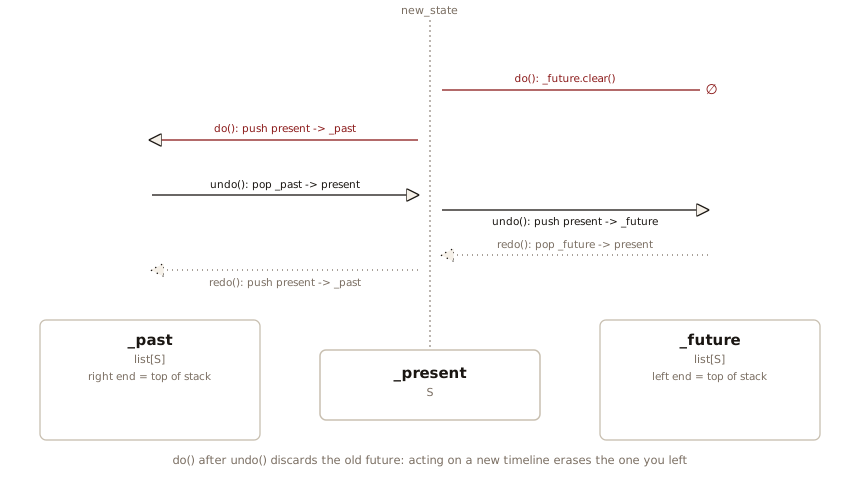
change is already a memento. Undo and redo are two stacks of
past and future states, generic over the state type (the
class History[S] syntax is from Static
Types):
# history.py
from collections.abc import Callable

class History[S]:
    def __init__(self, initial: S) -> None:
        self._present = initial
        self._past: list[S] = []
        self._future: list[S] = []

    @property
    def present(self) -> S:
        return self._present

    def do(self, new_state: S) -> None:
        self._past.append(self._present)
        self._present = new_state
        self._future.clear()

    def apply(self, edit: Callable[[S], S]) -> S:
        self.do(edit(self._present))
        return self._present

    def undo(self) -> S:
        previous = self._past.pop()
        self._future.append(self._present)
        self._present = previous
        return self._present

    def redo(self) -> S:
        following = self._future.pop()
        self._past.append(self._present)
        self._present = following
        return self._present

    def can_undo(self) -> bool:
        return bool(self._past)

    def can_redo(self) -> bool:
        return bool(self._future)

if __name__ == "__main__":
    from frozen_sketch import Drawing
    history = History(Drawing("Duck"))
    history.apply(lambda d: d.draw("circle"))
    history.apply(lambda d: d.draw("beak"))
    print(history.present)
    print(history.undo())
    print(history.redo())
#: Duck: circle beak
#: Duck: circle
#: Duck: circle beak
do() pushes the present into the past and clears
the future, because acting after an undo starts a new timeline.
Redo can no longer reach the states you undid, which is how
editors behave. undo() and redo() just
shuttle the present between the two stacks.
apply() exists because do() alone
leaves work to the caller. do() takes a finished
state, so every call site must remember to build that state from
history.present and then hand the result back. If
you build a new state and keep it without handing it back, the
history omits it. Because nothing mutates, every other state
stays valid and the gap goes unnoticed. apply()
takes the edit instead of its result. It reads
present itself and passes whatever the edit returns
straight to do(), so no call site can forget either
half. do() stays public for a state that arrives
from somewhere other than an edit of the present, as history_classic.py shows
below.
undo() and redo() check no
precondition of their own: undoing with no past raises
IndexError from pop(), and that
pop() comes first, so a refused undo leaves the
history as it was. can_undo() and
can_redo() exist so callers ask first, which is how
an editor knows to gray out the menu item. History
stores whole states, not descriptions of changes, so it never
interprets anything. That works for any state type, from
int to a full Drawing, with one
condition: states must be immutable. History cannot
protect a list that someone mutates in place. A
History of lists is a stack of aliases, the bug
that opened this chapter.
History does not require a frozen state class
either. The classic Memento from sketch.py is already
immutable, so the same generic caretaker holds snapshots of the
mutable Sketch, with the surrounding code calling
save() and restore() where frozen_sketch.py’s version
needed neither:
# history_classic.py
from history import History
from sketch import Memento, Sketch

sketch = Sketch()
sketch.draw("circle")
history: History[Memento] = History(
    sketch.save())
sketch.draw("beak")
history.do(sketch.save())
sketch.restore(history.undo())
print(sketch)
#: circle
# test_history.py
from history import History
def test_undo_and_redo() -> None:
history = History(0)
history.do(1)
history.do(2)
assert history.undo() == 1
assert history.undo() == 0
assert history.redo() == 1
def test_apply_edits_the_present() -> None:
history = History("a")
assert history.apply(lambda s: s + "b") == "ab"
assert history.present == "ab"
assert history.undo() == "a"
def test_new_action_clears_redo() -> None:
history = History("a")
history.do("ab")
history.undo()
history.do("ax")
assert not history.can_redo()
assert history.present == "ax"
def test_bounds_are_reported() -> None:
history = History(0)
assert not history.can_undo()
history.do(1)
assert history.can_undo() and not history.can_redo()
history.undo()
assert history.can_redo() and not history.can_undo()The alternative design stores commands instead of states.
Each undoable action carries its own inverse, the Command
variation that Function Objects
mentions. Command-based undo saves memory when a snapshot is
large, at the cost of writing and testing an inverse for every
action. Try snapshot-based undo first: immutable states make one
edit inexpensive, as sharing.py showed, and
switch to Command once growth_cost.py’s
O(k^2) starts to matter.
Restoring Part of a State
A whole-state snapshot answers one question: what did
everything look like then? Editors face a narrower one. Undo the
drawing, but keep the rename. History cannot
express that, because it moves whole states and never looks
inside them. The answer has to come from the state itself, and
for a state that defines __replace__(),
copy.replace() supplies it:
# partial_restore.py
import copy
from frozen_sketch import Drawing
from history import History

history = History(Drawing("Duck"))
history.apply(lambda d: d.draw("circle"))
checkpoint = history.present
history.apply(lambda d: d.draw("beak"))
history.apply(lambda d: copy.replace(d, title="Goose"))
history.apply(lambda d: d.draw("scribble"))
print(history.present)
#: Goose: circle beak scribble
history.apply(lambda d: copy.replace(
    d, strokes=checkpoint.strokes))
print(history.present)
#: Goose: circle
print(history.undo())
#: Goose: circle beak scribble
checkpoint names a past Drawing,
and immutability keeps that name accurate, since the state it
names cannot change. The restore takes the strokes from that
past state and the title from the present one, producing a state
that never existed before. It goes through apply()
like any other action, so the partial restore is undoable, as
the last line shows. The edit that apply() receives
is a lambda here rather than a method call, because a partial
restore combines two states and no single method on
Drawing does that.
copy.replace() is the general version of
dataclasses.replace(), which Data
Classes as Types describes. copy.replace()
rather than the dataclasses one keeps the technique
available to whatever state type a History holds:
NamedTuple, datetime, and any class
defining __replace__() all accept it.
Mementos That Outlive the Process
A snapshot in memory disappears when the process ends. The
same frozen value, serialized, becomes a saved game, a session
file, or a crash-recovery point. The standard library’s
pickle turns almost any Python object into bytes
and back:
# round_trip.py
import pickle
from frozen_sketch import Drawing

drawing = Drawing("Duck").draw("circle").draw("beak")
restored = pickle.loads(pickle.dumps(drawing))
print(restored == drawing, restored is drawing)
#: True False
The bytes from pickle.dumps() can go to a file
and come back in a different process, days later. The round trip
produces a different object with the same value, which is all a
memento needs, since a data class compares by value.
Only unpickle data you trust, because the format can execute
code. For untrusted storage or other languages, convert the
state with dataclasses.asdict() and write JSON,
which exercise 3 explores.
Pickle’s other limitation is time: the class can change
between the save and the load. The bytes encode a class by
module and name, not by the shape that class had at save time.
If the state class gains, loses, or renames a field before the
load, pickle.loads() still succeeds. What breaks is
whatever later touches a field the bytes never carried. The
listing simulates that drift, and puts the class in its own
module because in reality a class drifts between two runs of a
program, not inside one script:
# sketch_v1.py
from dataclasses import dataclass

@dataclass(frozen=True)
class SketchV1:
    strokes: tuple[str, ...]
# sketch_v2.py
from dataclasses import dataclass
@dataclass(frozen=True)
class SketchV2:
strokes: tuple[str, ...]
title: str# pickle_drift.py
import pickle
import sketch_v1
from sketch_v1 import SketchV1
from sketch_v2 import SketchV2
blob = pickle.dumps(SketchV1(("circle", "beak")))
sketch_v1.SketchV1 = SketchV2 # type: ignore
restored = pickle.loads(blob)
print(restored.strokes)
#: ('circle', 'beak')
try:
print(restored.title)
except AttributeError as e:
print(e)
#: 'SketchV2' object has no attribute 'title'The dump that builds blob runs while
sketch_v1.SketchV1 still means the one-field class.
sketch_v1.SketchV1 = SketchV2 stands in for an edit
and reload of that module, with a field added between the save
and the load. ty and mypy flag that reassignment as
unsound, so it carries a # type: ignore. Pyright
lets the reassignment pass. No practical annotation declares
that SketchV1 can become a different class.
pickle.loads() looks up the class by the name
pickle recorded, sketch_v1.SketchV1. That name now
points at SketchV2. pickle.loads()
builds a bare SketchV2, skipping
__init__(), and copies in only the fields the old
bytes had. The fields go straight into the object’s
__dict__, so frozen=True stays out of
the way: freezing guards attribute assignment, and pickle writes
the dictionary directly. title is absent, since the
old bytes never had one. The same shortcut skips
__post_init__(), so a memento saved before a
validated field existed can load a value nothing ever validated.
restored.strokes works because both versions agree
on that field. restored.title fails if anything
asks for it, which is often nowhere near the line that called
pickle.loads(). Pickle is convenient because it
hides this contract. Nothing enforces that the class on load
matches the class on save.
Drift in the other direction is quieter still. If you delete
a field, the old bytes load with no error anywhere. The dropped
name arrives in the object’s __dict__ as a ghost
attribute, readable but invisible to the class definition, so
repr() omits it and == ignores it. The
loaded object is equal to, and hashes the same as, one built
fresh without that field. The added-field drift above at least
fails when something touches the gap. This one never raises an
exception. The data is quietly wrong. Renaming a field is a
delete and an add at once, and does both: the old name becomes a
ghost and the new one is missing, so even repr()
raises AttributeError. Running the same
substitution backwards shows the quiet case:
# ghost_field.py
import pickle
import sketch_v2
from sketch_v1 import SketchV1
from sketch_v2 import SketchV2

blob = pickle.dumps(SketchV2(("circle",), "Duck"))
sketch_v2.SketchV2 = SketchV1  # type: ignore
restored = pickle.loads(blob)
print(restored)
#: SketchV1(strokes=('circle',))
print(restored.__dict__)
#: {'strokes': ('circle',), 'title': 'Duck'}
print(restored == SketchV1(("circle",)))
#: True
Each print contradicts the one before it. The
repr() shows a one-field object while the
__dict__ shows two entries, and the loaded object
is == to a SketchV1 that never had a
title, so nothing downstream can tell them apart.
Databases hit the same problem and gave it a name. A schema migration is the disciplined version of this drift, a versioned, deliberate step that moves the table shape and its data forward together, instead of discovering the mismatch when a query runs.
When either limitation rules out pickle, other
libraries answer drift and security separately.
msgspec and pydantic both validate on
load. A shape mismatch raises a clear error at the boundary,
instead of the delayed AttributeError from pickle_drift.py. Protocol
Buffers goes further. A schema shared across languages gives
every field an explicit, numbered slot. Old and new versions can
then read each other’s messages on purpose, not by accident.
None of the three execute the bytes they read, so none carry
pickle’s security risk either.
Snapshots in the Wild
Version control is the Memento pattern at industrial scale. A
git commit is an immutable snapshot of your whole tree, checkout
is restore(), and git shares unchanged content
between commits just as the immutable Drawing
states in History share their unchanged strokes.
Databases hand out savepoints, mementos scoped to a transaction.
Multiplayer games snapshot the world so they can rewind and
replay when a late packet arrives. Whenever you see rewind,
rollback, or restore, something is producing mementos.
Exercises
- Add
erase()to both sketches. It removes the last stroke. Insketch.pyit mutates. Infrozen_sketch.pyit returns a newDrawing. Write tests proving existing mementos and histories survive untouched in each version. - Give
Historya maximum depth. When the past grows beyondnstates, discard the oldest. What shouldcan_undo()report then? - Serialize a
Drawingto JSON usingdataclasses.asdict()and reconstruct it. What did the round trip change thatpicklepreserved, and where must your reconstruction compensate? - Change
sketch.pysoMementoholds the list itself instead of a tuple copy, and sorestore()assigns that list rather than copying it, leaving the sketch and the memento sharing one list in both directions. Then write the test that exposes the corruption. Which of the three tests intest_sketch.pycatches it first? - Add
goto(steps_back)toHistory: jump the present several states into the past in one call, keeping redo consistent. - A
HistoryofDrawingstates records a rename and three strokes. Writerestore_field(history, name, past)that pushes a new state taking one named field frompastand the rest fromhistory.present. Why must it go throughdo()rather than editing_pastdirectly? - Save two
Drawings withpickle, one of them with an empty title, then add a field with a default toDrawingand load the old bytes. Does the default appear? Now add a__post_init__()that rejects an empty title, and load the blank one again. What did pickle skip, and what wouldcopy.replace()have caught?