Multiple Dispatching

Dealing with multiple interacting types can get messy.
Consider a system that parses and executes mathematical
expressions. You want to say Number + Number,
Number * Number, etc., where Number is
the base class for a family of numerical objects. But when you
say a + b, and you don’t know the exact type of
either a or b, how can you get them to
interact properly?
The answer starts with a fact about the language that rarely comes up. Python dispatches on one type at a time. When two objects of unknown type interact, a method call resolves the type of only one of them, its receiver. You end up testing the other type by hand, writing out the dispatch the language performed for the first one.
The solution is Multiple Dispatching. Polymorphism broadly means that a function accepts arguments of more than one type (see Rethinking Objects). It takes three forms. Function overloading in C++ picks a function from the argument types. Generics write one body that works across many types. The form at work in this chapter is the runtime dispatch that inheritance provides, which resolves on the type of one object, the one receiving the method call. That is why one method call can resolve only one unknown type.
To dispatch on two unknown types, you need two method calls.
The first resolves the first type, and the second resolves the
second. Two unknown types means two dispatches, which is
double dispatching. In the example below, both
interacting objects come from a single hierarchy, and the two
dispatches go through methods named compete() and
eval_*(). If two different type hierarchies
interact, you need a dispatching method call for each
hierarchy.
Python already performs this second dispatch for you when the
interaction is an operator: a + b retries as
b.__radd__(a) if a.__add__(b)
declines, which is how the opening Number + Number
question resolves (Operators
Dispatch Twice below). The rest of this chapter builds the
general technique, for an interaction that is not an operator,
using a game of paper, scissors, rock as the working
example.
Both versions below share one result type, an enumeration
called Outcome: either WIN,
LOSE, or DRAW. Outcome is
a StrEnum, so each member is its string value and
prints as win, lose, or
draw:
# outcome.py
# The result of one Item competing with another.
from enum import StrEnum

class Outcome(StrEnum):
    WIN = "win"
    LOSE = "lose"
    DRAW = "draw"
You also need two small helper functions, one to generate random pairs of items, and one to play a pair off and print the result:
# arena.py
import random
from collections.abc import Iterator
from typing import Any

def item_pair_gen[T](base: type[T],
                     n: int) -> Iterator[tuple[T, T]]:
    items = base.__subclasses__()
    for _ in range(n):
        yield random.choice(items)(), random.choice(items)()

def duel(item1: Any, item2: Any) -> None:
    print(f"{item1} <--> {item2} : {item1.compete(item2)}")
item_pair_gen() is generic over whichever base
class it receives, and __subclasses__() lists that
base’s direct subclasses, as shape_name() in Factory
did. duel() settles for Any because
the two versions below define separate Item
hierarchies, and this file must serve both.
Here is Multiple Dispatching in action:
# paper_scissors_rock.py
import random
from typing import Any
from arena import duel, item_pair_gen
from outcome import Outcome

class Item:
    def __str__(self) -> str:
        return type(self).__name__

class Paper(Item):
    def compete(self, item: Any) -> Outcome:
        # First dispatch: self was Paper
        return item.eval_paper(self)
    def eval_paper(self, item: Any) -> Outcome:
        # Second dispatch: caller was Paper, and it draws
        return Outcome.DRAW
    def eval_scissors(self, item: Any) -> Outcome:
        # Second dispatch: caller was Scissors, and it wins
        return Outcome.WIN
    def eval_rock(self, item: Any) -> Outcome:
        # Second dispatch: caller was Rock, and it loses
        return Outcome.LOSE

class Scissors(Item):
    def compete(self, item: Any) -> Outcome:
        # First dispatch: self was Scissors
        return item.eval_scissors(self)
    def eval_paper(self, item: Any) -> Outcome:
        # Second dispatch: caller was Paper, and it loses
        return Outcome.LOSE
    def eval_scissors(self, item: Any) -> Outcome:
        # Second dispatch: caller was Scissors, and it draws
        return Outcome.DRAW
    def eval_rock(self, item: Any) -> Outcome:
        # Second dispatch: caller was Rock, and it wins
        return Outcome.WIN

class Rock(Item):
    def compete(self, item: Any) -> Outcome:
        # First dispatch: self was Rock
        return item.eval_rock(self)
    def eval_paper(self, item: Any) -> Outcome:
        # Second dispatch: caller was Paper, and it wins
        return Outcome.WIN
    def eval_scissors(self, item: Any) -> Outcome:
        # Second dispatch: caller was Scissors, and it loses
        return Outcome.LOSE
    def eval_rock(self, item: Any) -> Outcome:
        # Second dispatch: caller was Rock, and it draws
        return Outcome.DRAW

if __name__ == "__main__":
    random.seed(47)  # Reproducible pairs
    for item1, item2 in item_pair_gen(Item, 10):
        duel(item1, item2)
#: Scissors <--> Paper : win
#: Scissors <--> Rock : lose
#: Scissors <--> Rock : lose
#: Scissors <--> Scissors : draw
#: Rock <--> Scissors : win
#: Scissors <--> Rock : lose
#: Paper <--> Scissors : lose
#: Rock <--> Paper : lose
#: Paper <--> Paper : draw
#: Scissors <--> Scissors : draw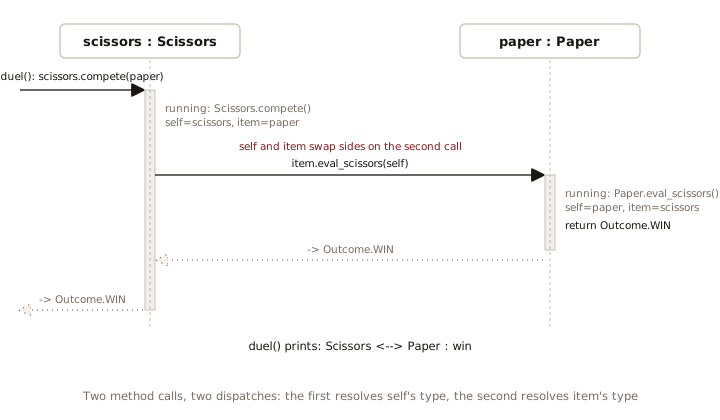
Follow one duel to keep the perspective straight.
scissors.compete(paper) resolves self
to Scissors, the first dispatch, and calls
paper.eval_scissors(...). That call is the second
dispatch. It resolves paper, arriving in
Paper.eval_scissors(), the one method that knows
both types. Which competitor does that result describe?
Paper.eval_scissors() returns WIN, and
that is the outcome for the scissors that started the duel, not
for the Paper whose code is running, since scissors
cut paper. Every eval_*() method answers for the
original caller, the type named in the method’s own name. If you
misread that convention, every result in the class appears
backward. Each eval_*() method also receives an
item argument, the original caller: the same object
compete() held as self before passing
it along. This game ignores it, since the outcome depends only
on the two types. A richer game would read the caller’s state
through it.
Those Any annotations give up static checking.
Item declares only __str__(), so
Any is the only annotation available short of a
Protocol naming all four methods. With
Any, a class can omit one of the nine answers and
the type checker stays silent. Python raises an
AttributeError at the first duel that needs the
missing method. A Protocol listing the four methods
would restore the checking, at the price of a declaration that
repeats every class’s method names. The table version sidesteps
the problem. Its answers are data rather than methods, so a
class has nothing to forget, and its Item declares
the one method the dispatch needs, compete(), so
the opponent parameter takes Item rather than
Any.
Each Item type encodes the answers for its own
combinations. Together they form a table spread across the
classes. That table is hard to maintain if you expect to modify
the behavior or to add a new Item class. Making the
table explicit can be more sensible, like this:
# paper_scissors_rock_table.py
import random
from typing import Final
from arena import duel, item_pair_gen
from outcome import Outcome

class Item:
    def compete(self, item: Item) -> Outcome:
        # Use a tuple of types to index into the table:
        return OUTCOME[type(self), type(item)]
    def __str__(self) -> str:
        return type(self).__name__

class Paper(Item):
    pass
class Scissors(Item):
    pass
class Rock(Item):
    pass

OUTCOME: Final[
    dict[tuple[type[Item], type[Item]], Outcome]] = {
    (Paper, Rock): Outcome.WIN,
    (Paper, Scissors): Outcome.LOSE,
    (Paper, Paper): Outcome.DRAW,
    (Scissors, Paper): Outcome.WIN,
    (Scissors, Rock): Outcome.LOSE,
    (Scissors, Scissors): Outcome.DRAW,
    (Rock, Scissors): Outcome.WIN,
    (Rock, Paper): Outcome.LOSE,
    (Rock, Rock): Outcome.DRAW,
}

if __name__ == "__main__":
    random.seed(47)  # Reproducible pairs
    for item1, item2 in item_pair_gen(Item, 10):
        duel(item1, item2)
#: Scissors <--> Paper : win
#: Scissors <--> Rock : lose
#: Scissors <--> Rock : lose
#: Scissors <--> Scissors : draw
#: Rock <--> Scissors : win
#: Scissors <--> Rock : lose
#: Paper <--> Scissors : lose
#: Rock <--> Paper : lose
#: Paper <--> Paper : draw
#: Scissors <--> Scissors : draw
Dictionary keys are flexible. A tuple works as a key, the
same as a single object. Two properties of the lookup carry over
from the table-driven
state machine. The lookup matches classes exactly, so a
subclass of Paper finds none of
Paper’s rows. And a missing pair raises a
KeyError at the first duel that needs it, the
fail-fast policy that suits a table under construction. Adding
Lizard in exercise 1 puts you in that
situation.
Exact matching surprises people. This listing shows the table
refusing a subclass. Origami derives from
Paper and inherits its compete(), but
the table has no row for it:
# exact_match.py
from paper_scissors_rock_table import OUTCOME, Paper, Rock

class Origami(Paper):
    pass

print(OUTCOME[Paper, Rock])
#: win
try:
    Origami().compete(Rock())
except KeyError as e:
    missing = e.args[0]  # The tuple key that was not found
    print(type(e).__name__, [c.__name__ for c in missing])
#: KeyError ['Origami', 'Rock']
A dictionary probe compares keys by equality, so
Origami is not Paper however closely
the two relate. Nothing walks the MRO on the
way to the answer.
One Type or Many
For dispatch on one argument’s type,
functools.singledispatch (see Visitor)
gives you open, per-type functions. For dispatch on two or more
types at once, the table above is the idiomatic answer: a
dict keyed by a tuple of types. Adding a new
Item then means adding rows to the table, with no
methods to edit across the classes.
The two match types differently. singledispatch
resolves through the MRO, so registering a base class catches
every subclass, while the table matches the class exactly.
Swapping one for the other changes which pairings the code
covers, not just how many types it considers.
A match statement with class patterns is a third
option for a two-type decision. Like
singledispatch, it tolerates subclasses: it tests
with isinstance(), so a subclass matches the
pattern its base would:
# match_dispatch.py
from outcome import Outcome
from paper_scissors_rock_table import Paper, Rock

class Origami(Paper):
    pass

def compete(a: object, b: object) -> Outcome:
    match a, b:
        case Paper(), Rock():
            return Outcome.WIN
        case Rock(), Paper():
            return Outcome.LOSE
        case _:
            raise ValueError(f"{a}, {b}")

print(compete(Origami(), Rock()))
#: win
Origami() matches the Paper()
pattern, the same subclass exact_match.py showed the
table refusing. Unlike singledispatch, every case
sits together in one block, closed the way the table is: adding
an Item means adding cases, not registering a
function elsewhere.
functools.singledispatchmethod (Functional
Toolkits catalogs it) combines the two dispatches in one
decorator. It dispatches once on self through
ordinary method resolution, then again on its first argument
through singledispatch, which is the pair of
dispatches the eval_*() family hand-rolls. Like
singledispatch, it matches on the MRO rather than
exactly. One trap is easy to fall into and hard to see: each
class needs its own @singledispatchmethod, because
registering on a shared base gives every subclass one
dispatcher, and the resolution on self then treats
them all alike. Here is the collapse:
# singledispatch_trap.py
from functools import singledispatchmethod

class Item:
    @singledispatchmethod
    def compete(self, item: object) -> str:
        raise NotImplementedError

class Paper(Item):
    pass

class Rock(Item):
    pass

@Paper.compete.register  # type: ignore
def _(self: Item, item: Rock) -> str:
    return "paper wins"

@Rock.compete.register  # type: ignore
def _(self: Item, item: Rock) -> str:
    return "rock draws"

print(Paper().compete(Rock()))
#: rock draws
print(Rock().compete(Rock()))
#: rock draws
Both registrations attach to Item.compete, the
attribute Paper and Rock both inherit,
so the second @register silently overwrites the
first’s entry for Rock. self’s type
never entered that lookup, so both duels return the same answer,
even though each was registered against its own class.
The version most programmers write first is neither of these:
it is an isinstance() ladder inside
compete(), testing the opponent’s type case by
case. It works, and it is the worst of both worlds. The type
tests scatter through every class as in the method version, with
none of dispatch’s automatic resolution, and every new
Item forces an edit to every ladder. Both patterns
in this chapter exist to avoid writing it.
The double-dispatch version, with eval_paper(),
eval_scissors(), and eval_rock() on
every class, comes from languages where a table keyed by a pair
of types is awkward to write. There, spreading the table across
the classes wins. A Python dict takes a tuple of
classes as a key, so the table is both shorter and easier to
maintain. A table cell can hold a function, so even elaborate
behavior fits the table, which is what exercise 9 builds. Use
the double-dispatch version when the behavior for a combination
belongs to the class rather than to the pairing: when it reads
the object’s own state, or when a subclass should be able to
override one combination and inherit the rest. A subclass can do
that by overriding compete() itself:
# paper_scissors_rock_subclass.py
from typing import Any
from outcome import Outcome
from paper_scissors_rock import Paper, Rock, Scissors

class DampPaper(Paper):
    def compete(self, item: Any) -> Outcome:
        if isinstance(item, Rock):
            return Outcome.DRAW  # Too soggy to wrap
        return super().compete(item)

print(DampPaper().compete(Rock()))
#: draw
print(DampPaper().compete(Scissors()))
#: lose
DampPaper overrides its outcome against
Rock and inherits every other combination from
Paper, unchanged, through
super().compete(item). The table version has no
comparable override: changing one cell means editing the shared
OUTCOME dictionary, and that edit affects every
Item rather than one subclass.
Testing Both Versions
The win/lose/draw result is pure logic, so tests validate it
easily. The spread-out method version and the table version must
return the same Outcome for every one of the nine
combinations. If they diverge, one of them has a bug.
# test_paper_scissors.py
from types import ModuleType
from typing import Final
import paper_scissors_rock as methods
import paper_scissors_rock_table as table
import pytest
from outcome import Outcome

# (player, opponent): the player's result
EXPECTED: Final[dict[tuple[str, str], Outcome]] = {
    ("Paper", "Rock"): Outcome.WIN,
    ("Paper", "Scissors"): Outcome.LOSE,
    ("Paper", "Paper"): Outcome.DRAW,
    ("Scissors", "Paper"): Outcome.WIN,
    ("Scissors", "Rock"): Outcome.LOSE,
    ("Scissors", "Scissors"): Outcome.DRAW,
    ("Rock", "Scissors"): Outcome.WIN,
    ("Rock", "Paper"): Outcome.LOSE,
    ("Rock", "Rock"): Outcome.DRAW,
}

def compete(module: ModuleType, player: str,
            opponent: str) -> Outcome:
    result: Outcome = getattr(module, player)().compete(
        getattr(module, opponent)())
    assert isinstance(result, Outcome)
    return result

MATCHUPS: Final[list[tuple[str, str, Outcome]]] = [
    (p, o, r) for (p, o), r in EXPECTED.items()
]

@pytest.mark.parametrize("module", [table, methods])
@pytest.mark.parametrize(
    "player, opponent, expected", MATCHUPS)
def test_matches_expected(module: ModuleType, player: str,
                          opponent: str,
                          expected: Outcome) -> None:
    assert compete(module, player, opponent) == expected

@pytest.mark.parametrize("outcome, expected", [
    (Outcome.WIN, "win"),
    (Outcome.LOSE, "lose"),
    (Outcome.DRAW, "draw"),
])
def test_outcome_str(outcome: Outcome,
                     expected: str) -> None:
    assert str(outcome) == expected
The test imports the two modules, not their classes.
getattr(module, player) looks the class up on
whichever module the test received, so one table of nine
expected answers drives two independent sets of
Paper, Scissors, and Rock
classes. Importing both modules works cleanly because each
guards its demonstration loop with
if __name__ == "__main__", so the loop runs only
when you execute the file directly, not when a test imports
it.
Operators Dispatch Twice
Python’s own operators dispatch twice, which answers the
Number + Number question that opened this chapter.
a + b first tries
type(a).__add__(a, b). If that returns the special
value NotImplemented, Python turns around and tries
type(b).__radd__(b, a), the reflected form
of __add__(). The first call dispatches on
a’s type, the fallback on b’s, and
that is double dispatching, built into the language. Every
arithmetic and bitwise operator has a reflected form, named by
inserting an r before the operator’s name:
__rsub__(), __rmul__(),
__rtruediv__(). This fallback is how a type written
decades after int can add itself to an
int on the left. Do not confuse the reflected forms
with the in-place forms, __iadd__() and its
siblings, which serve += and take no part in the
fallback. Returning NotImplemented (a sentinel
value, not the lookalike NotImplementedError
exception) is how an operand says “I don’t know this type; ask
the other object.” Here is the machinery, with each dispatch
traced:
# radd_dispatch.py
from dataclasses import dataclass

@dataclass(frozen=True)
class Meters:
    n: float

    def __add__(self, other: object) -> Meters:
        print(f"__add__({self!r}, {other!r})")
        if isinstance(other, Meters):
            return Meters(self.n + other.n)
        if isinstance(other, int | float):
            return Meters(self.n + other)
        return NotImplemented

    def __radd__(self, other: object) -> Meters:
        print(f"__radd__({self!r}, {other!r})")
        if isinstance(other, int | float):
            return Meters(other + self.n)
        return NotImplemented

print(Meters(3) + Meters(4))
#: __add__(Meters(n=3), Meters(n=4))
#: Meters(n=7)
print(Meters(3) + 4)  # The left operand handles it
#: __add__(Meters(n=3), 4)
#: Meters(n=7)
# Int declines; the right operand handles it
print(4 + Meters(3))
#: __radd__(Meters(n=3), 4)
#: Meters(n=7)
try:
    Meters(3) + "four"  # Both sides decline
except TypeError as e:
    print(e)
#: __add__(Meters(n=3), 'four')
#: unsupported operand type(s) for +: 'Meters' and 'str'
The first two additions resolve inside
__add__(): the left operand recognizes the type.
4 + Meters(3) asks int.__add__()
first, and int has never heard of
Meters, so it returns NotImplemented.
The sentinel is a decline rather than an error, so Python tries
Meters.__radd__() next, whose trace line shows the
operands arriving swapped. The last case shows why the sentinel
exists. Meters.__add__() runs and declines the
string, and str has no __radd__() to
consult. Only after both sides have declined does Python raise a
TypeError.
Three details of the fallback are easy to miss. Raising a
TypeError inside __add__() is not the
same as returning NotImplemented. The exception
propagates immediately, so the right operand never gets its
turn. Only the sentinel keeps the second dispatch alive. Python
also skips the reflected call when both operands have the same
type, so Meters + Meters settles inside
__add__(). A class that implements only
__radd__() cannot add itself to its own kind. One
case reverses the order: when the right operand’s type is a
subclass of the left’s and overrides the reflected method,
Python tries that reflected method first, so the more specific
type can answer before its base does.
Both methods declare -> Meters even though
each can return NotImplemented, and that is the
standard convention rather than a shortcut. Typeshed annotates
timedelta.__add__() as returning
timedelta, not a union. It can do that because it
gives NotImplemented a type that inherits from
Any, so returning the sentinel satisfies any
declared return type. Writing the union out,
Meters | NotImplementedType, makes ty
reject (Meters(1) + Meters(2)).n, since the
sentinel branch has no n. Pyright and mypy accept
the access, because that inheritance from Any lets
the sentinel branch claim any attribute. The sentinel signals
the interpreter and never reaches a caller, so an annotation
that names it describes the wrong thing. Widening the return to
Any describes nothing and turns off checking for
every caller.
Composite and Interpreter builds the expression system that opened this chapter, using these two methods to let Python’s own parser assemble the tree.
Turning One Unknown Type Into a Second Dispatch
Three techniques in this chapter answer the same question:
what do you do with a type the first dispatch could not resolve?
The eval_*() family and __add__() with
__radd__() answer it with a second dispatch, a
second method call that resolves the type by running a method
lookup. The OUTCOME table answers it differently.
compete() is defined once on Item and
no subclass overrides it, so
OUTCOME[type(self), type(item)] is one dictionary
lookup keyed on both types at once, not a second method
resolution. The methods hand the second dispatch to a second
method call that you write, and scatter the answers across the
classes. The table replaces both dispatches with a single
lookup, and collects the answers in one place. The operators are
the one case where Python performs the second dispatch itself.
Everywhere else you choose between writing a second dispatch in
methods and replacing both dispatches with one lookup in
data.
Exercises
- Add a fourth
Item,Lizard, topaper_scissors_rock_table.py. Lizard beats Paper and Scissors, and loses to Rock. Lizard versus Lizard is a draw. Add the seven new entries thatOUTCOMEneeds: both orders of each mixed pair, plus Lizard versus Lizard. - Add the same
Lizardtopaper_scissors_rock.py, the double-dispatch version, which means adding aneval_lizard()method to every existing class, plus aLizardclass with its owncompete()and foureval_*()methods. Compare how much code this took versus addingLizardto the table version. - In
test_paper_scissors.py, addLizard’s seven matchups toEXPECTED, taking it from nine entries to sixteen, and confirm both versions still agree with each other and withEXPECTED. - In
arena.py, giveitem_pair_gen()an optionalcounts: Counter[str] | None = Noneparameter that it updates in place with a tally of every item type it chooses, while still yielding(item1, item2)pairs so existing calls need no change. Pass in your ownCounterand print how many timesLizardappeared after iterating over all 100 pairs fromitem_pair_gen(Item, 100, counts), since the counter fills only as you consume the generator. - Give
Metersa__sub__()and a__rsub__().__sub__()handles aMeters, anint, or afloat, and returnsNotImplementedfor anything else.__rsub__()needs only theintandfloatcases, since Python never calls the reflected form for twoMeters. Subtraction does not commute, so the reflected form must undo the swap: check that10 - Meters(3)producesMeters(7)rather thanMeters(-7). Then confirm that"ten" - Meters(3)raises aTypeErrorrather than building anything. - Subclass
PaperasOrigamiand duel it againstRockin the table version, asexact_match.pydoes. Explain theKeyErrorin terms of how the lookup matches. Then make the table tolerate subclasses by walking both operands’__mro__for the first pair that has a row, and say what becomes of each of the two properties named after the table listing. - Create a business-modeling environment with three types of
Inhabitant:Dwarf(for engineers),Elf(for marketers), andTroll(for managers). Now create a class calledProjectthat creates the different inhabitants and causes them tointeract()with each other. Single dispatch is enough here. The next exercise adds the second dispatch. - Modify the above example to make the interactions more
detailed. Each
Inhabitantcan randomly produce aWeaponusingget_weapon(): aDwarfusesJargonorPlay, anElfusesInventFeatureorSellImaginaryProduct, and aTrollusesEdictorSchedule. You must decide which weapons “win” and “lose” in each interaction (as inpaper_scissors_rock.py). Add abattle()method toProjectthat takes twoInhabitants and matches them against each other. Now create ameeting()method forProjectthat creates groups ofDwarf,Elf, andTrolland battles the groups against each other until only members of one group remain. These are the “winners.” - The chapter claims that a table cell can hold a function, so
even elaborate behavior fits the table. Build that version. In
paper_scissors_rock_table.py, give everyOUTCOMEcell aCallable[[Item, Item], Outcome]in place of itsOutcome, and havecompete()call the cell it finds:OUTCOME[type(self), type(item)](self, item). The call site staysitem1.compete(item2). Write a helper that wraps a constantOutcomein a callable, so the eight unchanged cells stay one line each. Then givePaperawetattribute and make the(Paper, Rock)cell read it: dry paper wraps the rock and wins, wet paper is too soggy and draws. The chapter gives two reasons for preferring the double-dispatch version. Say which one this change answers, and which one survives it. - Modify Exercise 8 to use the table lookup technique of
paper_scissors_rock_table.py.