Pattern Refactoring
This chapter follows one problem through several designs. A first solution solves it, then we ask “what will change?” and reshape the design to absorb that change cheaply. This is the spirit of Martin Fowler’s Refactoring, applied to patterns rather than single statements.
It is also a Python lesson. Many patterns in GoF Design Patterns work around the limitations of statically typed languages without multiple dispatch. Python lacks those limitations, so some of those patterns become unnecessary. We will point that out as it happens.
The example is a trash sorting simulation, and it evolves across the chapter: an initial solution, then successive redesigns as new requirements appear. Read that evolution as a template for your own designs, which can start as an adequate fit for one problem and grow into a flexible fit for a class of problems.
Simulating a Trash Recycler
Trash arrives at the recycling plant mixed together. The program must sort it by material and report the total value of each kind. The trash starts out as an undifferentiated pile, and you must recover the type of each piece to sort it.
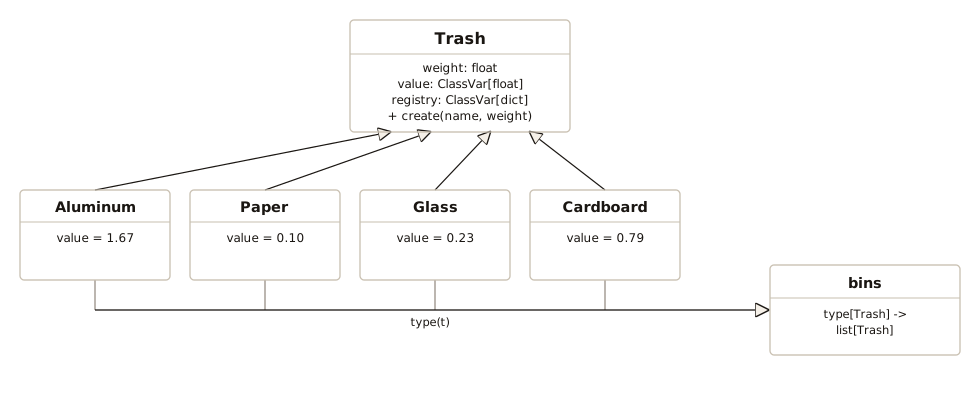
In the Trash hierarchy, each material carries a
per-pound value. The base class keeps a
registry of its subclasses, filled automatically by
__init_subclass__(), and a create()
method builds an instance from a material name (this is a Factory):
# trash.py
from typing import ClassVar

type Bins = dict[type[Trash], list[Trash]]

class Trash:
    value: ClassVar[float] = 0.0  # Dollars per pound (per subclass)
    registry: ClassVar[dict[str, type[Trash]]] = {}

    def __init__(self, weight: float) -> None:
        self.weight = weight

    def __init_subclass__(cls, **kwargs: object) -> None:
        super().__init_subclass__(**kwargs)
        Trash.registry[cls.__name__] = cls

    @classmethod
    def create(cls, name: str, weight: float) -> Trash:
        return Trash.registry[name](weight)

class Aluminum(Trash):
    value = 1.67

class Paper(Trash):
    value = 0.10

class Glass(Trash):
    value = 0.23

class Cardboard(Trash):
    value = 0.79

def sum_value(items: list[Trash]) -> float:
    total = 0.0
    for t in items:
        print(f"weight of {type(t).__name__} = {t.weight}")
        total += t.weight * t.value
    print(f"Total value = {total:.2f}")
    return total
Python implicitly makes __init_subclass__ a
classmethod, so cls doesn’t need an
@classmethod decorator. It runs once per subclass,
immediately after Python creates that subclass, so each one can
register itself in Trash.registry
automatically.
Each subclass’s value = ... line creates its own
class attribute, separate from Trash.value. The
ClassVar annotation just tells type checkers it
belongs to the class rather than an instance. It doesn’t share
storage across subclasses.
None of the subclasses redeclare
value: ClassVar[float]. They don’t need to because
the checker resolves value through the MRO and
finds it already declared ClassVar[float] on
Trash. It treats each subclass’s assignment as
filling in that same classvar rather than introducing a new
one.
Adding a new recyclable type is a single class definition. It
registers itself, and create() can build it.
sum_value() is an ordinary function. It relies on
polymorphism (t.value, t.weight) and
never asks what type each piece is.
We test that each subclass registers itself,
create() builds one by name, the per-pound values
are correct, and sum_value() totals weight times
value:
# test_trash.py
import pytest
from trash import Aluminum, Cardboard, Glass, Paper, Trash, sum_value

def test_subclasses_self_register() -> None:
    assert set(Trash.registry) == {
        "Aluminum", "Paper", "Glass", "Cardboard"}

def test_create_builds_by_name() -> None:
    t = Trash.create("Aluminum", 2.0)
    assert isinstance(t, Aluminum)
    assert t.weight == 2.0

def test_per_pound_values() -> None:
    assert Aluminum.value == 1.67
    assert Paper.value == 0.10
    assert Glass.value == 0.23
    assert Cardboard.value == 0.79

def test_sum_value_totals_weight_times_value() -> None:
    items: list[Trash] = [Aluminum(2.0), Paper(5.0)]
    assert sum_value(items) == pytest.approx(3.84)  # 2*1.67 + 5*0.10
A data file describes the trash to process, one
Name:weight line per piece:
# trash.dat
Glass:54
Paper:22
Paper:11
Glass:17
Aluminum:89
Paper:88
Aluminum:76
Cardboard:96
Aluminum:25
Aluminum:34
Glass:11
Glass:68
Glass:43
Aluminum:27
Cardboard:44
Aluminum:18
Paper:91
Glass:63
Glass:50
Glass:80
Aluminum:81
Cardboard:12
Parsing it into Trash objects goes through the
registry, so the parser never mentions a concrete material. Add
a new kind of trash and the parser keeps working unchanged:
# parse_trash.py
# Read "Name:weight" lines into Trash objects through the registry.
from pathlib import Path
from trash import Trash

def parse(filename: str) -> list[Trash]:
    items: list[Trash] = []
    for line in Path(filename).read_text().splitlines():
        line = line.strip()
        if not line or line.startswith("#"):
            continue
        name, weight = line.split(":")
        items.append(Trash.create(name.strip(), float(weight)))
    return items
Testing parses a small in-memory file, so it does not depend
on trash.dat:
# test_parse_trash.py
from pathlib import Path
from parse_trash import parse

def test_parse_reads_and_skips_comments(tmp_path: Path) -> None:
    data = tmp_path / "trash.dat"
    data.write_text("""\
# header
Aluminum:2.0

Glass:3.0
""")
    items = parse(str(data))
    assert [type(t).__name__ for t in items] == ["Aluminum", "Glass"]
    assert items[0].weight == 2.0
    assert items[1].weight == 3.0
The First Cut: Checking Every Type
The most obvious way to sort is to look at each piece and
discover its type using match:
# recycle_rtti.py
from collections import defaultdict
from parse_trash import parse
from trash import Aluminum, Bins, Cardboard, Glass, Paper, sum_value

bins: Bins = defaultdict(list)
for t in parse("trash.dat"):
    match t:
        case Aluminum():
            bins[Aluminum].append(t)
        case Paper():
            bins[Paper].append(t)
        case Glass():
            bins[Glass].append(t)
        case Cardboard():
            bins[Cardboard].append(t)
for kind, items in bins.items():
    print(f"--- {kind.__name__} ---")
    sum_value(items)
#: --- Glass ---
#: weight of Glass = 54.0
#: weight of Glass = 17.0
#: weight of Glass = 11.0
#: weight of Glass = 68.0
#: weight of Glass = 43.0
#: weight of Glass = 63.0
#: weight of Glass = 50.0
#: weight of Glass = 80.0
#: Total value = 88.78
#: --- Paper ---
#: weight of Paper = 22.0
#: weight of Paper = 11.0
#: weight of Paper = 88.0
#: weight of Paper = 91.0
#: Total value = 21.20
#: --- Aluminum ---
#: weight of Aluminum = 89.0
#: weight of Aluminum = 76.0
#: weight of Aluminum = 25.0
#: weight of Aluminum = 34.0
#: weight of Aluminum = 27.0
#: weight of Aluminum = 18.0
#: weight of Aluminum = 81.0
#: Total value = 584.50
#: --- Cardboard ---
#: weight of Cardboard = 96.0
#: weight of Cardboard = 44.0
#: weight of Cardboard = 12.0
#: Total value = 120.08
This satisfies the requirement, but it has a classic flaw. It
tests for every type in the system. When a new material
joins the system, Plastic say, you must find every
case statement that enumerates specific types. Any
you miss will silently drop trash on the floor. Readers of Composite and
Interpreter may expect assert_never() to make
the checker catch the missed case, and here it cannot help:
exhaustiveness checking needs a closed union, and the
registry keeps Trash deliberately open, so no
checker can know the set is complete. This is a
match over an open set, exactly what Pattern
Matching warned against. When the set is open, sorting must
not enumerate it, which is what the next section arranges.
Testing for one type, or a small subset that needs special
handling, is fine. Testing for all of them means you are doing
polymorphism’s job by hand.
Let a Dictionary Do the Sorting
We can use a dictionary keyed by type:
# recycle_dict.py
from collections import defaultdict
from parse_trash import parse
from trash import Bins, sum_value

bins: Bins = defaultdict(list)

for t in parse("trash.dat"):
    bins[type(t)].append(t)  # Bin chosen by the trash piece

for kind, items in bins.items():
    print(f"--- {kind.__name__} ---")
    sum_value(items)
#: --- Glass ---
#: weight of Glass = 54.0
#: weight of Glass = 17.0
#: weight of Glass = 11.0
#: weight of Glass = 68.0
#: weight of Glass = 43.0
#: weight of Glass = 63.0
#: weight of Glass = 50.0
#: weight of Glass = 80.0
#: Total value = 88.78
#: --- Paper ---
#: weight of Paper = 22.0
#: weight of Paper = 11.0
#: weight of Paper = 88.0
#: weight of Paper = 91.0
#: Total value = 21.20
#: --- Aluminum ---
#: weight of Aluminum = 89.0
#: weight of Aluminum = 76.0
#: weight of Aluminum = 25.0
#: weight of Aluminum = 34.0
#: weight of Aluminum = 27.0
#: weight of Aluminum = 18.0
#: weight of Aluminum = 81.0
#: Total value = 584.50
#: --- Cardboard ---
#: weight of Cardboard = 96.0
#: weight of Cardboard = 44.0
#: weight of Cardboard = 12.0
#: Total value = 120.08
type(t) is the perfect key because it adapts to
new types, even ones added at runtime. Nothing needs
maintaining, and nothing gets forgotten. The key is the
exact class, the same dictionary-probe dispatch as the
tables in State
Machines and Multiple
Dispatching. Derive CrushedAluminum from
Aluminum and it sorts into its own bin, not its
parent’s, which is what a sorter usually wants, but is worth
knowing before you subclass a material.
Adding Operations: Visitor, and Why Python Skips It
We have changed types cheaply so far. The other axis
of change is adding new operations. Suppose the
Trash hierarchy is fixed (maybe it ships from a
vendor) and you want to add new behaviors to it without editing
it: price it, weigh it, print recycling instructions, and more
later.
Visitor solves this problem.
Visitor is elaborate: a Visitor base class with one
visit() overload per material, an
accept() method added to every element, and
double dispatch to route each piece to the correct
visit(). It exists because languages like Java and
C++ dispatch on only one type at a time and cannot add methods
to a class from outside. Python has neither limitation. The
standard library provides functools.singledispatch
which dispatches on the type of its first argument, with new
types registered from anywhere.
In Python, a single-dispatch function implements Visitor:
# recycling_note.py
from functools import singledispatch
from parse_trash import parse
from trash import Aluminum, Cardboard, Glass, Trash

@singledispatch
def recycling_note(t: Trash) -> str:
    return f"{type(t).__name__}: no special handling"

@recycling_note.register
def _(t: Aluminum) -> str:
    return "Aluminum: crush and bale"

@recycling_note.register
def _(t: Glass) -> str:
    return "Glass: sort by color, then crush"

@recycling_note.register
def _(t: Cardboard) -> str:
    return "Cardboard: flatten and bundle"

seen: set[type[Trash]] = set()
for t in parse("trash.dat"):
    if type(t) not in seen:
        seen.add(type(t))
        print(recycling_note(t))
#: Glass: sort by color, then crush
#: Paper: no special handling
#: Aluminum: crush and bale
#: Cardboard: flatten and bundle
Each implementation above is named _, a
throwaway name Visitor
explains. recycling_note() is a new operation
defined outside the Trash hierarchy.
Paper has no registered note, so it falls through
to the base function and performs the default behavior. Adding a
price() or weight() operation means
writing another single-dispatch function. Adding a
Plastic material means defining the class and, if
it needs a special note, registering one line.
Compare this to a Visitor implementation. No
Visitor class exists, no accept()
method bolted onto every material, and no decorator gymnastics
to fake overloading.
When the operation is the same for every type, you do not
even need single dispatch. sum_value() earlier was
a function. Use singledispatch only when the
behavior genuinely differs by type. For operations that belong
on the objects and vary by type,
singledispatchmethod does the same thing as a
method.
Choosing the Lightest Construct
Design patterns are about separating things that change from things that stay the same. Polymorphism is one way to do that, but it is not the only one. The deeper skill is spotting the vector of change (The Pattern Concept) in a problem (here, new types versus new operations) and choosing the lightest construct that isolates it. This chapter discovered its vectors the honest way, one requirement at a time, rather than predicting them up front. In Python that construct is often a language feature, not a multi-class pattern. The honest measure of a pattern is whether it is still useful once the language does part of the work for you.
Exercises
- Add a
Plasticmaterial with a per-pound value. Confirm thatrecycle_dict.pyandparse_trash.pyneed no changes, and that onlytrash.datand (optionally) a one-linerecycling_note()registration do. - Write a
price()operation as a function over a list ofTrash, and aheaviest()operation that returns the single heaviest piece. Decide for each whether it needssingledispatch. - Replace the
recycling_note()single-dispatch function with asingledispatchmethodon aSorterclass, and explain what changed.