Multiple Dispatching
Dealing with multiple interacting types can get messy.
Consider a system that parses and executes mathematical
expressions. You want to say Number + Number,
Number * Number, etc., where Number is
the base class for a family of numerical objects. But when you
say a + b, and you don’t know the exact type of
either a or b, how can you get them to
interact properly?
The answer starts with something you probably never consider. Python only performs single dispatching. That is, if you are performing an operation on more than one object whose type is unknown, Python can invoke the dynamic binding mechanism on only one of those types. You end up detecting some types manually and effectively producing your own dynamic binding behavior.
The solution is Multiple Dispatching. Polymorphism broadly means that a function accepts arguments of more than one type (see Rethinking Objects). It takes several forms. Function overloading in C++ picks a function from the argument types. Generics write one body that works across many types. The form at work in this chapter is the runtime dispatch that inheritance provides, which resolves on the type of one object, the one receiving the method call. That is why one method call can resolve only one unknown type.
To dispatch on two unknown types, you need two method calls.
The first resolves the first type, and the second resolves the
second. Each unknown type needs its own dispatching method call.
The following example names its methods compete()
and eval_*(), and all belong to the same hierarchy.
Here there will be only two dispatches. This is double
dispatching. If you are working with two different type
hierarchies that are interacting, then you’ll need a dispatching
method call for each hierarchy.
Both versions below share one result type, an enumeration
called Outcome: either WIN,
LOSE, or DRAW. Outcome is
a StrEnum, so each member is its string value and
prints as win, lose, or
draw:
# outcome.py
# The result of one Item competing with another.
from enum import StrEnum

class Outcome(StrEnum):
    WIN = "win"
    LOSE = "lose"
    DRAW = "draw"
We also need two small helper functions, one to generate random pairs of items, and one to play a pair off and print the result:
# arena.py
import random
from collections.abc import Iterator
from typing import Any

def item_pair_gen(base: type, n: int) -> Iterator[tuple[Any, Any]]:
    items = base.__subclasses__()
    for _ in range(n):
        yield random.choice(items)(), random.choice(items)()

def duel(item1: Any, item2: Any) -> None:
    print(f"{item1} <--> {item2} : {item1.compete(item2)}")
Here we demonstrate Multiple Dispatching:
# paper_scissors_rock.py
import random
from typing import Any
from arena import duel, item_pair_gen
from outcome import Outcome

class Item:
    def __str__(self) -> str:
        return self.__class__.__name__

class Paper(Item):
    def compete(self, item: Any) -> Outcome:
        # First dispatch: self was Paper
        return item.eval_paper(self)
    def eval_paper(self, item: Any) -> Outcome:
        # Item was Paper, we're in Paper
        return Outcome.DRAW
    def eval_scissors(self, item: Any) -> Outcome:
        # Item was Scissors, we're in Paper
        return Outcome.WIN
    def eval_rock(self, item: Any) -> Outcome:
        # Item was Rock, we're in Paper
        return Outcome.LOSE

class Scissors(Item):
    def compete(self, item: Any) -> Outcome:
        # First dispatch: self was Scissors
        return item.eval_scissors(self)
    def eval_paper(self, item: Any) -> Outcome:
        # Item was Paper, we're in Scissors
        return Outcome.LOSE
    def eval_scissors(self, item: Any) -> Outcome:
        # Item was Scissors, we're in Scissors
        return Outcome.DRAW
    def eval_rock(self, item: Any) -> Outcome:
        # Item was Rock, we're in Scissors
        return Outcome.WIN

class Rock(Item):
    def compete(self, item: Any) -> Outcome:
        # First dispatch: self was Rock
        return item.eval_rock(self)
    def eval_paper(self, item: Any) -> Outcome:
        # Item was Paper, we're in Rock
        return Outcome.WIN
    def eval_scissors(self, item: Any) -> Outcome:
        # Item was Scissors, we're in Rock
        return Outcome.LOSE
    def eval_rock(self, item: Any) -> Outcome:
        # Item was Rock, we're in Rock
        return Outcome.DRAW

if __name__ == "__main__":
    random.seed(47)  # Reproducible pairs
    for item1, item2 in item_pair_gen(Item, 10):
        duel(item1, item2)
#: Scissors <--> Paper : win
#: Scissors <--> Rock : lose
#: Scissors <--> Rock : lose
#: Scissors <--> Scissors : draw
#: Rock <--> Scissors : win
#: Scissors <--> Rock : lose
#: Paper <--> Scissors : lose
#: Rock <--> Paper : lose
#: Paper <--> Paper : draw
#: Scissors <--> Scissors : draw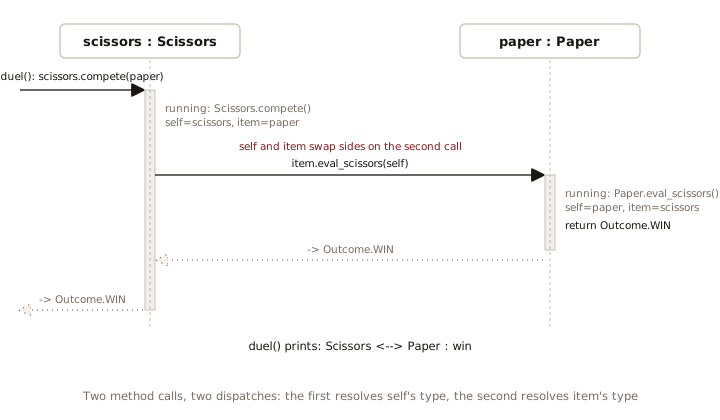
Follow one duel to keep the perspective straight.
scissors.compete(paper) resolves self
to Scissors, the first dispatch, and calls
paper.eval_scissors(...). That call is the second
dispatch: it resolves paper, landing in
Paper.eval_scissors(), the one method that knows
both types. Now note whose result it returns.
Paper.eval_scissors() returns WIN, and
that is the outcome for the scissors that started the
duel, not for the Paper whose code is running:
scissors cut paper. Every eval_*() method answers
for the original caller, the object named in the method’s own
name. Misread that convention and every result in the class
appears backward.
Each type of Item encodes the information about
the various combinations. This is a kind of table, spread across
the classes. It is not easy to maintain if you expect to modify
the behavior or to add a new Item class. It can be
more sensible to make the table explicit, like this:
# paper_scissors_rock_table.py
import random
from typing import Any, Final
from arena import duel, item_pair_gen
from outcome import Outcome

class Item:
    def compete(self, item: Any) -> Outcome:
        # Use a tuple of types to index into the table:
        return OUTCOME[self.__class__, item.__class__]
    def __str__(self) -> str:
        return self.__class__.__name__

class Paper(Item):
    pass
class Scissors(Item):
    pass
class Rock(Item):
    pass

OUTCOME: Final[dict[tuple[type, type], Outcome]] = {
  (Paper, Rock): Outcome.WIN,
  (Paper, Scissors): Outcome.LOSE,
  (Paper, Paper): Outcome.DRAW,
  (Scissors, Paper): Outcome.WIN,
  (Scissors, Rock): Outcome.LOSE,
  (Scissors, Scissors): Outcome.DRAW,
  (Rock, Scissors): Outcome.WIN,
  (Rock, Paper): Outcome.LOSE,
  (Rock, Rock): Outcome.DRAW,
}

if __name__ == "__main__":
    random.seed(47)  # Reproducible pairs
    for item1, item2 in item_pair_gen(Item, 10):
        duel(item1, item2)
#: Scissors <--> Paper : win
#: Scissors <--> Rock : lose
#: Scissors <--> Rock : lose
#: Scissors <--> Scissors : draw
#: Rock <--> Scissors : win
#: Scissors <--> Rock : lose
#: Paper <--> Scissors : lose
#: Rock <--> Paper : lose
#: Paper <--> Paper : draw
#: Scissors <--> Scissors : draw
Notice the flexibility of dictionaries. A tuple serves as a
key just as easily as a single object. Two properties of the
lookup carry over from the table-driven state
machine. The match is on classes exactly, so a
subclass of Paper finds none of
Paper’s rows. And a missing pair raises
KeyError at the first duel that needs it, the
fail-fast policy that suits a table under construction, which is
exactly what you want while adding Lizard in
exercise 1.
One Type or Many
Python dispatches on a single type at a time. For dispatch on
one argument’s type, functools.singledispatch (see
Visitor)
gives you open, per-type functions. For dispatch on two or more
types at once, the table above is the idiomatic answer: a
dict keyed by a tuple of types. Adding a new
Item is then a matter of adding rows to the table,
with no methods to edit across the classes.
The version most programmers write first is neither of these:
it is an isinstance() ladder inside
compete(), testing the opponent’s type case by
case. It works, and it is the worst of both worlds, type tests
scattered through every class like the method version, with none
of dispatch’s automatic resolution, and every new
Item forces an edit to every ladder. Both patterns
in this chapter exist to avoid writing it.
The double-dispatch version, where each class implements
eval_paper(), eval_scissors(), and
eval_rock(), is a workaround for languages that
cannot store types in a table and look a behavior up by them.
Python can, so the table is both shorter and easier to maintain.
Use the spread-out method version only when a combination needs
substantial, type-specific code that will not fit in a table
cell.
Python’s own operators already contain a two-step dispatch,
and it answers the Number + Number question that
opened this chapter. a + b first tries
type(a).__add__(a, b). If that returns the special
value NotImplemented, Python turns around and tries
type(b).__radd__(b, a), the reflected form
of __add__(). The first call dispatches on
a’s type, the fallback on b’s: double
dispatching, built into the language. Every binary operator has
a reflected form, named by inserting an r before
the operator’s name: __rsub__(),
__rmul__(), __rtruediv__(). This is
how an int on the left can learn to add itself to a
type written decades after int was. Returning
NotImplemented (a sentinel value, not the
NotImplementedError exception, a lookalike pair
worth keeping apart) is how an operand says “I don’t know this
type; ask the other object.” Here is the machinery, with each
dispatch traced:
# radd_dispatch.py
from typing import Any

class Meters:
    def __init__(self, n: float) -> None:
        self.n = n

    def __repr__(self) -> str:
        return f"Meters({self.n})"

    def __add__(self, other: object) -> Any:
        print(f"__add__({self!r}, {other!r})")
        if isinstance(other, Meters):
            return Meters(self.n + other.n)
        if isinstance(other, int | float):
            return Meters(self.n + other)
        return NotImplemented

    def __radd__(self, other: object) -> Any:
        print(f"__radd__({self!r}, {other!r})")
        if isinstance(other, int | float):
            return Meters(other + self.n)
        return NotImplemented

print(Meters(3) + Meters(4))
#: __add__(Meters(3), Meters(4))
#: Meters(7)
print(Meters(3) + 4)  # The left operand handles it
#: __add__(Meters(3), 4)
#: Meters(7)
print(4 + Meters(3))  # Int declines; the right operand handles it
#: __radd__(Meters(3), 4)
#: Meters(7)
try:
    Meters(3) + "four"  # Both sides decline
except TypeError as e:
    print(type(e).__name__)
#: __add__(Meters(3), 'four')
#: TypeError
The first two additions resolve inside
__add__(): the left operand recognized the type.
The third is the interesting one. 4 + Meters(3)
asks int.__add__ first, and int has
never heard of Meters, so it returns
NotImplemented. Python then, with no error
anywhere, turns to Meters.__radd__, whose trace
line shows the operands arriving swapped. The last case shows
what the sentinel is for. Meters.__add__ runs,
declines the string, str has no
__radd__ to consult, and only after both sides have
declined does Python raise TypeError. Declining is
not failing; the error appears only when nobody volunteers.
The win/lose/draw result is pure logic, which makes it easy
to validate through testing. The spread-out method version and
the table version must return the same Outcome for
every one of the nine combinations. If they diverge, one of them
has a bug.
# test_paper_scissors.py
from types import ModuleType
from typing import Final
import paper_scissors_rock as methods
import paper_scissors_rock_table as table
import pytest
from outcome import Outcome

# (player, opponent): the player's result
EXPECTED: Final[dict[tuple[str, str], Outcome]] = {
    ("Paper", "Rock"): Outcome.WIN,
    ("Paper", "Scissors"): Outcome.LOSE,
    ("Paper", "Paper"): Outcome.DRAW,
    ("Scissors", "Paper"): Outcome.WIN,
    ("Scissors", "Rock"): Outcome.LOSE,
    ("Scissors", "Scissors"): Outcome.DRAW,
    ("Rock", "Scissors"): Outcome.WIN,
    ("Rock", "Paper"): Outcome.LOSE,
    ("Rock", "Rock"): Outcome.DRAW,
}

def compete(module: ModuleType, player: str,
            opponent: str) -> Outcome:
    result: Outcome = getattr(module, player)().compete(
        getattr(module, opponent)())
    assert isinstance(result, Outcome)
    return result

@pytest.mark.parametrize("module", [table, methods])
def test_matches_expected(module: ModuleType) -> None:
    for (player, opponent), result in EXPECTED.items():
        assert compete(module, player, opponent) == result

def test_both_versions_agree() -> None:
    for player, opponent in EXPECTED:
        assert (compete(methods, player, opponent)
                == compete(table, player, opponent))

@pytest.mark.parametrize("outcome, expected", [
    (Outcome.WIN, "win"),
    (Outcome.LOSE, "lose"),
    (Outcome.DRAW, "draw"),
])
def test_outcome_str(outcome: Outcome, expected: str) -> None:
    assert str(outcome) == expected
Importing both modules works cleanly because each guards its
demonstration loop with if __name__ == "__main__",
so the loop runs only when you execute the file directly, not
when a test imports it.
Exercises
- Add a fourth
Item,Lizard, topaper_scissors_rock_table.py. Lizard beats Paper and Scissors, and loses to Rock. Lizard versus Lizard is a draw. Add the seven new entries thatOUTCOMEneeds: both orders of each mixed pair, plus Lizard versus Lizard. - Add the same
Lizardtopaper_scissors_rock.py, the double-dispatch version, which means adding aneval_lizard()method to every existing class, plus aLizardclass with its owncompete()and foureval_*()methods. Compare how much code this took versus addingLizardto the table version. - In
test_paper_scissors.py, addLizardtoEXPECTEDwith its nine (now sixteen) matchups, and confirm both versions still agree with each other and withEXPECTED. - In
arena.py, giveitem_pair_gen()an optionalcounts: Counter[str] | None = Noneparameter that it updates in place with a tally of every item type it chooses, while still yielding(item1, item2)pairs so existing calls need no change. Pass in your ownCounterand print how many timesLizardappeared acrossitem_pair_gen(Item, 100, counts).