Composite and Interpreter
The Composite pattern arranges objects in a tree, so
you can treat a single object and a group of objects uniformly.
The Interpreter pattern represents sentences in a small
language as trees, then evaluates them. GoF Design
Patterns presents them as separate patterns, but the second
is the first with meaning attached. In Python both reduce to one
technique: a union of frozen data classes for the nodes, and
recursive functions that match on them. This
chapter builds each pattern with exhaustive
matching.
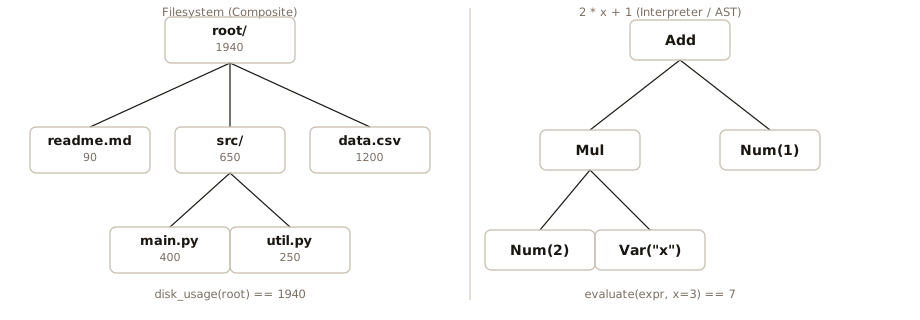
The Classic Composite
A file system is the canonical composite. A directory holds entries, and each entry is a file or another directory. The payoff is uniformity.
The traditional version puts the operation in a class hierarchy:
# filesystem_classic.py
from abc import ABC, abstractmethod
from typing import override

class Node(ABC):
    def __init__(self, name: str) -> None:
        self.name = name

    @abstractmethod
    def size(self) -> int: ...

class File(Node):
    def __init__(self, name: str, byte_count: int) -> None:
        super().__init__(name)
        self.byte_count = byte_count

    @override
    def size(self) -> int:
        return self.byte_count

class Directory(Node):
    def __init__(self, name: str, *entries: Node) -> None:
        super().__init__(name)
        self.entries = entries

    @override
    def size(self) -> int:
        return sum(e.size() for e in self.entries)

src = Directory(
    "src", File("main.py", 400), File("util.py", 250))
root = Directory(
    "root", File("readme.md", 90), src, File("data.csv", 1200))
print(root.size(), src.size(), File("lone.txt", 10).size())
#: 1940 650 10
Directory.size() calls size() on
each entry without knowing whether the entry is a
File or another Directory. The same
call works on the whole tree, on a subtree, and on a single
file.
Adding operations exposes the weakness. Counting files, finding an entry by name, and printing the tree each require a new method in every class. Visitor exists to solve this problem.
A Composite of Data Classes
In Python, you can define the node types as frozen data classes. Name the closed set of alternatives with a union. Write each operation as a recursive function that matches on the union:
# filesystem.py
from collections.abc import Iterator
from dataclasses import dataclass
from typing import assert_never

@dataclass(frozen=True)
class File:
    name: str
    size: int

@dataclass(frozen=True)
class Directory:
    name: str
    entries: tuple[Node, ...]

type Node = File | Directory

def disk_usage(entry: Node) -> int:
    match entry:
        case File(_, size):
            return size
        case Directory(_, entries):
            return sum(disk_usage(e) for e in entries)
        case _:
            assert_never(entry)

def walk(entry: Node, prefix: str = "") -> Iterator[str]:
    match entry:
        case File(name, _):
            yield prefix + name
        case Directory(name, entries):
            for e in entries:
                yield from walk(e, f"{prefix}{name}/")
        case _:
            assert_never(entry)

if __name__ == "__main__":
    src = Directory("src", (
        File("main.py", 400), File("util.py", 250)))
    root = Directory("root", (
        File("readme.md", 90), src, File("data.csv", 1200)))
    print(disk_usage(root), disk_usage(src),
          disk_usage(File("lone.txt", 10)))
    for path in walk(root):
        print(path)
#: 1940 650 10
#: root/readme.md
#: root/src/main.py
#: root/src/util.py
#: root/data.csv
disk_usage() accepts a lone File, a
subtree, or the whole tree. What changed is where operations
live. disk_usage() and walk() are
ordinary functions outside the node classes, so a new operation
is a new function, and the nodes never change. This is the same
trade explored in Rethinking
Objects: a closed set of types, with operations gathered in
one place each. The assert_never() in each
case _ makes that closed set pay off. Add a
Symlink class to the Node union. Every
function whose case _ calls
assert_never() now fails type checking, because
entry could be a Symlink that no case
handles. The checker flags each function that still needs a new
case, so none can be forgotten.
walk() is a generator, so a composite is also
iterable. The yield from flattens the recursion
into a single stream of paths, and any consumer of that stream
stays decoupled from the tree structure (see Iterators).
The entries field is a tuple of
Node, so the whole tree is immutable. The demo
builds src first, then places it inside
root. Nothing can modify src
afterward, so sharing subtrees is safe (see Foundations).
# test_filesystem.py
from typing import Final
import pytest
from filesystem import Directory, File, Node, disk_usage, walk

SUB: Final[Directory] = Directory(
    "sub", (File("b", 2), File("c", 3)))
TREE: Final[Directory] = Directory(
    "top", (File("a", 1), SUB))

@pytest.mark.parametrize("entry, expected", [
    (TREE, 6),
    (SUB, 5),
    (File("solo", 7), 7),
])
def test_disk_usage_is_uniform(entry: Node, expected: int) -> None:
    assert disk_usage(entry) == expected

def test_walk_yields_full_paths() -> None:
    assert list(walk(TREE)) == [
        "top/a", "top/sub/b", "top/sub/c"]

def test_empty_directory() -> None:
    assert disk_usage(Directory("empty", ())) == 0
    assert list(walk(Directory("empty", ()))) == []
The classic version is still useful when the set of node
types is open. If plugins or other packages must add new kinds
of entries, a method on a base class lets them do that without
touching your code, while a central match would
need editing. The guidance from Pattern
Matching applies directly. Match over a closed set, use
polymorphism for an open one.
Interpreter
A tree whose shape follows a grammar is an abstract syntax tree (AST). Interpreter is Composite applied to language. Represent each construct as a node type, and evaluation becomes a tree walk.
In most languages the pattern has a reputation for heaviness, because you must write a class per construct and a parser to build the trees. Python removes both costs. Data classes make the node declarations nearly free, and operator overloading lets Python’s own parser build the trees. Here is the complete grammar for a small arithmetic language:
# expr.py
from dataclasses import dataclass

class Operators:
    def __add__(self: Expr, other: Expr | int) -> Add:
        return Add(self, wrap(other))

    def __radd__(self: Expr, other: int) -> Add:
        return Add(Num(other), self)

    def __mul__(self: Expr, other: Expr | int) -> Mul:
        return Mul(self, wrap(other))

    def __rmul__(self: Expr, other: int) -> Mul:
        return Mul(Num(other), self)

@dataclass(frozen=True)
class Num(Operators):
    value: int

@dataclass(frozen=True)
class Var(Operators):
    name: str

@dataclass(frozen=True)
class Add(Operators):
    left: Expr
    right: Expr

@dataclass(frozen=True)
class Mul(Operators):
    left: Expr
    right: Expr

type Expr = Num | Var | Add | Mul

def wrap(value: Expr | int) -> Expr:
    return Num(value) if isinstance(value, int) else value
The four node classes are the grammar. An expression is a
number, a variable, a sum, or a product. Add and
Mul hold expressions themselves, which is what
makes it a composite.
The Operators base class is the clever part.
Every node inherits __add__() and
__mul__(), and those methods do not compute
anything. They build nodes. Writing x + 1 on two
Expr values produces an Add, so
ordinary Python arithmetic notation constructs the AST. The
reflected forms __radd__() and
__rmul__() handle an integer on the left, and
wrap() promotes integers to Num nodes,
so 2 * x + 1 is a valid sentence in the little
language. Python has already parsed it, honoring precedence,
before the interpreter ever runs.
The reflected methods ride the operator dispatch from Multiple
Dispatching: 2 * x works because
int.__mul__ returns NotImplemented and
Python turns to x.__rmul__(2). Unlike that
chapter’s Meters, though, these reflected methods
trust their operand completely. The type checker rejects
"a" + x in source it can see, but at runtime
nothing checks: str.__add__ declines,
Var.__radd__ runs, and
Add(Num("a"), x) is built without complaint, an
ill-typed tree instead of an error. Exercise 6 closes the hole
with the declining-NotImplemented idiom.
This technique is used in SymPy expressions, Pandas and Polars column arithmetic, and SQLAlchemy filter conditions. Overloaded operators build an expression tree, and a library interprets that tree later, symbolically, over a whole column, or as SQL.
Evaluation Is a Tree Walk
Evaluation is a recursive match function.
Variables need values, supplied here as keyword arguments:
# evaluate.py
from typing import assert_never
from expr import Add, Expr, Mul, Num, Var

def evaluate(e: Expr, **env: int) -> int:
    match e:
        case Num(value):
            return value
        case Var(name):
            return env[name]
        case Add(left, right):
            return evaluate(left, **env) + evaluate(right, **env)
        case Mul(left, right):
            return evaluate(left, **env) * evaluate(right, **env)
        case _:
            assert_never(e)

if __name__ == "__main__":
    x = Var("x")
    expr = 2 * x + 1
    by_hand = Add(Mul(Num(2), x), Num(1))
    print(expr == by_hand)
    print(evaluate(expr, x=3), evaluate(expr, x=10))
#: True
#: 7 21
Data classes generate __eq__(), so two trees
compare by value, and the demo confirms that the operators build
the tree you would assemble by hand. The second
print() line evaluates that same expr
twice, once with x=3 and once with
x=10. Building 2 * x + 1 did not
compute a number. It built a tree, so expr is a
value you can hand to evaluate() under different
variable bindings, as many times as you like. An unbound
variable raises KeyError, naming the variable.
# test_evaluate.py
import pytest
from evaluate import evaluate
from expr import Add, Mul, Num, Var

def test_literal_and_variable() -> None:
    assert evaluate(Num(42)) == 42
    assert evaluate(Var("x"), x=3) == 3

def test_operators_build_the_tree() -> None:
    x = Var("x")
    assert 2 * x + 1 == Add(Mul(Num(2), x), Num(1))
    assert 1 + x == Add(Num(1), x)
    assert x * x == Mul(x, x)

def test_one_tree_many_environments() -> None:
    area = Var("w") * Var("h")
    assert evaluate(area, w=2, h=3) == 6
    assert evaluate(area, w=10, h=10) == 100

def test_unbound_variable_raises() -> None:
    with pytest.raises(KeyError):
        evaluate(Var("y"), x=1)
New Operations, Same Tree
Evaluation has no privileged status. Rendering the tree as an infix string is another function, in another file, and the node classes never hear about it:
# infix.py
from typing import assert_never
from expr import Add, Expr, Mul, Num, Var

def to_infix(e: Expr) -> str:
    match e:
        case Num(value):
            return str(value)
        case Var(name):
            return name
        case Add(left, right):
            return f"({to_infix(left)} + {to_infix(right)})"
        case Mul(left, right):
            return f"({to_infix(left)} * {to_infix(right)})"
        case _:
            assert_never(e)

if __name__ == "__main__":
    x = Var("x")
    print(to_infix(2 * x + 1))
    print(to_infix((x + 1) * (x + 2)))
#: ((2 * x) + 1)
#: ((x + 1) * (x + 2))
This is the ability Visitor
fights to provide: new operations over a fixed hierarchy,
defined outside it. The match version needs no
accept() hook and no visitor classes, and unlike
singledispatch it looks inside the nodes, binding
their fields in the patterns.
Simplification Rewrites the Tree
An interpreter need not produce a number or a string. It can
produce another tree. simplify() applies algebraic
identities. Adding zero and multiplying by one vanish,
multiplying by zero collapses, and constant subtrees fold into a
single Num. Each rule is a nested pattern over a
pair of already-simplified children:
# simplify.py
from typing import assert_never
from expr import Add, Expr, Mul, Num, Var

def simplify(e: Expr) -> Expr:
    match e:
        case Num(_) | Var(_):
            return e
        case Add(left, right):
            lhs, rhs = simplify(left), simplify(right)
            match (lhs, rhs):
                case (Num(0), other) | (other, Num(0)):
                    return other
                case (Num(a), Num(b)):
                    return Num(a + b)
                case _:
                    return Add(lhs, rhs)
        case Mul(left, right):
            lhs, rhs = simplify(left), simplify(right)
            match (lhs, rhs):
                case (Num(0), _) | (_, Num(0)):
                    return Num(0)
                case (Num(1), other) | (other, Num(1)):
                    return other
                case (Num(a), Num(b)):
                    return Num(a * b)
                case _:
                    return Mul(lhs, rhs)
        case _:
            assert_never(e)

if __name__ == "__main__":
    from infix import to_infix
    x = Var("x")
    messy = 1 * x + 0 * Var("y") + (Num(2) + 3) * x
    print(to_infix(messy))
    print(to_infix(simplify(messy)))
#: (((1 * x) + (0 * y)) + ((2 + 3) * x))
#: (x + (5 * x))
The patterns read like the algebra they implement.
(Num(0), other) | (other, Num(0)) says “zero on
either side, keep the other side,” with the alternatives binding
the same name. (Num(a), Num(b)) captures two
constants for folding. Because every node is frozen,
simplify() never edits the input. It returns a new
tree that shares unchanged subtrees with the original.
# test_simplify.py
from typing import Final
import pytest
from expr import Add, Expr, Mul, Num, Var
from simplify import simplify

X: Final[Var] = Var("x")

@pytest.mark.parametrize("expr, expected", [
    (X + 0, X),
    (0 + X, X),
    (1 * X, X),
    (X * 1, X),
])
def test_identity_elements_vanish(
    expr: Expr, expected: Expr,
) -> None:
    assert simplify(expr) == expected

def test_zero_absorbs_multiplication() -> None:
    assert simplify(Var("x") * 0) == Num(0)
    assert simplify(0 * Var("x")) == Num(0)

def test_constant_folding() -> None:
    assert simplify(Num(2) + 3) == Num(5)
    assert simplify(Num(2) * 3 + 4) == Num(10)

def test_rewriting_reaches_every_level() -> None:
    x = Var("x")
    assert simplify((x + 0) * (1 * x)) == Mul(x, x)

def test_already_simple_is_unchanged() -> None:
    x = Var("x")
    assert simplify(2 * x + 1) == Add(Mul(Num(2), x), Num(1))
The full shape of the two patterns is now visible. Composite
is the data: a union of node types, some holding others.
Interpreter is the behavior: recursive functions that give the
tree meaning. Python compresses the pair into frozen data
classes, a union, operator methods that build nodes, and
match functions that walk them. One practical limit
rides along: every function here recurses once per level of
tree, and Python’s recursion limit (roughly a thousand frames)
caps how deep a tree they can walk. Realistic expressions never
approach it. A machine-generated chain of thousands of nested
nodes does, and the escape is an iterative walk driving an
explicit stack of pending nodes.
Exercises
- Add
find(entry, name)tofilesystem.py: a generator yielding the path of every entry whose name matches. A directory can match, and matching should continue into it. - Add a
Symlinknode to theNodeunion infilesystem.py, holding a name and a target path, and let the type checker show you every operation that must change. Decide whatdisk_usage()andwalk()should do with a link. - Add
Neg(negation) andDiv(division) nodes toexpr.py, along with__neg__()and__truediv__()operator methods. Updateevaluate(),to_infix(), andsimplify(). What shouldsimplify()do with division byNum(0)? to_infix()parenthesizes every operation. Rewrite it to emit only the parentheses that precedence requires, so2 * x + 1renders as2 * x + 1but(x + 1) * (x + 2)keeps its parentheses.- Write
derivative(e, name): a function that returns the symbolic derivative of an expression with respect to a variable, using the sum rule and the product rule. Run its results throughsimplify()and compare. - At runtime,
"a" + xsilently buildsAdd(Num("a"), x), an ill-typed tree the checker would have rejected in source it can see. Rewrite__radd__()and__rmul__()to returnNotImplementedfor a non-intoperand (Multiple Dispatching shows the idiom), and confirm"a" + xnow raisesTypeError.