Surrogate
Both Proxy and State provide a surrogate class that you use in your code. This surrogate class hides the real class that does the work. When you call a method in the surrogate, it turns around and calls the method in the implementing class. These two patterns are so similar that the Proxy is a special case of State.
The basic idea is simple. From a base class, you derive the surrogate along with the class or classes that provide the actual implementation:
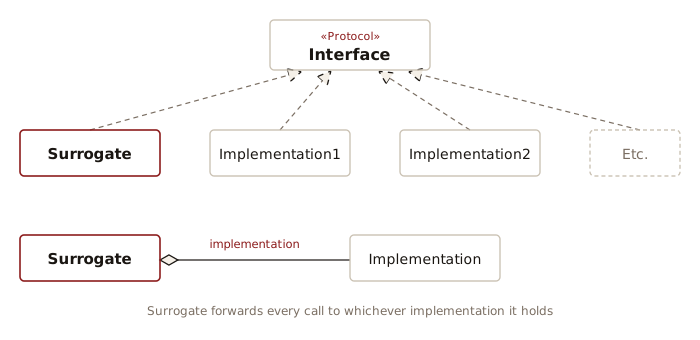
A surrogate object acquires an implementation, either constructing one or receiving one. The surrogate forwards all method calls to that implementation.
Structurally, the difference between Proxy and State is simple. A Proxy has only one implementation, while State has more than one. GoF Design Patterns considers the applications of the two patterns distinct. Proxy is used to control access to its implementation, while State allows you to change the implementation dynamically. However, if you expand your notion of “controlling access to implementation,” the two fit neatly together.
Proxy
If we implement Proxy by following the above diagram, it looks like this:
# proxy_1.py

class Implementation:
    def f(self) -> None:
        print("Implementation.f()")
    def g(self) -> None:
        print("Implementation.g()")
    def h(self) -> None:
        print("Implementation.h()")

class Proxy:
    def __init__(self) -> None:
        self.__implementation = Implementation()
    # Pass method calls to the implementation:
    def f(self) -> None: self.__implementation.f()
    def g(self) -> None: self.__implementation.g()
    def h(self) -> None: self.__implementation.h()

p = Proxy()
p.f()
#: Implementation.f()
p.g()
#: Implementation.g()
p.h()
#: Implementation.h()
It isn’t necessary that Implementation have the
same interface as Proxy. As long as
Proxy is somehow “speaking for” the class it
forwards method calls to, it satisfies the basic idea (this
statement is at odds with the definition for Proxy in GoF
Design Patterns). However, it is convenient to have a
common interface that forces Implementation to
fulfill all the methods that Proxy needs to call.
An abstract base class is one way to express that interface.
Each method the Proxy delegates to is an
@abstractmethod, so you cannot instantiate an
implementation that omits one:
# proxy_interface.py
from abc import ABC, abstractmethod
from typing import override

class Service(ABC):
    @abstractmethod
    def f(self) -> None: ...
    @abstractmethod
    def g(self) -> None: ...

class Complete(Service):
    @override
    def f(self) -> None: print("Complete.f()")
    @override
    def g(self) -> None: print("Complete.g()")

class Partial(Service):  # Missing g()
    @override
    def f(self) -> None: print("Partial.f()")

Complete().f()
#: Complete.f()
try:
    Partial()
except TypeError as e:
    print(type(e).__name__)
#: TypeError
Complete implements both methods and works.
Partial omits g(), so constructing it
raises TypeError at once, instead of failing later
when the Proxy tries to delegate a call it
cannot.
A Protocol
is the structural alternative. The implementation needs no base
class. The type checker verifies conformance by shape
statically, and, with @runtime_checkable,
isinstance() does so at runtime:
# proxy_protocol.py
from typing import Protocol, runtime_checkable

@runtime_checkable  # Allows isinstance() against a Protocol
class Service(Protocol):
    def f(self) -> None: ...
    def g(self) -> None: ...

class Complete:  # Conforms without inheriting Service
    def f(self) -> None: print("Complete.f()")
    def g(self) -> None: print("Complete.g()")

class Partial:  # Missing g()
    def f(self) -> None: print("Partial.f()")

print(isinstance(Complete(), Service))
#: True
print(isinstance(Partial(), Service))
#: False
The abstract base class forces completeness at construction,
through inheritance. A Protocol instead reports the
mismatch where code uses an object as a Service,
and needs no common base. One caveat: isinstance()
against a @runtime_checkable Protocol checks only
that the methods exist, not that their signatures match. The
static checker verifies signatures.
Python has a built-in delegation mechanism,
__getattr__(), that makes Proxy even
simpler to implement:
# proxy_2.py
from typing import Any

class Implementation2:
    def f(self) -> None:
        print("Implementation.f()")
    def g(self) -> None:
        print("Implementation.g()")
    def h(self) -> None:
        print("Implementation.h()")

class Proxy2:
    def __init__(self) -> None:
        self.__implementation = Implementation2()
    def __getattr__(self, name: str) -> Any:
        return getattr(self.__implementation, name)

p = Proxy2()
p.f()
#: Implementation.f()
p.g()
#: Implementation.g()
p.h()
#: Implementation.h()
The beauty of using __getattr__() is that
Proxy2 is completely generic, and not tied to any
particular implementation.
One limit: special methods bypass __getattr__().
Python looks up dunders like __len__() and
__str__() on the proxy’s type, not on the
instance, so len(p) and print(p) do
not delegate, even though an explicit p.__len__()
would:
# dunder_bypass.py
from typing import Any

class Words:
    def __init__(self) -> None:
        self.items = ["spam", "eggs"]

    def __len__(self) -> int:
        return len(self.items)

class Proxy:
    def __init__(self) -> None:
        self.__implementation = Words()

    def __getattr__(self, name: str) -> Any:
        return getattr(self.__implementation, name)

p = Proxy()
print(p.__len__())  # The explicit call delegates
#: 2
try:
    # Special-method lookup skips the instance:
    len(p)  # type: ignore
except TypeError as e:
    print(type(e).__name__)
#: TypeError
The two calls look interchangeable and are not.
p.__len__() is ordinary attribute access, so the
failed instance lookup falls through to
__getattr__(), which delegates. len(p)
asks type(p) for __len__() directly,
finds none, and reports that Proxy has no length.
The type checker agrees, rejecting len(p)
statically for the same reason, which is why the listing needs
the # type: ignore to show the runtime failure. A
proxy that must forward special methods defines them
explicitly.
Identity has the same seam. isinstance(p, Words)
is False; delegation forwards the methods, not the
type. But an isinstance() check against a
@runtime_checkable Protocol passes,
because its probe for each method is ordinary attribute access,
which __getattr__() answers like any other lookup.
Code that checks surrogates structurally keeps working; code
that demands the implementation’s class does not. One more
reason structural typing suits this pattern.
State
The State pattern adds more implementations to Proxy, along with a way to switch from one implementation to another during the lifetime of the surrogate:
# state.py
from typing import Any

class Surrogate:
    def __init__(self, implementation: Any) -> None:
        self.__implementation = implementation
    def change_to(self, new_implementation: Any) -> None:
        self.__implementation = new_implementation
    # Delegate calls to the implementation:
    def __getattr__(self, name: str) -> Any:
        return getattr(self.__implementation, name)

class Implementation1:
    def f(self) -> None:
        print("Fiddle de dum, Fiddle de dee,")
    def g(self) -> None:
        print("Eric the half a bee.")
    def h(self) -> None:
        print("Ho ho ho, tee hee hee,")

class Implementation2:
    def f(self) -> None:
        print("We're Knights of the Round Table.")
    def g(self) -> None:
        print("We dance whene'er we're able.")
    def h(self) -> None:
        print("We do routines and chorus scenes")

def run(b: Any) -> None:
    b.f()
    b.g()
    b.h()
    b.g()

b = Surrogate(Implementation1())
run(b)
#: Fiddle de dum, Fiddle de dee,
#: Eric the half a bee.
#: Ho ho ho, tee hee hee,
#: Eric the half a bee.
b.change_to(Implementation2())
run(b)
#: We're Knights of the Round Table.
#: We dance whene'er we're able.
#: We do routines and chorus scenes
#: We dance whene'er we're able.
The demo uses the first implementation for a while, then swaps in the second and uses that.
Testing hands the State surrogate a small stand-in and
confirms calls reach the current implementation, and that
change_to() swaps it:
# test_state.py
from state import Surrogate

class StateA:
    def name(self) -> str:
        return "A"

class StateB:
    def name(self) -> str:
        return "B"

def test_state_delegates_and_change_swaps() -> None:
    s = Surrogate(StateA())
    assert s.name() == "A"
    s.change_to(StateB())
    assert s.name() == "B"
The difference between Proxy and State is in the problems that are solved. The common uses for Proxy as described in GoF Design Patterns are:
- Remote proxy. This proxies for an object in a different address space. Distributed-object systems generate these for you. In Python, remote procedure call (RPC) libraries play this role.
- Virtual proxy. This provides “lazy initialization” to create expensive objects on demand.
- Protection proxy. Used when you don’t want the client programmer to have full access to the proxied object.
- Smart reference. To add actions when code accesses the proxied object. For example, to keep track of the number of references that are held for a particular object, to implement the copy-on-write idiom and prevent object aliasing. A simpler example is keeping track of the number of calls to a particular method.
A Smart reference proxy adds behavior around each
access. With __getattr__() you can wrap every
method call, for example to count them:
# counting_proxy.py
from typing import Any

class Implementation:
    def f(self) -> None: print("f()")
    def g(self) -> None: print("g()")

class CountingProxy:
    def __init__(self, impl: Any) -> None:
        self._impl = impl
        self.calls = 0

    def __getattr__(self, name: str) -> Any:
        attr = getattr(self._impl, name)
        if callable(attr):
            def counted(*args: Any, **kwargs: Any) -> Any:
                self.calls += 1
                return attr(*args, **kwargs)
            return counted
        return attr

p = CountingProxy(Implementation())
p.f()
#: f()
p.g()
#: g()
p.f()
#: f()
print("calls:", p.calls)
#: calls: 3
Because __getattr__() intercepts only the
lookups not found directly on the proxy, one generic proxy can
add lazy initialization (a virtual proxy), access
checks (a protection proxy), or call tracking (a
smart reference) to any object, with no per-method
code.
Do not confuse __getattr__() with its lookalike,
__getattribute__(). The one used here is the
fallback hook: Python calls it only after normal lookup
fails, which is why self._impl and
self.calls inside it resolve normally.
__getattribute__() intercepts every
attribute access, including each self. access in
its own body, so the naive version calls itself forever. Writing
one means routing every internal access through
object.__getattribute__(self, "_impl"), machinery a
surrogate almost never needs. The fallback hook has a related
trap of its own: if __getattr__()’s body touches a
proxy attribute that does not exist, a misspelled
self._imp, or any attribute on an instance built
without __init__(), that failed lookup calls
__getattr__() again, and the error surfaces as
RecursionError, not the AttributeError
that would point at the typo.
GoF Design Patterns gives Proxy and
State different structures and so treats them as
unrelated. But both are really a Surrogate: a front
object that passes method calls through to an implementation.
Proxy fronts for one implementation to control access
to it. State swaps among several to change behavior
over time. In Python both are the same few lines of
__getattr__() delegation, with State
adding a method to change the implementation. You need the
separate implementation hierarchy that GoF Design
Patterns uses only when you do not control the implementing
code. When you do, the single generic surrogate above is simpler
and just as flexible.
Testing hands the counting proxy a small stand-in and confirms the proxy forwards the call with its result, and counts only callable accesses:
# test_counting_proxy.py
from counting_proxy import CountingProxy

class Doubler:
    def double(self, n: int) -> int:
        return n * 2

def test_proxy_forwards_call_and_result() -> None:
    p = CountingProxy(Doubler())
    assert p.double(5) == 10
    assert p.double(3) == 6

def test_proxy_counts_only_calls() -> None:
    class HasValue:
        answer = 42

    p = CountingProxy(HasValue())
    assert p.answer == 42  # Non-callable attribute passes through
    p2 = CountingProxy(Doubler())
    p2.double(1)
    p2.double(1)
    assert p.calls == 0
    assert p2.calls == 2
Exercises
- Create an example of the “virtual proxy.”
- Change
CountingProxyincounting_proxy.pyto keep a per-method tally in acollections.Counterinstead of a single total. Confirm the tally reportsfcalled twice andgcalled once. - Create a simple copy-on-write implementation.
- In
counting_proxy.py, misspellself._implasself._impinside__getattr__()and run it. Explain why the failure reports asRecursionErrorrather than anAttributeErrornaming the typo, using the fallback-hook behavior described in this chapter. - Create a program similar to certain DBMS systems that allow only a fixed number of connections at any time. Implement this with a singleton-like system (Singleton) that controls the number of “connection” objects it creates. When a user finishes with a connection, the system must check that connection back in for reuse. To guarantee this, hand out a proxy instead of a reference to the actual connection, and design the proxy to release the connection back to the system.