Fronting for an Implementation
Both Proxy and State provide a surrogate class that you use in your code; the real class that does the work is hidden behind this surrogate class. When you call a method in the surrogate, it simply turns around and calls the method in the implementing class. These two patterns are so similar that the Proxy is simply a special case of State.
The basic idea is simple: from a base class, the surrogate is derived along with the class or classes that provide the actual implementation:
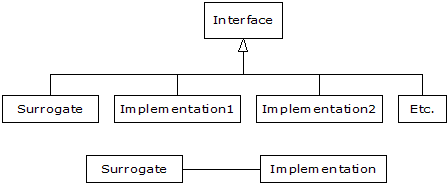
When a surrogate object is created, it is given an implementation to which to send all of the method calls.
Structurally, the difference between Proxy and State is simple: a Proxy has only one implementation, while State has more than one. The application of the patterns is considered (in Design Patterns) to be distinct: Proxy is used to control access to its implementation, while State allows you to change the implementation dynamically. However, if you expand your notion of “controlling access to implementation” then the two fit neatly together.
Proxy
If we implement Proxy by following the above diagram, it looks like this:
# proxy_demo.py
# Simple demonstration of the Proxy pattern.

class Implementation:
    def f(self) -> None:
        print("Implementation.f()")
    def g(self) -> None:
        print("Implementation.g()")
    def h(self) -> None:
        print("Implementation.h()")

class Proxy:
    def __init__(self) -> None:
        self.__implementation = Implementation()
    # Pass method calls to the implementation:
    def f(self) -> None: self.__implementation.f()
    def g(self) -> None: self.__implementation.g()
    def h(self) -> None: self.__implementation.h()

p = Proxy()
p.f()
p.g()
p.h()
It isn’t necessary that Implementation have the same
interface as Proxy; as long as Proxy is
somehow “speaking for” the class that it is referring method calls
to then the basic idea is satisfied (note that this statement is at
odds with the definition for Proxy in GoF). However, it is
convenient to have a common interface so that
Implementation is forced to fulfill all the methods
that Proxy needs to call.
Python has a built-in delegation mechanism that makes
Proxy even simpler to implement:
# proxy_demo2.py
# Simple demonstration of the Proxy pattern.
from typing import Any


class Implementation2:
    def f(self) -> None:
        print("Implementation.f()")
    def g(self) -> None:
        print("Implementation.g()")
    def h(self) -> None:
        print("Implementation.h()")

class Proxy2:
    def __init__(self) -> None:
        self.__implementation = Implementation2()
    def __getattr__(self, name: str) -> Any:
        return getattr(self.__implementation, name)

p = Proxy2()
p.f()
p.g()
p.h()
The beauty of using __getattr__() is that
Proxy2 is completely generic, and not tied to any
particular implementation.
State
The State pattern adds more implementations to Proxy, along with a way to switch from one implementation to another during the lifetime of the surrogate:
# state_demo.py
# Simple demonstration of the State pattern.
from typing import Any


class StateD:
    def __init__(self, imp: Any) -> None:
        self.__implementation = imp
    def change_imp(self, new_imp: Any) -> None:
        self.__implementation = new_imp
    # Delegate calls to the implementation:
    def __getattr__(self, name: str) -> Any:
        return getattr(self.__implementation, name)

class Implementation1:
    def f(self) -> None:
        print("Fiddle de dum, Fiddle de dee,")
    def g(self) -> None:
        print("Eric the half a bee.")
    def h(self) -> None:
        print("Ho ho ho, tee hee hee,")

class Implementation2:
    def f(self) -> None:
        print("We're Knights of the Round Table.")
    def g(self) -> None:
        print("We dance whene'er we're able.")
    def h(self) -> None:
        print("We do routines and chorus scenes")

def run(b: Any) -> None:
    b.f()
    b.g()
    b.h()
    b.g()

b = StateD(Implementation1())
run(b)
b.change_imp(Implementation2())
run(b)
You can see that the first implementation is used for a bit, then the second implementation is swapped in and that is used.
The difference between Proxy and State is in the problems that are solved. The common uses for Proxy as described in Design Patterns are:
Remote proxy. This proxies for an object in a different address space. A remote proxy is created for you automatically by the RMI compilerrmicas it creates stubs and skeletons.Virtual proxy. This provides “lazy initialization” to create expensive objects on demand.Protection proxy. Used when you don’t want the client programmer to have full access to the proxied object.Smart reference. To add additional actions when the proxied object is accessed. For example, to keep track of the number of references that are held for a particular object, in order to implement the copy-on-write idiom and prevent object aliasing. A simpler example is keeping track of the number of calls to a particular method.
A Smart reference proxy adds behavior around each
access. With __getattr__ you can wrap every method
call, for example to count them:
# counting_proxy.py
# A "smart reference" proxy: count calls by intercepting attribute
# access.
from typing import Any


class Implementation:
    def f(self) -> None: print("f()")
    def g(self) -> None: print("g()")


class CountingProxy:
    def __init__(self, impl: Any) -> None:
        self._impl = impl
        self.calls = 0

    def __getattr__(self, name: str) -> Any:
        attr = getattr(self._impl, name)
        if callable(attr):
            def counted(*args: Any, **kwargs: Any) -> Any:
                self.calls += 1
                return attr(*args, **kwargs)
            return counted
        return attr


p = CountingProxy(Implementation())
p.f()
p.g()
p.f()
print("calls:", p.calls)
Because __getattr__ intercepts only the lookups not
found directly on the proxy, one generic proxy can add lazy
initialization (a virtual proxy), access checks (a
protection proxy), or call tracking (a smart
reference) to any object, with no per-method code.
In Design Patterns, Proxy and State
are given different structures and so are treated as unrelated. But
both are really a Surrogate: a front object that passes
method calls through to an implementation. Proxy fronts for
one implementation to control access to it; State swaps
among several to change behavior over time. In Python both are the
same few lines of __getattr__ delegation, with
State adding a method to change the implementation. The
separate implementation hierarchy that Design Patterns uses
is needed only when you do not control the implementing code; when
you do, the single generic surrogate above is simpler and just as
flexible.
Testing the Surrogates
Because each surrogate wraps any object, a test can hand it a
small stand-in with real return values and check the delegation
directly. For the proxy, that the call is forwarded with its result
and counted; for the state, that calls reach the current
implementation and that change_imp swaps it:
# test_fronting.py
from counting_proxy import CountingProxy
from state_demo import StateD


class Doubler:
    def double(self, n: int) -> int:
        return n * 2


def test_proxy_forwards_call_and_result() -> None:
    p = CountingProxy(Doubler())
    assert p.double(5) == 10
    assert p.double(3) == 6


def test_proxy_counts_only_calls() -> None:
    class HasValue:
        answer = 42

    p = CountingProxy(HasValue())
    assert p.answer == 42  # non-callable attribute passes through
    p2 = CountingProxy(Doubler())
    p2.double(1)
    p2.double(1)
    assert p.calls == 0
    assert p2.calls == 2


class StateA:
    def name(self) -> str:
        return "A"


class StateB:
    def name(self) -> str:
        return "B"


def test_state_delegates_and_change_imp_swaps() -> None:
    s = StateD(StateA())
    assert s.name() == "A"
    s.change_imp(StateB())
    assert s.name() == "B"