Concurrency
Performance makes one stream of instructions faster. Concurrency runs independent tasks so they happen “at the same time” instead of waiting in line. Performance is about the math, while concurrency is about the machine. Both try to speed progress.
The meaning of “at the same time” depends on context. Early machines had a single CPU, and early operating systems (OS) were basically just program loaders. The first step beyond that was time-sharing. The CPU runs one program for a slice of time, then the OS stops it and switches to a different program for another time slice. Later came a finer-grained unit of scheduling that lives inside a program: the thread of execution. A modern OS schedules threads, not whole programs. We say that each task (unit of work) is allocated its own thread, and the OS performs context switching from one thread to the next. The OS controls everything: allocating threads, deciding how long a time slice is, performing the context switch, and deciding which thread is ready to run next.
Each process (allocated to a program when you start it) gets one thread and its own heap. Every thread has its own stack. The program can request more threads from the OS, but all threads within a process share the same heap. This means each thread must not corrupt parts of the heap used by other threads.
When a program requests an additional thread from the OS, that thread gets its own function-call stack, separate from the original process stack. Every function call pushes arguments and the return address onto the stack. When the function ends, its stack frame is popped and execution jumps back to the return address. (The return value typically travels back in a CPU register.) Thus it is essential that each thread own its call stack.
The heap and the stack grow in opposite ways. The heap has no space reserved for it in advance. It starts essentially empty and grows only as the program asks for more, one allocation at a time. A stack is the reverse: its maximum size is fixed when its thread is created, and that size never changes. What varies at runtime is the amount used out of that fixed allotment. If a chain of function calls needs more room than the maximum, the stack overflows instead of growing to fit. A heap allocation is reached only through a reference, which can be redirected to a new, larger block. A stack is addressed directly by the code running on it, so it cannot be moved to a new location.
A context switch must preserve the state of the current thread before switching to a different thread. It stores the CPU register set, which includes:
- The program counter (the next instruction to execute)
- The stack pointer
- Other registers and flags used by the program
The thread’s stack is not copied because every thread has its own stack. There is only a single heap, shared between all threads in that process.
Context switching between threads is as efficient as possible, but it still has overhead. Also, the OS must time slice fairly frequently to evenly distribute computing resources across threads. Typically a thread only runs a few milliseconds at a time.
Using more than one thread within a program solves an immediate problem. When a thread gets stuck (blocked) waiting for I/O (e.g. disk, network, waiting on a lock), it hands its CPU back to the operating system. While that thread is blocked, the OS can run other threads, producing faster overall progress.
Another benefit of threads emerged when more CPUs became available on a single machine. Threads were already designed to distribute computing resources, so more CPUs simply meant more resources to distribute (of course, it wasn’t quite that easy). By adapting the threading mechanism, threads could also perform ad-hoc parallelism: multiple CPUs could run multiple parts of a program simultaneously.
Although threads are adapted to these purposes, the OS is always at a disadvantage: it doesn’t know details of the program it’s running, and therefore cannot optimize that program. For example, the OS does not know what data is important to preserve and what isn’t. If it knew, it could perform faster context switches. In addition, each thread reserves a stack large enough to serve virtually any program, even though some tasks need only a fraction of that. Engineers learned various tricks to make programs run faster despite these disadvantages, but these tricks made the resulting programs more expensive to create and maintain.
Asynchrony, implemented with coroutines, moves the context switch out of the OS and into the program. Engineers don’t have to fight the threading system. The programming language decides, based on its knowledge of the program, the smallest amount of data to include in the context switch. The programmer minimizes context switches by deciding when they happen. This shift in control of context switching greatly simplifies writing and reasoning about the program.
The second big shift was in language-level control of parallelism. Mapping every parallel task onto its own OS thread worked, but it pushed all scheduling decisions onto the OS and needed extra machinery (thread pools, pinning, tuning) to perform well. Languages and runtimes responded by taking on more of that scheduling, multiplexing many lightweight, language-managed tasks onto a smaller number of OS threads.
I/O-Bound vs CPU-Bound
A task is I/O-bound when it waits on something outside the process: a network reply, a disk read, a database query. Given nothing else to do, the processor sits idle through the wait. A task is CPU-bound when it spends its time computing inside the process. The processor is busy from start to finish.
That boundary decides the tool to use. Waiting can overlap on
a single thread. While one task waits, the thread runs another.
Computing cannot. One core runs one stream of instructions at a
time. I/O-bound work overlaps within a single process, with
asyncio or a thread pool. CPU-bound work needs
multiple cores. A separate process is the traditional way to get
more than one core. Later in this chapter, we show two other
approaches, each running inside a single process.
async def,
await, and the Event Loop
Instead of using threads for I/O-bound problems, asynchrony
allows you to create coroutines. Each coroutine, upon
encountering I/O, suspends itself and yields control … but not
to the OS. Instead, control is given to the event loop
which discovers the next available task to run. This is captured
in two keywords and the asyncio library:
async defdefines a coroutine function. Calling it doesn’t run anything but instead returns a coroutine object. This is a description of work that has not started.awaitstarts that work and pauses the awaiting coroutine until the result is ready. While that coroutine waits, the event loop finds other coroutines that are ready to run.asyncio.gather()awaits several coroutines at once and collects their results in order.asyncio.run()starts the event loop, runs one coroutine to completion, and shuts the loop down. This is the entry point, called once to run the program:
# async_mechanics.py
import asyncio

async def fetch(item: str, delay: float) -> str:
    print(f"{item}: started")
    await asyncio.sleep(delay)  # Stand-in for a network request
    print(f"{item}: resumed")
    return item.upper()

async def main() -> None:
    x = fetch("a", 0.03)  # Nothing runs yet
    print(type(x).__name__)
    results = await asyncio.gather(  # Run all three concurrently
        x, fetch("b", 0.02), fetch("c", 0.01))
    print(results)

asyncio.run(main())
#: coroutine
#: a: started
#: b: started
#: c: started
#: c: resumed
#: b: resumed
#: a: resumed
#: ['A', 'B', 'C']
The first printed line is proof that calling a coroutine runs
nothing. fetch("a", 0.03) is called on
main()’s first line, yet no “started” line appears,
only the type of object the call built: coroutine.
The work begins when gather() receives that object.
If you forget await gather(), the work doesn’t
happen. Python points this out with a
RuntimeWarning: coroutine 'fetch' was never awaited
when the forgotten object is garbage-collected.
The trace shows the event loop’s schedule.
gather() wraps each coroutine in a task,
the event loop’s unit of scheduling, and starts the tasks in the
order given. Each runs until it reaches its await,
so the started lines print as a, b, c. At the await
each task suspends. It stops executing, remembers its
place in the function, and hands control back to the event
loop.
A suspended task is a paused frame that runs no bytecode and uses no processor time. Local variables remain intact, waiting to continue. The event loop starts the next coroutine, which is how all three are in flight during the first wait.
Suspending also registers a wake-up condition with the event
loop. asyncio.sleep() asks for a timer, but a real
network request would ask the loop to watch a socket for the
reply. When the timer fires, the loop resumes that task where it
paused, just after the await.
The three delays make the resumptions visible: c sleeps
shortest, so its timer fires first, and the resumed lines print
as c, b, a, the reverse of the starting order.
gather() returns ['A', 'B', 'C'],
showing that the results follow the argument order, not the
finishing order. Note that the total wait is the longest delay
(0.03 seconds), not the sum of all three.
An await is only legal inside an
async def, which is why the demonstration needs
main().
Beware a list comprehension that awaits.
[await c for c in coroutines] becomes the
sequential version of gather(). Each
await runs its coroutine to completion before the
next one starts, so nothing overlaps and the delays add.
gather() is concurrent because it wraps and
schedules every coroutine as a task before it waits for
any of them.
Scheduling does not mean running. The task bodies execute
only after gather() suspends (the event loop drives
gather() too). Each runs until its first
await, which is what the a: started,
etc., lines in the trace show. The comprehension doesn’t achieve
multiple coroutines in flight: it does not start the next
coroutine until the previous one has finished.
Structured
Concurrency with TaskGroup
What happens if gather() encounters a failure?
If one of its coroutines raises an exception,
gather() re-raises that exception into the awaiting
code, but the other tasks it started keep running. Those other
tasks become unsupervised and their results and errors are
discarded.
The following two examples use common code:
# utils/fetch_demo.py
import asyncio

PAIRS = [
    ("a", 0.01),
    ("b", 0.02),
    ("c", 0.03),
    ("d", 0.03),
    ("e", 0.2),
    ("f", 0.3),
]

async def fetch(item: str, delay: float) -> str:
    print(f"{item}: started")
    await asyncio.sleep(delay)
    if item in ("c", "d"):
        raise ValueError(f"fetch({item!r}) failed")
    print(f"{item}: fetched")
    return item.upper()
a and b have the shortest delays
and succeed. c and d share the same
delay, so they fail together. e and f
are still sleeping when that happens, with a wide gap to their
own deadlines. The gap gives cancellation time to arrive first
on any platform’s timer, which keeps the trace
deterministic.
asyncio.TaskGroup (added in 3.11) is the
structured alternative. An async with block owns
every task started inside it and does not exit until every one
is accounted for:
# task_group.py
import asyncio
from fetch_demo import PAIRS, fetch

async def main() -> None:
    try:
        async with asyncio.TaskGroup() as tg:
            tasks = {
                item: tg.create_task(fetch(item, delay))
                for item, delay in PAIRS
            }
    except* ValueError as group:
        for exc in group.exceptions:
            print(f"caught: {exc}")
    for item, task in tasks.items():
        if task.cancelled():
            print(f"{item}: cancelled")
        elif (exc := task.exception()) is not None:
            print(f"{item}: raised {exc!r}")
        else:
            print(f"{item}: {task.result()}")

asyncio.run(main())
#: a: started
#: b: started
#: c: started
#: d: started
#: e: started
#: f: started
#: a: fetched
#: b: fetched
#: caught: fetch('c') failed
#: caught: fetch('d') failed
#: a: A
#: b: B
#: c: raised ValueError("fetch('c') failed")
#: d: raised ValueError("fetch('d') failed")
#: e: cancelled
#: f: cancelled
tg.create_task() schedules a task immediately,
so all six are in flight together. c and
d raise exceptions at the same 0.03-second mark,
and the TaskGroup responds by cancelling
e and f, which are still suspended
with far more sleep to go, so neither ever reaches its
fetched print.
Only when every task has finished or been cancelled does the
block exit. As it exits, it re-raises both failures wrapped in
an exception group, a container for simultaneous
failures, since more than one task can fail at once. The
except* form catches members of a group by type,
and iterating through group.exceptions reaches
every member.
Keeping the task objects pays off even after a partial
failure. a and b already succeeded,
and their results are untouched: task.result()
returns 'A' and 'B', as if nothing
else had gone wrong. c and d each
completed with their own exception, so
task.exception() returns the
ValueError instead of raising it. e
and f never reach their fetched print
because the group cancels them, so task.cancelled()
is True for both. A partial failure cancels
whatever was still in flight. It does not erase what already
succeeded.
When failure is not termination but data,
gather(..., return_exceptions=True) handles the
situation differently:
# gather_with_exceptions.py
import asyncio
from fetch_demo import PAIRS, fetch

async def main() -> None:
    results = await asyncio.gather(
        *(fetch(item, delay) for item, delay in PAIRS),
        return_exceptions=True,
    )
    for (item, _), result in zip(PAIRS, results):
        match result:
            case BaseException():
                print(f"{item}: raised {result!r}")
            case _:
                print(f"{item}: {result}")

asyncio.run(main())
#: a: started
#: b: started
#: c: started
#: d: started
#: e: started
#: f: started
#: a: fetched
#: b: fetched
#: e: fetched
#: f: fetched
#: a: A
#: b: B
#: c: raised ValueError("fetch('c') failed")
#: d: raised ValueError("fetch('d') failed")
#: e: E
#: f: F
Again, c and d fail at the
0.03-second mark, but this time nothing stops.
gather() does not supervise its siblings the way
TaskGroup does. e and f
are not cancelled. Both keep sleeping and eventually print their
fetched line. return_exceptions=True
catches both ValueErrors and places them in the
result list, in argument order, alongside the successful
results. Nothing propagates, so no
try/except* is needed at the call
site.
This is the trade gather() offers instead of
TaskGroup’s all-or-cancel contract. For a batch
where partial failure is data to examine rather than a reason to
stop, return_exceptions=True collects failures as
values instead of cancelling whatever is still in flight. A
health check across ten services needs all the answers including
the errors, not a cancelled remainder of the batch.
TaskGroup has no such mode. Its contract is
all-or-cancel. Keeping siblings alive past a failure means
catching exceptions inside each task yourself. Use
TaskGroup where a failure should stop the batch.
gather() provides failure-as-data.
Overlapping the Waits
asyncio runs many tasks on one thread by
switching between them at each await. When a task
awaits, the event loop finds another task to run in the
meantime.
In the following example, the same price lookup appears
twice. io_price() awaits
asyncio.sleep() as a stand-in for a network call.
cpu_price() performs computations to represent
heavy work. A Meter records the peak number of
tasks in flight at once. Meter is a context manager:
__enter__() counts the task in flight,
__exit__() counts it done, and
__exit__() runs even if the body raises an
exception:
# peak_concurrency.py
import asyncio
from collections.abc import Awaitable, Callable
from dataclasses import dataclass

@dataclass
class Meter:
    active: int = 0
    peak: int = 0

    def __enter__(self) -> None:
        self.active += 1
        self.peak = max(self.peak, self.active)

    def __exit__(self, exc_type: object, exc: object,
                 tb: object) -> None:
        self.active -= 1

async def io_price(order: int, meter: Meter) -> int:
    with meter:
        await asyncio.sleep(0.05)  # Off-processor work
    return order * 10

async def cpu_price(order: int, meter: Meter) -> int:
    with meter:
        total = 0
        for _ in range(1_000_000):  # On-processor work
            total += 1
    return order * 10

# The type of an async price function:
type PriceTask = Callable[[int, Meter], Awaitable[int]]

async def run(price_task: PriceTask,
              orders: list[int]) -> tuple[list[int], int]:
    meter = Meter()
    coroutines = [price_task(o, meter) for o in orders]
    prices = await asyncio.gather(*coroutines)
    return prices, meter.peak

async def main() -> None:
    orders = [1, 2, 3, 4, 5]
    io_prices, io_peak = await run(io_price, orders)
    cpu_prices, cpu_peak = await run(cpu_price, orders)
    print(f"io : peak={io_peak}, prices={io_prices}")
    print(f"cpu: peak={cpu_peak}, prices={cpu_prices}")

asyncio.run(main())
#: io : peak=5, prices=[10, 20, 30, 40, 50]
#: cpu: peak=1, prices=[10, 20, 30, 40, 50]
run() creates the Meter object,
then passes it to each task. A task uses that object as a
context manager, writing with meter: around its own
active span.
Both runs use the same asyncio.gather(), yet the
peaks differ. The I/O tasks each reach their await,
at which point that task suspends. All five are in flight at
once: peak 5. The CPU tasks never await, so each
runs to the end before the next starts: peak 1.
The event loop overlaps waiting, not computing.
Notice that asyncio.sleep() in
io_price is different from
time.sleep(). Awaiting asyncio.sleep()
suspends only the current task and hands control to the event
loop, which is what let all five io_price tasks
overlap. time.sleep() is a blocking call: it stops
the whole thread, so a coroutine that calls it freezes every
task in the program, not just itself:
# blocking_the_loop.py
import asyncio
import time
from collections.abc import Awaitable, Iterable

async def yielding_wait() -> None:
    await asyncio.sleep(0.05)  # Suspends this task only

async def blocking_wait() -> None:
    time.sleep(0.05)  # Stops the event loop

async def elapsed(tasks: Iterable[Awaitable[None]]) -> float:
    start = time.perf_counter()
    await asyncio.gather(*tasks)
    return time.perf_counter() - start

async def main() -> None:
    t_yield = await elapsed(yielding_wait() for _ in range(5))
    t_block = await elapsed(blocking_wait() for _ in range(5))
    print(f"awaited sleeps overlap: {t_yield < 0.05 * 2}")
    print(f"blocking sleeps serialize: {t_block >= 0.05 * 5}")

asyncio.run(main())
#: awaited sleeps overlap: True
#: blocking sleeps serialize: True
Five awaited sleeps finish together in about the time of one. Five blocking sleeps cannot overlap: each stalls the loop for its full duration, so the total is never less than their sum.
Notice that you cannot await time.sleep(), which
is an extra indicator that it is the wrong function to use.
Escaping to a Thread
The rule inside async def is to
await, never block. If you cannot rewrite a
blocking call, for example a library function that reads a file
or talks to a database, you can put it in a thread.
await asyncio.to_thread(blocking_call) moves
blocking_call into a thread, allowing the event
loop to keep running:
# to_thread.py
import asyncio
import time

async def offloaded_wait() -> None:
    await asyncio.to_thread(time.sleep, 0.05)  # Runs in a thread

async def main() -> None:
    start = time.perf_counter()
    await asyncio.gather(*(offloaded_wait() for _ in range(5)))
    elapsed = time.perf_counter() - start
    print(f"offloaded sleeps overlap: {elapsed < 0.05 * 2}")

asyncio.run(main())
#: offloaded sleeps overlap: True
offloaded_wait() calls the same
time.sleep() that stalled
blocking_the_loop.py’s
blocking_wait(), but through
asyncio.to_thread(), which hands the call to a
worker thread and awaits its completion.
time.sleep() itself still blocks, but it blocks a
worker thread, not the one running the event loop, so the loop
stays free to run the other four tasks while each sleep
finishes. Five offloaded sleeps overlap and finish together, the
same shape of result asyncio.sleep() gave the loop
directly.
Simulation builds a full
program on these mechanics: a pack of rats exploring a maze as
cooperating tasks, and Observer uses
gather() to notify slow observers together instead
of one at a time.
A Single Thread Still Races
asyncio runs one coroutine at a time, never two
at once. This makes it tempting to conclude that shared state
needs no locking. But “one at a time” only protects the
instructions between two awaits, not a value that
lives across one. Two coroutines that read a shared value,
await, then write it back can lose an update with
no thread and no GIL in sight:
# async_race.py
import asyncio

counter = 0

async def increment(count: int) -> None:
    global counter
    for _ in range(count):
        value = counter  # Read
        await asyncio.sleep(0)  # Release control to the event loop
        counter = value + 1  # Write

async def main() -> None:
    await asyncio.gather(*(increment(50) for _ in range(8)))
    print(counter)

asyncio.run(main())
#: 50
Eight coroutines each add 50, so counter should
reach 400. Instead it stops at 50. Every
await asyncio.sleep(0) releases control to the
event loop before the write happens. (The sleep(0)
is a stand-in for a database query or an HTTP call.) In each
round all eight coroutines read the same value before any of
them writes, so eight additions collapse into one.
The GIL Does Not
Prevent Races shows the identical failure with threads. A
thread switch is preemptive, landing at points the interpreter
picks and you did not choose, while a coroutine switch happens
only at an await you chose to write. That makes the
gap easier to find, not safer to leave unguarded. A
read-modify-write that spans an await needs
asyncio.Lock, just as the same race between threads
needs a threading.Lock.
Parallelism
A CPU-bound task cannot overlap if only a single core is
available. Give it several cores and it can.
ProcessPoolExecutor runs each call in its own
process, each with its own interpreter and GIL, so the operating
system can place them on different cores and run them at the
same time:
# parallel_cpu.py
from concurrent.futures import ProcessPoolExecutor

def cpu_price(order: int) -> int:
    total = 0
    for _ in range(1_000_000):  # Processor work
        total += 1
    return order * 10

if __name__ == "__main__":
    orders = [1, 2, 3, 4, 5]
    with ProcessPoolExecutor() as pool:
        prices = list(pool.map(cpu_price, orders))
    print(prices)
pool.map() sends each order to a worker process
and gathers the results in order, printing
[10, 20, 30, 40, 50], the same answer as the other
versions. The computation is the same cpu_price()
as before. But it is no longer on a single shared interpreter on
a single core. The work has been distributed across multiple
interpreters, each on its own core. With enough cores the
wall-clock time falls toward the time of a single task.
Two issues separate a process pool from every in-process tool in this chapter, and both surface in this short listing:
- The
if __name__ == "__main__"guard is not decoration. To create a worker, the operating system starts a fresh Python interpreter, and that interpreter imports this module to findcpu_price(). During the import the module’s name is not"__main__", so the guard keeps each worker from runningmain()and building a pool of workers of its own. Leave it out and Python detects the runaway spawning and raisesRuntimeError. - Work crosses the process boundary by pickling. Each
argument and each return value is serialized in one process and
rebuilt in the other. The function itself travels by name, so it
must be importable from the top level of the module. Passing a
lambdatopool.map()fails with a pickling error. This echoes Performance’s coarse-interface rule: a million tiny results can cost more to pickle than the parallelism saved.
ProcessPoolExecutor is not the only way to get
separate processes. The multiprocessing module
underneath it exposes the raw pieces: a Process you
start and join(), and a Queue to carry
results back, since a process cannot return a value the way a
function call does:
# multiprocessing_raw.py
import multiprocessing as mp

def cpu_price(order: int, results: mp.Queue) -> None:
    total = 0
    for _ in range(1_000_000):  # Processor work
        total += 1
    results.put((order, order * 10))

if __name__ == "__main__":
    orders = [1, 2, 3, 4, 5]
    results: mp.Queue = mp.Queue()
    workers = [
        mp.Process(target=cpu_price, args=(order, results))
        for order in orders
    ]
    for w in workers:
        w.start()
    for w in workers:
        w.join()
    pairs = sorted(results.get() for _ in workers)
    print([price for _, price in pairs])
Everything pool.map() did is now explicit:
starting each worker, waiting for it to finish, and reassembling
results that can arrive in any order (sorted()
restores the input order, since each result is tagged with its
order). Draining a queue means reading
every item out of it until it is empty. Doing that after
join() only works here because all five results are
small enough for every worker to finish writing without needing
a reader first. A queue carrying bulky data must be drained
before joining: each worker’s feeder thread blocks
until its data is consumed, so the join() would
deadlock.
ProcessPoolExecutor is built on
multiprocessing. It reuses a pool of workers
instead of spawning one process per call, returns ordered
results without manual bookkeeping, and shares its
submit()/map()/Future
interface with ThreadPoolExecutor, so switching
between processes and threads, as the next section does, is a
one-line change.
A pool fits work shaped like a function call: one call in,
one result out. Use multiprocessing when the job is
a different shape:
- A worker that runs continuously and communicates over its
own
Queue. - Processes that share state through a
multiprocessing.Manager,Value, orArray.ProcessPoolExecutordoes not expose these.
We can test the claim that wall-clock time falls toward a single task’s time as we add more cores. Split a fixed amount of work into a growing number of tasks, keep the pool warm across every measurement, and watch what happens once task count passes the number of cores:
# task_scaling.py
import os
import time
from concurrent.futures import ProcessPoolExecutor
from typing import Final

TOTAL: Final[int] = 20_000_000  # Loop iterations, split across tasks
CORE_MULTIPLIER: Final[int] = 2  # Largest sweep point = cores * this

def work_chunk(n: int) -> int:
    total = 0
    for i in range(n):
        total += i * i  # CPU-intensive
    return total

def timed_split(
    pool: ProcessPoolExecutor, total_work: int, tasks: int
) -> float:
    chunk = total_work // tasks
    start = time.perf_counter()
    list(pool.map(work_chunk, [chunk] * tasks))
    return time.perf_counter() - start

if __name__ == "__main__":
    cores = os.cpu_count() or 1
    max_tasks = cores * CORE_MULTIPLIER
    doubled = {2**i for i in range(20) if 2**i <= max_tasks}
    task_counts = sorted(doubled | {cores, max_tasks})
    print(f"cores = {cores}, total = {TOTAL}")

    with ProcessPoolExecutor() as pool:
        list(pool.map(work_chunk, [1]))  # Warm up, not timed
        baseline: float | None = None
        for tasks in task_counts:
            elapsed = timed_split(pool, TOTAL, tasks)
            baseline = baseline or elapsed
            print(
                f"{tasks:>3} tasks: {elapsed:6.3f}s "
                f"({baseline / elapsed:4.2f}x)"
            )
The only difference between one run and another is how finely the total work gets split.
The pool is created once and warmed up with a throwaway call before any measurement starts. This way, process startup delays never leak into a timed result. Each later call reuses that same pool, so only the split changes from one line of output to the next.
Wall time drops sharply as the split grows from one task to one task per core, then keeps dropping a little past that point as smaller, more numerous chunks balance the load better across workers, before flattening out.
Task counts double from 1 up to CORE_MULTIPLIER
times the core count, so the sweep covers well below, at, and
beyond the number of cores available. One run on a 32-core
machine produced this:
cores = 32, total = 20000000
  1 tasks:  0.600s (1.00x)
  2 tasks:  0.367s (1.64x)
  4 tasks:  0.247s (2.43x)
  8 tasks:  0.186s (3.22x)
 16 tasks:  0.145s (4.14x)
 32 tasks:  0.103s (5.85x)
 64 tasks:  0.111s (5.42x)
This is one machine’s real output. Exact timings shift with
load and hardware, but the shape holds: wall time drops sharply
up to the core count, then flattens or even reverses past it, as
doubling from 32 to 64 tasks did here. TOTAL and
CORE_MULTIPLIER are the two constants worth
changing: raise TOTAL for a slower, more dramatic
slope on your own machine, or lower CORE_MULTIPLIER
to stop the sweep at the core count instead of past it.
Why Speedup Isn’t Linear
task_scaling.py’s curve keeps dropping, then
flattens. This is Amdahl’s Law. Every parallel job
carries some part that cannot be split. Building each chunk,
pickling it across the process boundary, and reassembling the
results are unavoidably serial, whatever else runs on more
cores. If that serial part is a fraction s of the total
work, the best any number of cores can do is:
speedup(n) = 1 / (s + (1 − s) / n)As n → ∞, that ceiling approaches 1 / s and stops climbing. A job that spends 10 percent of its time in serial overhead never speeds up more than tenfold, on 16 cores or 1,600.
Splitting into more, smaller tasks buys real gains up to a
point, since finer chunks even out the load across workers, as
described above. Past that point, though, each additional task
adds its own slice of the same serial overhead: one more chunk
to pickle, one more result to collect. Once that added overhead
outweighs the benefit of the smaller pieces, the curve stops
falling. This ceiling is not specific to
ProcessPoolExecutor, or even to Python; it applies
to any system that divides work across independent workers,
which is why adding cores is not, by itself, a scaling
strategy.
The GIL and Free Threading
Threads don’t help with the previous section’s CPU-bound work. The standard CPython build has a Global Interpreter Lock (GIL). With the GIL, only one thread runs Python bytecode at a time, no matter how many cores sit idle.
However, a thread waiting on I/O releases the GIL. That release is why a thread pool helps with I/O-bound work. The next two examples make that concrete, one for waiting and one for computing. Both use the same harness, which runs a price function sequentially and threaded, confirms they agree, and times each:
# thread_compare.py
import timeit
from collections.abc import Callable
from concurrent.futures import ThreadPoolExecutor
from typing import NamedTuple

class Times(NamedTuple):
    sequential: float
    threaded: float

def compare(
    price: Callable[[int], int], orders: list[int], number: int
) -> Times:
    def sequential() -> list[int]:
        return [price(o) for o in orders]

    def threaded() -> list[int]:
        with ThreadPoolExecutor() as pool:
            return list(pool.map(price, orders))

    assert threaded() == sequential()
    return Times(timeit.timeit(sequential, number=number),
                 timeit.timeit(threaded, number=number))
Two timings of the same type come back from one call, so
returning them as a bare tuple[float, float] would
leave every caller remembering which float came first.
Times names them, as Data
Transfer Objects describes. The two callers below use the
two styles a NamedTuple allows, access by field
name and positional unpacking.
Here time.sleep() stands in for a blocking
network call, and five threads overlap five of those waits even
with the GIL in place:
# io_threads.py
import time
from thread_compare import compare

def io_price(order: int) -> int:
    time.sleep(0.05)  # Stand-in for I/O
    return order * 10

orders = [1, 2, 3, 4, 5]
times = compare(io_price, orders, number=1)
print("threads at least 3x faster on I/O: "
      f"{times.threaded * 3 < times.sequential}")
#: threads at least 3x faster on I/O: True
Five 50-millisecond waits finish in about the time of one.
Each sleeping thread has released the GIL, so the operating
system runs another thread while it waits, the same overlap
asyncio achieved with suspended tasks. This is
blocking_the_loop.py turned inside out: a blocking
call freezes an event loop, but a pool of threads absorbs
blocking calls. This is why asyncio.to_thread()
hands its blocking work to this kind of pool. Use a thread pool
for I/O when the blocking calls already exist and rewriting them
as coroutines is not worth the surgery. asyncio
pays off when you have thousands of waits, since tasks are far
lighter than threads.
In contrast, a thread that is computing never releases the GIL for another thread to run:
# gil_threads.py
from thread_compare import compare

def cpu_price(order: int) -> int:
    total = 0
    for _ in range(1_000_000):  # Processor work
        total += 1
    return order * 10

orders = [1, 2, 3, 4, 5]
seq, thr = compare(cpu_price, orders, number=5)
print(f"threads no faster: {thr > seq * 0.9}")
#: threads no faster: True
Swapping the loop for a thread pool changes nothing. Five threads still take turns holding the one GIL, so the threaded run costs the same as the sequential one, sometimes a little more because of the added scheduling. This is why Parallelism used processes instead. Each process gets its own interpreter with its own GIL.
Why Python Has a GIL
(This condenses my PyCon 2026 presentation Demystifying the GIL, which includes a short book that covers each topic in depth.)
The GIL is the consequence of three earlier decisions. Each was reasonable on its own. In 1990, Python adopted reference counting for memory management. Every object carries a count of the references to it. When the count reaches zero, the object is freed immediately. This gave Python deterministic cleanup with no collector pauses.
It also added a cost. Every count update is a read-modify-write sequence, and updates happen millions of times per second.
In 1991, the C API exposed those counts directly to extension authors. Easy extensions made Python a coordination language for C libraries and eventually produced the scientific Python stack. In exchange, reference counting became part of the compiled binary interface. Changing how it works breaks every extension. In 1992, threads arrived, for I/O concurrency rather than for multi-core speed. Now two threads could update the same count at once and lose one of the updates, freeing an object still in use or leaking it forever.
One interpreter-wide lock was the cheapest fix that fit the three earlier decisions. It made every count update, every dict and list mutation, and every existing extension safe at once. Single-threaded code paid almost nothing.
Every alternative undid one of the earlier decisions. Atomic
count updates slow every program to benefit a few. A 1996 patch
tried fine-grained locks and ran single-threaded code about
twice as slow. A tracing garbage collector would have broken
every extension. In rejecting that 1996 patch, Guido van Rossum
set the bar that stood for three decades: remove the GIL without
slowing single-threaded code. Attempts kept failing to clear it,
so workarounds shipped instead. multiprocessing
arrived in 2008, asyncio in 2014, and the
per-interpreter GIL of the next section in 2023.
The GIL Does Not Prevent Races
The lock ensures that reference counts stay consistent, dictionaries never corrupt their internal structure, and imports do not collide.
Your shared state gets no such protection. The statement
counter += 1 compiles to separate bytecode
instructions:
LOAD_GLOBAL     counter  # Read the current value
LOAD_SMALL_INT  1        # Push the constant 1
BINARY_OP       13 (+=)  # Compute counter + 1
STORE_GLOBAL    counter  # Write the result back
The GIL can move to another thread between instructions. When two threads both read before either writes, they compute the same result, and one increment vanishes.
Since 3.11 the interpreter only switches threads at a function call or at the jump that closes a loop iteration, so this particular sequence is no longer interrupted in practice. That is scheduling luck, not safety.
Any function call between the read and the write reopens the
gap. Here the call is a one-microsecond
time.sleep(), which is a blocking call. Blocking
calls release the GIL:
# gil_race.py
import time
from concurrent.futures import ThreadPoolExecutor

counter = 0

def increment(count: int) -> None:
    global counter
    for _ in range(count):
        value = counter  # Read
        time.sleep(0.000_001)  # Let other threads run
        counter = value + 1  # Write back

with ThreadPoolExecutor(max_workers=8) as pool:
    list(pool.map(increment, [50] * 8))
print(f"lost updates: {counter < 8 * 50}")
#: lost updates: True
Eight threads each add 50, so counter should
reach 400. A typical run lands near 50. Each sleep releases the
GIL between a read and its write, so all eight threads read the
same value, and their eight writes store the same result.
At full speed, with no deliberate sleep, the GIL made this race rare. But it never made it impossible. Threads that share mutable state need a lock, or a queue like the one in Coordinating Threads with Queues.
Free Threading
Since 3.13, CPython also provides a free-threaded
build, tracked by PEP 703 and
installed separately (python3.15t rather than
python3.15). It removes the GIL, so threads run
Python bytecode on separate cores at the same time. Running
gil_threads.py under a free-threaded interpreter
turns the ratio around:
threads speedup: 3.8x(The speedup needs a free-threaded interpreter, which the book’s build does not use, so that measurement does not run during verification. The number is one machine’s actual output.)
Free threading finally cleared the 1996 bar by making
reference counting cheap without a global lock. Most objects are
only ever touched by the thread that created them. Biased
reference counting lets that owning thread update the count
with ordinary, non-atomic arithmetic. Only other threads pay for
an atomic operation. Permanent objects like None,
True, and small integers become immortal.
Their counts never change. Immortality landed in 3.12 for every
build but pays off most here, since it removes the one atomic
operation every thread would otherwise contest. Mutable
containers like dictionaries and lists carry individual locks,
so two threads contend only when they touch the same container.
Single-threaded code pays a small penalty for this machinery,
roughly five to fifteen percent depending on the workload, but
this should improve in future releases.
Removing the lock also removed three decades of accidental protection for C extensions, which were written assuming that only one thread runs at a time. The free-threaded build comes with a safety net. Loading an extension that has not declared itself thread-safe re-enables the GIL for the whole process and emits a warning. Free threading pays off only when every extension you load has been audited, so check compatibility before switching a project.
Free threading also rewards a particular program shape.
Threads that mostly work on data they do not share, like
threaded() above, scale across cores. The same is
true of threads that accumulate results locally and merge them
once at the end, caches that are read far more often than
written, and pipeline stages connected by queues.
Fine-grained sharing loses. A counter with a lock around every increment serializes the threads all over again, and adds lock overhead the GIL never charged. On a free-threaded interpreter, threads alone are enough for CPU-bound work, and they share memory directly, without a process pool’s pickling between processes.
Subinterpreters
Subinterpreters work on standard Python, and do not need free threading. The process pool in Parallelism gets its speedup by giving each worker its own interpreter, and thus its own GIL, but it pays with an operating-system process per worker.
Since 3.12, CPython can create additional interpreters inside
the same process (PEP 684), each with
its own GIL, avoiding the per-worker process cost.
InterpreterPoolExecutor (added in 3.14) runs each
call in one of these subinterpreters. Within a single process,
multiple interpreters run in parallel:
# subinterpreters.py
import timeit
from concurrent.futures import InterpreterPoolExecutor

def cpu_price(order: int) -> int:
    total = 0
    for _ in range(1_000_000):  # Processor work
        total += 1
    return order * 10

def sequential(orders: list[int]) -> list[int]:
    return [cpu_price(o) for o in orders]

orders = [1, 2, 3, 4, 5]
t_seq = timeit.timeit(lambda: sequential(orders), number=5)

with InterpreterPoolExecutor() as pool:
    parallel = list(pool.map(cpu_price, orders))
    assert parallel == sequential(orders)
    t_sub = timeit.timeit(
        lambda: list(pool.map(cpu_price, orders)), number=5
    )

print(f"subinterpreters at least 1.5x faster: {t_seq > t_sub * 1.5}")
#: subinterpreters at least 1.5x faster: True
Unlike a thread pool, this genuinely overlaps computation. Each worker interpreter holds its own GIL, so several of them run on separate cores at once instead of taking turns. The interpreters share the process’s memory, but each keeps its own isolated objects. Arguments and results cross that boundary by copying.
A subinterpreter needs no separate build and no separate install, which makes it the first thing to try for CPU-bound work, before a process pool or a free-threaded interpreter. The one compatibility check mirrors free threading’s: pure Python always works, but a C extension must support per-interpreter isolation to be imported in a subinterpreter.
Coordinating Threads with Queues
When threads divide up work, the danger is shared mutable
state. The standard solution is a thread-safe queue that hands
each item to a single consumer, with built-in locking.
queue.Queue is first-in, first-out, while
queue.PriorityQueue (the threaded form of
heapq seen in Performance) always produces the
smallest item:
# priority_queue.py
from concurrent.futures import ThreadPoolExecutor
from queue import PriorityQueue

type Job = tuple[int, str]  # (priority, description)

tasks: PriorityQueue[Job] = PriorityQueue()

def enqueue(jobs: list[Job]) -> None:
    for job in jobs:
        tasks.put(job)

with ThreadPoolExecutor(max_workers=2) as pool:
    pool.submit(enqueue, [(3, "backup"), (1, "page oncall")])
    pool.submit(enqueue, [(2, "rotate logs"), (1, "alert")])

while not tasks.empty():
    print(tasks.get())
#: (1, 'alert')
#: (1, 'page oncall')
#: (2, 'rotate logs')
#: (3, 'backup')
The four jobs arrive from two threads in an unpredictable interleaving, but the drain comes out in priority order no matter who won each race. When two jobs share a priority, tuple comparison falls through to the second field, the description string.
Producers calling put() and consumers calling
get() is how thread pools distribute work.
get() blocks until an item is available, so an idle
consumer simply waits. The Object Pool
in Context Managers uses the same Queue as a
throttle.
while not tasks.empty() is trustworthy here only
because the with block already waited for both
producers to finish before it exited, so nothing can add or
remove an item while this loop runs.
That guarantee is specific to this listing. While other
threads are still adding or removing items,
empty()’s answer can be true the instant it returns
and already wrong by the time the loop acts on it. A live
consumer does not poll empty(); it calls
get() directly and lets the block do the
waiting.
Python provides three queue classes with near-identical interfaces, the first two of which we’ve already seen:
queue.Queue(and its siblingPriorityQueue) coordinates threads within one interpreter, protecting its internals with locks.multiprocessing.Queue, seen inmultiprocessing_raw.py, carries items across process boundaries by pickling them.asyncio.Queue, which coordinates tasks on an event loop.
asyncio.Queue has an
await queue.get() that suspends the calling task
instead of blocking the thread:
# async_queue.py
import asyncio

async def consumer(queue: asyncio.Queue[str]) -> None:
    item = await queue.get()  # Suspends until an item arrives
    print(f"consumed {item}")

async def producer(queue: asyncio.Queue[str]) -> None:
    await asyncio.sleep(0.01)  # Stand-in for slow work
    await queue.put("data")

async def main() -> None:
    queue: asyncio.Queue[str] = asyncio.Queue()
    async with asyncio.TaskGroup() as tg:
        tg.create_task(consumer(queue))
        tg.create_task(producer(queue))

asyncio.run(main())
#: consumed data
consumer starts first and finds the queue empty,
so get() suspends it rather than blocking the
thread underneath it. producer then runs, sleeps to
stand in for slow work, and puts an item, which wakes the
waiting consumer. asyncio.Queue needs
no locks, since the event loop lets only one coroutine touch it
at a time. That guarantee holds only within the event loop’s own
thread. Call it from another thread and nothing protects it,
which is why the class is not thread-safe.
The similar queue interfaces hide a consequential difference.
queue.Queue and multiprocessing.Queue
block the calling thread while they wait.
asyncio.Queue suspends a task instead. As
blocking_the_loop.py showed, a blocked thread
freezes every task on an event loop, while a suspended task lets
the rest keep running. Match the queue to the concurrency
model.
One Task, Many Backends
Every section so far has kept threads, processes,
subinterpreters, and asyncio apart. Blending them
without knowing which parts are compatible produces races and
pickling errors. Two real points of convergence exist in the
standard library, though, not because the models are secretly
the same, but because two small pieces of them genuinely
are.
The first is concurrent.futures.Executor.
ThreadPoolExecutor,
ProcessPoolExecutor, and
InterpreterPoolExecutor are not just similar. They
all subclass Executor and inherit
submit() and map() from it. A function
written against that base class runs unmodified on all
three:
# any_executor.py
from concurrent.futures import (
    Executor,
    InterpreterPoolExecutor,
    ProcessPoolExecutor,
    ThreadPoolExecutor,
)

def cpu_price(order: int) -> int:
    total = 0
    for _ in range(1_000_000):  # Processor work
        total += 1
    return order * 10

def run_on(executor: Executor, orders: list[int]) -> list[int]:
    with executor:
        return list(executor.map(cpu_price, orders))

if __name__ == "__main__":
    orders = [1, 2, 3, 4, 5]
    backends: list[Executor] = [
        ThreadPoolExecutor(),
        ProcessPoolExecutor(),
        InterpreterPoolExecutor(),
    ]
    results = [run_on(b, orders) for b in backends]
    print(results[0])
    print(all(r == results[0] for r in results))
run_on() accepts the base type
Executor, so it takes all three subtypes, whose
workers could not be more different: an OS thread, an OS
process, a subinterpreter.
asyncio does not fit here. An
Executor blocks a worker and hands back a result. A
coroutine does the opposite. It is a suspended function that
runs only when the event loop resumes it.
The second point of convergence is await. A
native coroutine, a to_thread() call, and a
run_in_executor() call all produce an
awaitable. TaskGroup
does not care which kind of task it is holding:
# mixed_await.py
import asyncio
import time
from concurrent.futures import ProcessPoolExecutor

async def io_price(order: int) -> int:
    await asyncio.sleep(0.05)  # Native coroutine
    return order * 10

def blocking_price(order: int) -> int:
    time.sleep(0.05)  # Blocking call, needs a thread
    return order * 10

def cpu_price(order: int) -> int:
    total = 0
    for _ in range(1_000_000):  # Needs its own process
        total += 1
    return order * 10

async def process_price(
    pool: ProcessPoolExecutor, order: int
) -> int:
    loop = asyncio.get_running_loop()
    return await loop.run_in_executor(pool, cpu_price, order)

async def main() -> None:
    with ProcessPoolExecutor() as pool:
        async with asyncio.TaskGroup() as tg:
            tasks = [
                tg.create_task(io_price(1)),
                tg.create_task(asyncio.to_thread(blocking_price, 2)),
                tg.create_task(process_price(pool, 3)),
            ]
    print([t.result() for t in tasks])

if __name__ == "__main__":
    asyncio.run(main())
Three different backends are running inside one
TaskGroup. io_price() suspends and
resumes on the event loop the way fetch() did in
this chapter’s first listing. to_thread() hands
blocking_price() to a worker thread the way it did
in to_thread.py. process_price() hands
cpu_price() to a worker process the way
parallel_cpu.py did, wrapped in one
async def so TaskGroup can hold it
alongside the others. All three start together, and the block
does not exit until all three finish. The event loop is doing
the job it has done all chapter. It schedules awaitables, and it
no longer cares whether the work underneath is a coroutine, a
thread, or a process.
Each of these two interfaces unifies one small piece of the
backends, not the whole. Executor unifies backends
that share a blocking, submit-and-wait shape. await
unifies backends that share nothing but a promised result.
Everything else about the backends stays different. Most of what
concurrency asks of you is knowing what a shared interface
hides, and what it leaves different underneath.
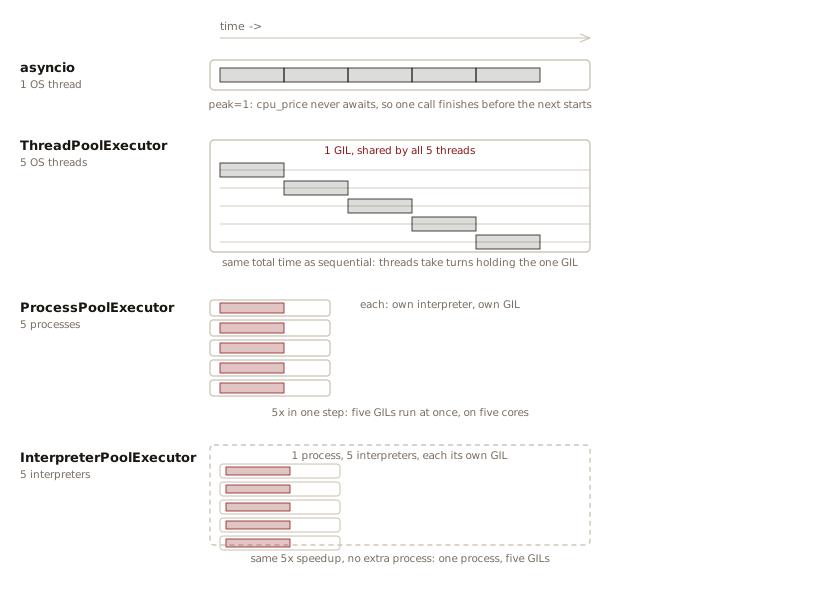
Are Threads Still Necessary?
asyncio handles I/O-bound work. Processes and
subinterpreters handle CPU-bound work. With both halves covered,
does new code ever need threads?
It does, but not for the reason threads were once the default
choice. I/O-Bound vs
CPU-Bound divides concurrent work into two kinds, and
neither kind needs threads. asyncio overlaps waits
on external operations. A process pool or subinterpreter overlaps CPU-bound
computing.
What role remains for threads? Creating bridges to code that
doesn’t cooperate with an event loop. Most database drivers,
most GUI toolkits, and plenty of C extensions block the calling
thread and expose no async entry point.
If Python had always supported coroutines, all libraries
could be expected to conform. But rewriting all existing
libraries to use asyncio instead of threads is not
realistic. asyncio.to_thread(), from Escaping to a Thread, is the
standard library solution. Thus, even a program written as
asyncio from top to bottom keeps a thread pool
underneath, because the libraries it calls still block.
Free threading, however, does not affect I/O-bound work. It solves a narrower problem: without the GIL, a thread can genuinely parallelize CPU-bound work from inside one process while sharing memory directly, paying no pickling cost. This is something neither a GIL-bound thread nor a process pool offers.
Under the standard build, then, a thread no longer structures
your concurrency. asyncio does that. A thread’s
remaining job is to absorb a blocking call, so the wait cannot
freeze the event loop.
The GIL does not prevent races. It doesn’t protect a read-modify-write spanning a function call. With free threading, two threads can execute at the same instant on separate cores. Race conditions become even easier.
asyncio only switches at an await,
which makes it easier to reason about
interleaving. A thread costs an OS stack and an OS
scheduling entity that free threading does not remove, while an
asyncio task is cheap enough to run in the
thousands. TaskGroup’s
structured, cancellable batches have no thread equivalent. There
is still no safe way to cancel a running thread. Free threading
changes what a thread is for. It does not change what
asyncio is for.
Measuring the Difference
We can support the claim that a thread costs real memory
while a task costs much less.
threading.stack_size() reports and sets the stack
CPython reserves for each new thread. A common default across
platforms is on the order of one mebibyte.1 tracemalloc can
measure a task’s actual heap footprint directly, since a task is
made of ordinary Python objects. We can calculate the ratio
between the two:
# task_vs_thread_memory.py
import asyncio
import threading
import tracemalloc

TASKS = 5_000
STACK_SIZE = 1024 * 1024  # 1 MiB, a common thread stack reservation

async def parked() -> None:
    await asyncio.sleep(999)  # Suspended, never resumes

async def bytes_per_task() -> float:
    tracemalloc.start()
    before = tracemalloc.take_snapshot()
    tasks = [asyncio.create_task(parked()) for _ in range(TASKS)]
    await asyncio.sleep(0)  # Let every task reach its own await
    after = tracemalloc.take_snapshot()
    grown = sum(
        stat.size_diff
        for stat in after.compare_to(before, "lineno")
        if stat.size_diff > 0
    )
    for t in tasks:
        t.cancel()
    # Without "return_exceptions=True", the first CancelledError
    # would raise an exception and exit the function:
    await asyncio.gather(*tasks, return_exceptions=True)
    tracemalloc.stop()
    return grown / TASKS

default_stack = threading.stack_size()
threading.stack_size(STACK_SIZE)  # A real, settable cost
configured_stack = threading.stack_size()
threading.stack_size(default_stack)  # Restore the previous setting

task_cost = asyncio.run(bytes_per_task())
tasks_per_stack = configured_stack / task_cost
print(f"one thread's stack reservation: {configured_stack:,} bytes")
print(f"average bytes per task: {task_cost:.0f}")
print(f"tasks fitting in one thread's stack: {tasks_per_stack:.0f}")
print(f"holds over 200 tasks: {tasks_per_stack > 200}")
#: one thread's stack reservation: 1,048,576 bytes
#: average bytes per task: 1350
#: tasks fitting in one thread's stack: 777
#: holds over 200 tasks: True
bytes_per_task() creates 5,000 tasks that
immediately suspend on asyncio.sleep(999), so they
stay alive doing nothing. The two tracemalloc
snapshots capture the heap they add.
threading.stack_size() is read, set, read again,
then restored, so the measurement leaves the rest of the program
untouched. A single thread’s reserved stack, paid before it runs
one line of its target function, could instead hold roughly 777
suspended tasks. The stack figure is address space set aside
whether every byte is touched or not. The task figure is heap
measured by tracemalloc. The comparison favors
tasks over threads by hundreds to one.
We see a similar difference in time:
# thread_vs_task_speed.py
import asyncio
import threading
import time

COUNT = 3000

def noop() -> None:
    pass

async def async_noop() -> None:
    pass

def spawn_threads() -> float:
    start = time.perf_counter()
    threads = [threading.Thread(target=noop) for _ in range(COUNT)]
    for t in threads:
        t.start()
    for t in threads:
        t.join()
    return time.perf_counter() - start

async def spawn_async_tasks() -> float:
    start = time.perf_counter()
    await asyncio.gather(*(async_noop() for _ in range(COUNT)))
    return time.perf_counter() - start

t_threads = spawn_threads()
t_tasks = asyncio.run(spawn_async_tasks())
print(f"tasks at least 5x faster to spawn: {t_tasks * 5 < t_threads}")
#: tasks at least 5x faster to spawn: True
Starting and joining 3,000 threads does OS-level work for
each one, allocating a stack, registering with the scheduler,
tearing it down again. Scheduling 3,000 tasks skips all of that.
gather() only builds Python objects and steps the
event loop through them.
How many threads can one machine support before
Thread.start() raises
RuntimeError: can't start new thread? That number
belongs to the machine, not to Python. On one well-provisioned
machine, 60,000 threads parked on a never-set
threading.Event started in about four seconds with
room to spare. A laptop with far less memory can fail at a
fraction of that. To find your own machine’s number, raise
COUNT in thread_vs_task_speed.py until
thread creation raises an exception. Tasks have no equivalent
ceiling, because a task consumes none of the OS resources that
limit threads.
Locks, Semaphores, and Failure Modes
async_race.py showed shared mutable state losing
updates with no coordination in place, but using tasks instead
of threads. Threads are not the source of deadlock and livelock.
That source is shared mutable state, and asyncio
shares it just as readily as threads do. Removing the OS thread
scheduler does not remove these failure modes. It only moves
where they can happen. With threads, that point is anywhere the
OS decides to preempt you. asyncio narrows this to
the await points you wrote yourself.
Locks
A lock grants exclusive access to a shared resource
so only one task holds it at a time. Wrapping the
read-modify-write from async_race.py in an
asyncio.Lock restores the missing updates by
serializing access to counter:
# async_locks.py
import asyncio

counter = 0
lock = asyncio.Lock()

async def increment(count: int) -> None:
    global counter
    for _ in range(count):
        async with lock:
            value = counter  # Read
            await asyncio.sleep(0)  # Yield to the event loop
            counter = value + 1  # Write

async def main() -> None:
    await asyncio.gather(*(increment(50) for _ in range(8)))
    print(counter)

asyncio.run(main())
#: 400
The only change from async_race.py is the
addition of async with lock. This protects the
read, the yielding await, and the write. If a task
reaches async with lock while another task already
holds the lock, it suspends itself until that lock becomes
available. This way, only one task’s read-modify-write is ever
in progress, no matter how many times the event loop switches to
another task in between. All 400 increments now occur, the same
fix threading.Lock produces for threads.
Semaphores
A semaphore generalizes a lock from a single
lock-holder to a fixed number of them. Where a lock admits one
task, asyncio.Semaphore(n) admits up to
n at once and suspends the rest:
# async_semaphore.py
import asyncio

active = 0
peak = 0
semaphore = asyncio.Semaphore(2)

async def worker() -> None:
    global active, peak
    async with semaphore:
        active += 1
        peak = max(peak, active)
        await asyncio.sleep(0.05)
        active -= 1

async def main() -> None:
    await asyncio.gather(*(worker() for _ in range(5)))
    print(f"peak concurrent workers: {peak}")

asyncio.run(main())
#: peak concurrent workers: 2
Five tasks start together, but semaphore admits
only two at a time. peak tracks the same live-count
idea as Meter in Overlapping the Waits. A
threaded equivalent of this worker would need its own lock
around active += 1 and
peak = max(peak, active), since a preemptive switch
could land between them. Here, the first await
comes after both updates, so the task keeps control through them
and needs no lock.
A semaphore initialized to one behaves like a lock, with one
difference worth knowing. A Lock refuses a release
it never granted, raising
RuntimeError: Lock is not acquired. An
over-released Semaphore quietly raises its own
limit instead, so a stray release() turns a
semaphore of one into a semaphore of two. Raising the count
deliberately turns it into a throttle on a limited resource,
such as a fixed number of database connections.
Deadlock
Deadlock happens when two or more tasks each hold a resource the other needs, so neither can proceed. Four conditions must all hold at once:
- Exclusive access to each resource
- A task holds one resource while it waits for another
- No way to force a task to give up what it holds
- A cycle of tasks each waiting on the next
Break any one of the four and deadlock becomes impossible.
None of these conditions mentions threads or an OS scheduler,
which means we can also produce deadlock with
asyncio. This example has two tasks and two
asyncio.Lock objects. The two locks are acquired in
opposite order:
# async_deadlock.py
import asyncio

lock_a = asyncio.Lock()
lock_b = asyncio.Lock()

async def worker(first: asyncio.Lock, second: asyncio.Lock) -> None:
    async with first:
        await asyncio.sleep(0.01)  # Let the other task grab its lock
        async with second:
            pass  # Never reached

async def main() -> None:
    try:
        await asyncio.wait_for(
            asyncio.gather(
                worker(lock_a, lock_b),
                worker(lock_b, lock_a),
            ),
            timeout=0.5,
        )
    except TimeoutError:
        print("deadlock detected")

asyncio.run(main())
#: deadlock detected
The first task takes lock_a then reaches for
lock_b. The second takes lock_b then
reaches for lock_a. The sleep(0.01)
gives each task time to grab its first lock before either
reaches for its second. Tasks, unlike threads, run one at a
time, so no OS scheduler can interleave the two tasks’ first
lines in an unlucky order.
Once both hold their first lock, each task’s
async with second: suspends on a lock the other
holds and will never release. A real deadlock has no
timeout and never resolves. Both tasks wait
forever, the event loop included, since nothing remains that can
wake them. Here, the timeout ensures that the example
terminates.
The fix is the same one that works for threads: have every
task acquire shared locks in the same global order. If both
tasks had reached for lock_a first, whichever got
there first would finish and release that lock before the other
waited.
Livelock
A livelock blocks nothing. Tasks keep running and keep changing state, but none of them makes progress, the way two people in a hallway each step aside for the other, forever. No lock is involved, so no timeout can fix it, and there is nothing to acquire:
# async_livelock.py
import asyncio

a_wants = True
b_wants = True

async def giver(name: str) -> None:
    global a_wants, b_wants
    for _ in range(3):
        other_wants = b_wants if name == "a" else a_wants
        if other_wants:
            print(f"{name}: gives")
        else:
            print(f"{name}: proceeds")
            if name == "a":
                a_wants = False
            else:
                b_wants = False
        await asyncio.sleep(0)

async def main() -> None:
    await asyncio.gather(giver("a"), giver("b"))
    print(f"resolved: {not (a_wants or b_wants)}")

asyncio.run(main())
#: a: gives
#: b: gives
#: a: gives
#: b: gives
#: a: gives
#: b: gives
#: resolved: False
Each round, a checks b_wants and
b checks a_wants, and both still see
the other wanting the resource, so both give. Thus both still
want it on the next round. Being polite when interacting with a
task that is equally polite produces no progress, even though
the event loop keeps both tasks busy the whole time.
A real livelock looks busy on a monitor, with CPU time spent and state visibly changing. A deadlock looks idle, with tasks parked and waiting. In both cases, nothing gets done. The usual fix is to break the symmetry, for example letting only the task with the lower ID give.
Guidelines
- Remember that concurrency is a performance tool. Explore Performance before deciding you require a concurrent solution.
- Don’t wrap a lone wait in
async/awaitmachinery.asynciopays off once you have multiple waits that overlap. - A comprehension that awaits is not
concurrent.
[await c for c in coroutines]runs one coroutine at a time. Onlygather()orTaskGroupschedule every coroutine as a task before waiting on any of them. - Choose
TaskGroupwhen a failure should stop the batch,gather(return_exceptions=True)when it shouldn’t.TaskGroup’s contract is all-or-cancel.gather()can hand back errors as data alongside the successes. - A read-modify-write that spans an
awaitstill races, with no thread in sight. Guard it withasyncio.Lock, the same fix a lock gives for threads. - Never call a blocking function inside a
coroutine.
time.sleep()freezes every task on the loop, not just its own. Useasyncio.sleep(), or hand the blocking call toasyncio.to_thread(). - Prefer
ProcessPoolExecutorover rawmultiprocessing. A pool fits work shaped like a function call: one call in, one result out. Use rawmultiprocessingwhen the job is a different shape: a worker that runs continuously, or processes that share state through aManager. - More cores only speed up the parallel fraction of the work. Splitting past the number of cores sometimes buys a little more. Then the per-task cost of pickling and reassembling catches up, and the gains flatten (Amdahl’s Law).
- For CPU-bound work, try a subinterpreter first, a process pool second, and a free-threaded build only once every extension you use is known to support it.
- Match the queue to the concurrency model.
queue.Queueblocks a thread,multiprocessing.Queuepickles across processes,asyncio.Queuesuspends a task and needs no locking. - A shared lock only prevents deadlock if every user agrees on the order. Acquire shared locks in the same sequence everywhere. When two units keep yielding to each other instead, break the symmetry so only one of them gives way.
Concurrency is Not Easy
Concurrency is neither simple nor solved.
There are ongoing arguments about what the term even means. Rob Pike, creator of the Go language, famously muddied the waters by declaring, “concurrency is not parallelism” (I’m hoping he meant to say “concurrency is not only parallelism”).2 As we’ve seen in this chapter, concurrency means “operating or occurring at the same time.” This works for both asynchrony and parallelism.
Also, notice how much we’ve talked about the OS in this chapter. The comfortable abstraction provided by normal programming is pierced to tatters by concurrency. Sometimes you even need to go beyond the OS-level abstraction, all the way to hardware, in order to understand a particular bug.
Someone who declares “concurrency is easy!” has dipped their toes in it and never encountered a tricky problem. This chapter makes concurrency look (somewhat) easy because it has only touched the surface of shared mutable state problems.
Even when you understand the problems produced by shared mutable state, you might not have a choice. Some problems preclude immutability. For example, a solution might require packing as much data as possible into RAM. In those cases you almost inevitably share mutable state. These are the kinds of decisions you must make when you move from the examples presented in this chapter into serious real-world concurrency.
People continue to work toward better ways of concurrent programming.3 Only in the last decade or so have advances such as async/await and structured concurrency become widely accepted. The vocabulary this chapter built, from processes and threads to tasks and coroutines, is a small corner of the territory. Here are a few of the topics beyond it:
- Barriers: Make a group of threads or tasks
wait until every one of them arrives, then release them
together. Unlike
gather()orTaskGroup, a barrier is a rendezvous point the running code reaches and blocks on itself, often reused across repeated phases, not a supervisor waiting from outside for everything to finish. - Message passing and channels: Let concurrent units exchange data by sending values instead of sharing memory directly. Actor languages and CSP, below, are two different disciplines built on this same idea.
- Actor languages: Give each unit of concurrency the shape of an actor, an isolated object that reacts only to messages sent to its own mailbox, never shares state directly, and can spawn more actors. The most established production examples include Erlang, built at Ericsson for telephone switches. Elixir is newer and built on Erlang’s BEAM virtual machine.
- Communicating Sequential Processes (CSP): Independent processes that communicate only over explicit, shared channels, rather than an actor’s private mailbox. This is the approach Go’s goroutines and channels are built on.
- Software transactional memory (STM): Runs a block of code as an atomic transaction against shared memory, retrying automatically if another thread interferes.4
- Memory models and data races: Define which writes by one thread are guaranteed visible to another, and what happens when two threads touch the same memory with no synchronization between them.
Exercises
- In
async_mechanics.py, add a fourth call,fetch("d", 0.005), to thegather()line. Confirm that “d” starts last but resumes first, and that the printed list still grows to four entries in the order given, not the order they finish. - In
async_mechanics.py, replace thegather()call with[await c for c in coroutines], wherecoroutinesis a list of the same threefetch()calls. Predict the started/resumed trace and the total run time before running it, and explain why this version takes the sum of the three delays. - In
peak_concurrency.py, add a third task function,mixed_price(), that awaitsasyncio.sleep(0.05)and then also runs the 1,000,000-iteration loop fromcpu_price(). Run it throughrun()and predict itsmeter.peakbefore checking: is it closer to the I/O peak or the CPU peak? - In
peak_concurrency.py, changeio_price()’sawait asyncio.sleep(0.05)totime.sleep(0.05)and predict what happens to itsmeter.peakbefore running it. Explain the result usingblocking_the_loop.py. - In
async_locks.py, replacelock = asyncio.Lock()withlock = asyncio.Semaphore(1). Confirmcounterstill reaches400, and explain why a semaphore initialized to1stands in for a lock here. Then add one straysemaphore.release()before thegather()call and explain the result. - Remove the
if __name__ == "__main__"guard fromparallel_cpu.py, callingmain()unconditionally, and run it. Read the error, then explain it with the import mechanics described in Parallelism: what did each worker process do when it imported the module? - In
gil_race.py, remove thetime.sleep(0.000_001)call and run the script several times. Explain, using The GIL Does Not Prevent Races, why the race becomes far less likely to show up without that sleep, but is not thereby fixed. - In
priority_queue.py, add a third thread submitting[(1, "zzz"), (3, "aaa")]and confirm the drain order still respects priority first, then the description as a tiebreaker.