Comprehensions
Comprehensions (first introduced in Control Flow) build one collection from another in a single expression. The idea originated in mathematical set-builder notation, and passed into functional programming. Haskell had list comprehensions, and Python borrowed them.
Comprehensions require a mental shift. With a loop you describe how to build the result: make an empty list, walk the input, test each item, and append the ones you want. With a comprehension you describe what the result is, as a single expression, and let Python build it. A comprehension is shorter, it reads like the definition of the result rather than a recipe for it, and one line replaces several lines of loop bookkeeping.
List Comprehensions
A list comprehension consists of:
- An input sequence.
- A variable representing members of the input sequence.
- An optional predicate expression.
- An output expression producing elements of the output list from members of the input sequence that satisfy the predicate.
Let’s select the integers from a mixed list and square them. Several examples in this chapter use the same input list:
# a_list.py
a_list = [1, "4", 9, "a", 0, 4]
The list comprehension selects integers from the list and squares them:
# list_comprehension.py
from a_list import a_list

squared_ints = [e ** 2 for e in a_list if isinstance(e, int)]
print(squared_ints)
#: [1, 81, 0, 16]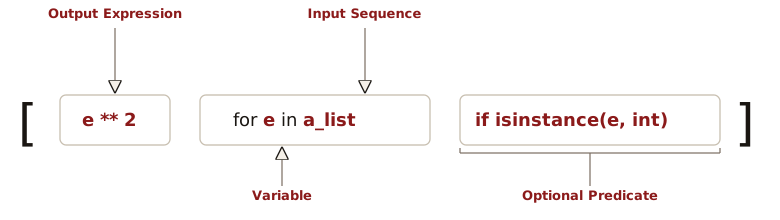
In this comprehension:
- The iterator part iterates through each member
eof the input sequencea_list. - The predicate checks if the member is an integer.
- If the member is an integer, the output expression squares it and appends it to the output list.
You can achieve the same results using the built-in functions
map() and filter() with an anonymous
lambda. filter() applies a predicate
to a sequence and retains the members that satisfy the
predicate. It produces a lazy iterator, which
list() expands into a list:
# filtering.py
from a_list import a_list

ints = list(filter(lambda e: isinstance(e, int), a_list))

if __name__ == "__main__":
    print(ints)
#: [1, 9, 0, 4]
map() applies a function to each member:
# mapping.py
from filtering import ints

print(list(map(lambda e: e ** 2, ints)))  # type: ignore
#: [1, 81, 0, 16]
The two combine into a single expression:
# map_and_filter.py
from a_list import a_list

print(list(map(lambda e: e ** 2,  # type: ignore
               filter(lambda e: isinstance(e, int), a_list))))
#: [1, 81, 0, 16]
The nested form funnels every element through
lambda calls, and is harder to read. The
comprehension inlines the test and the expression.
The # type: ignore comments mark a third cost.
filter() with a lambda predicate does
not narrow the element type, so the checker still sees
int | str coming out and rejects
e ** 2. The comprehension’s
if isinstance(e, int) does narrow, which is why
list_comprehension.py needs no such comment.
filter() can narrow, but only when its predicate is
a named function annotated to return TypeIs[int]
rather than bool.
List brackets ([]) enclose the list
comprehension, so it is immediately evident that it produces a
list. The if clause names isinstance()
directly and the output expression squares directly, with no
lambda wrappers in the way.
Nested Comprehensions
An identity matrix of size n is an
n by n square matrix with ones on the
main diagonal and zeros elsewhere. In Python we can represent
such a matrix by a list of lists, where each sub-list represents
a row. The following comprehension generates an identity
matrix:
# identity_matrix.py
from typing import Final

SIZE: Final[int] = 6

matrix = [[1 if col == row else 0 for col in range(SIZE)]
          for row in range(SIZE)]

for row in matrix:
    print(row)
#: [1, 0, 0, 0, 0, 0]
#: [0, 1, 0, 0, 0, 0]
#: [0, 0, 1, 0, 0, 0]
#: [0, 0, 0, 1, 0, 0]
#: [0, 0, 0, 0, 1, 0]
#: [0, 0, 0, 0, 0, 1]
Techniques
Use zip() to walk two sequences together, taking
one element from each:
# zip_pairs.py
names = ["a", "b", "c", "d"]
values = [1, 2, 3]
print([f"{n}={v}" for n, v in zip(names, values)])
#: ['a=1', 'b=2', 'c=3']
zip() stops at the end of the shorter sequence;
pass strict=True to make a length mismatch raise
ValueError instead of silently truncating.
Unpack a tuple in the iterator, here a
(name, function) pair applied to a value:
# zip_unpack.py
all_slots = [
    ("doubled", lambda v: v * 2),
    ("squared", lambda v: v ** 2),
]
values = [10, 3, 42]
print([
    f"{name}({v}) = {f(v)}"
    for (name, f), v in zip(all_slots, values)
])
#: ['doubled(10) = 20', 'squared(3) = 9']
Here’s a two-level list comprehension using
Path.walk():
# path_walk_comprehension.py
import tempfile
from pathlib import Path

# Build a small tree to walk: two .py files and one to skip
with tempfile.TemporaryDirectory() as tmp:
    root = Path(tmp)
    (root / "pkg").mkdir()
    for name in ("main.py", "pkg/util.py", "pkg/notes.txt"):
        (root / name).write_text("")
    py_paths = [
        (dirpath / f).relative_to(root).as_posix()
        for dirpath, _, files in root.walk()
        for f in files if f.endswith(".py")
    ]

for path in sorted(py_paths):  # Sorted for stable output
    print(path)
#: main.py
#: pkg/util.py
tempfile.TemporaryDirectory() is a context
manager that creates a scratch directory and deletes it, and
everything in it, when the with block exits. That
gives the example a throwaway file tree to walk, without
touching any real files or leaving anything behind.
In the py_paths comprehension, the first
for walks the directories and the second
for walks the files in each, flattening the tree
into one list of paths.
A with block, unlike a function body, does not
create a new scope. py_paths is assigned inside the
with, but the name is still visible afterward, in
the for path in sorted(py_paths): line below it. By
then the directory is already deleted. The comprehension already
finished building py_paths as plain strings while
the directory still existed, so nothing later needs the files
themselves.
Breaking Up a Complex Comprehension
A comprehension earns its place when it reads clearly.
Nothing stops you from nesting more for and
if clauses, or wrapping the whole thing in another
call, but each addition makes the expression harder to read in
one pass. Here, filtering, flattening, sorting, and formatting
all happen in a single expression:
# dense_comprehension.py
warehouses = {
    "East": [
        ("widget", 12, 4.50),
        ("gadget", 0, 9.00),
        ("gizmo", 5, 2.25),
    ],
    "West": [
        ("widget", 3, 4.75),
        ("thingamajig", 8, 15.00),
    ],
}

report = [
    f"{wh}: {name} (${price:.2f})"
    for wh, name, price in sorted(
        [(wh, name, price)
         for wh, items in warehouses.items()
         for name, qty, price in items
         if qty > 0 and price < 10],
        key=lambda t: t[2])
]

if __name__ == "__main__":
    for line in report:
        print(line)
#: East: gizmo ($2.25)
#: East: widget ($4.50)
#: West: widget ($4.75)
Reading this means untangling several questions at once:
which items qualify, how the warehouses flatten together, what
order the result ends up in, and how each line is displayed. A
comprehension nested inside sorted(), itself nested
inside the outer comprehension, is doing four jobs in one
expression.
Splitting it into named steps removes none of the logic, but each step now states its own purpose:
# comprehension_steps.py
from dense_comprehension import warehouses

in_stock = [
    (wh, name, price)
    for wh, items in warehouses.items()
    for name, qty, price in items
    if qty > 0 and price < 10
]
in_stock.sort(key=lambda t: t[2])

report = [
    f"{wh}: {name} (${price:.2f})"
    for wh, name, price in in_stock
]

for line in report:
    print(line)
#: East: gizmo ($2.25)
#: East: widget ($4.50)
#: West: widget ($4.75)
in_stock answers “which items qualify, flattened
across warehouses.” sort() answers “in what order.”
report answers “how each line is displayed.” Each
name documents a stage of the pipeline, so a reader can follow
the transformation one step at a time instead of parsing every
step simultaneously. Use this split whenever a comprehension
needs a comment to explain what it does.
Comprehensions Build, Loops Execute
A comprehension’s output expression can be any expression,
including a call with a side effect, such as
print(). Nothing stops you from using a
comprehension to run code and throw away the result it
builds:
# comprehension_side_effects.py
wasted = [print(n) for n in [1, 2, 3]]
print(wasted)
#: 1
#: 2
#: 3
#: [None, None, None]
wasted runs print() for its side
effect. print() returns None, so
wasted ends up holding three Nones.
wasted is a list built only to be thrown away.
Worse, a reader scanning [...] expects a meaningful
collection, not a loop wearing a disguise.
The idiomatic version says what it does:
# for_loop_side_effects.py
for n in [1, 2, 3]:
    print(n)
#: 1
#: 2
#: 3
Same effect, no wasted list. The for loop reads
honestly. It executes code rather than building a collection.
Use a comprehension when you want the collection it produces,
and a for loop when you want the side effect. If a
comprehension’s result is never assigned or used, that’s a sign
it should be a loop instead.
Set Comprehensions
Set comprehensions construct sets using the same principles
as list comprehensions. Instead of [], a set
comprehension uses {}.
The following set comprehension normalizes each name (capital first letter, the rest lower case), keeps the names longer than one character, and collapses the duplicates and case variants:
# set_comprehension.py
names = ["Bob", "JOHN", "alice", "bob", "ALICE", "J", "Bob"]

unique = {name[0].upper() + name[1:].lower()
          for name in names if len(name) > 1}

print(sorted(unique))  # Sorted for stable display
#: ['Alice', 'Bob', 'John']

same = set([name[0].upper() + name[1:].lower()
            for name in names if len(name) > 1])

print(unique == same)
#: True
same builds a list with a list comprehension,
then passes it to set(). This produces the same
result, but because it builds a throwaway list first, the set
comprehension is more efficient.
Dictionary Comprehensions
A dictionary comprehension builds a dict,
producing a key and a value for each element, with an optional
filter. Here each name becomes an upper-case key mapped to its
length, keeping only the names longer than three characters:
# dict_comprehension.py
names = ["Arthur", "Lancelot", "Bedevere", "Ni", "Robin"]

lengths = {name.upper(): len(name) for name in names if len(name) > 3}
print(lengths)
#: {'ARTHUR': 6, 'LANCELOT': 8, 'BEDEVERE': 8, 'ROBIN': 5}
The three parts mirror the list comprehension: the
for clause supplies each name, the
if clause drops "Ni", and the
key: value expression before for
produces each entry.
A common variant swaps a dictionary’s keys and values to invert a lookup:
# invert_dict.py
seat_of = {"Arthur": 1, "Galahad": 2, "Robin": 3}

name_at = {seat: name for name, seat in seat_of.items()}
print(name_at)
#: {1: 'Arthur', 2: 'Galahad', 3: 'Robin'}
Inverting assumes the values are unique. If two keys share a value, the later entry wins, just as with any duplicate key.
Generator Expressions
A comprehension evaluates eagerly, which means it immediately builds the entire result in memory. For a large data set, that wastes time and space, especially if you consume the result only once. A generator expression uses the same syntax with parentheses instead of brackets, and produces its values one at a time, on demand:
# generator_expression.py
from itertools import islice

squares = (n ** 2 for n in range(1_000_000))
print(next(squares))
#: 0
print(next(squares))
#: 1
print(list(islice(squares, 3)))
#: [4, 9, 16]
No computation happens until you pull a value.
next() produces them one at a time, and
itertools.islice() takes a few without ever
building the million-element list.
A generator expression can also feed set() and
dict():
# set_dict_from_genexp.py
words = ["pol", "parrot", "pining", "fjord", "ex"]

lengths = set(len(w) for w in words)
print(sorted(lengths))
#: [2, 3, 5, 6]

initials = dict((w, w[0]) for w in words)
print(initials)
#: {'pol': 'p', 'parrot': 'p', 'pining': 'p', 'fjord': 'f', 'ex': 'e'}
No lazy set or dict exists, though.
A set or dict must hold every element, so set(...)
or dict(...) consumes the whole generator
immediately. Neither saves anything over the set comprehension
{len(w) for w in words} or the dict comprehension
{w: w[0] for w in words}, which read more directly
and are the better choice.
Use a generator expression when the consumer takes values one
at a time and never needs them all, such as sum(),
any(), all(), min(),
max(), or str.join():
# genexp_consumers.py
nums = range(1_000_000)

print(sum(n * n for n in nums))
#: 333332833333500000
print(any(n == 12_345 for n in nums))
#: True
print(max(len(str(n)) for n in nums))
#: 6
None of these builds an intermediate collection of a million
items, and any() stops when it finds a match. Iterators explores
generators further.
Unpacking in Comprehensions
path_walk_comprehension.py flattened a tree by
writing two for clauses. Python 3.15 (PEP 798) adds a
more direct way to flatten. The unpacking operators
* and ** may appear in the output
expression of a comprehension or generator expression, splicing
each iterable or mapping into the result. This extends the PEP 448 unpacking
from [*a, *b] and {**d1, **d2} to the
comprehension form, and replaces many uses of nested
comprehensions, itertools.chain(), and
itertools.chain.from_iterable():
# unpacking_comprehensions.py
rows = [[1, 2], [3, 4], [5]]
dicts = [{"a": 1}, {"b": 2}, {"a": 3}]

# * splices each iterable into the result:
print([*row for row in rows])
#: [1, 2, 3, 4, 5]

# ** merges each mapping. Later keys win, order preserved:
print({**d for d in dicts})
#: {'a': 3, 'b': 2}

# The same syntax works in a generator expression:
flat = (*row for row in rows)
print(list(flat))
#: [1, 2, 3, 4, 5]
[*row for row in rows] reads as “splice each
row in,” and produces the same flat list as the
nested [x for row in rows for x in row], while
saying what it does more directly. This is a shallow flatten: it
splices only the outer iterable, so a nested list inside a row
stays nested. [*row for row in [[1, [2, 3]], [4]]]
produces [1, [2, 3], 4], not
[1, 2, 3, 4]. ** does the same for
dictionaries, merging each mapping with later keys winning. The
set form {*s for s in sets} and the asynchronous
generator form ((*a async for a in agen())) work
the same way.
Exercises
- Using
a_listfroma_list.py([1, "4", 9, "a", 0, 4]), write a list comprehension that finds the string elements made only of digits (e.isdigit()), converts each tointwithint(e), and squares it. The predicate must reject"a"soint()never sees it. Onlystrhasisdigit(), so the predicate must testisinstance(e, str)before calling it. - In
identity_matrix.py, change the comprehension to build a 3 by 3 matrix with2on the diagonal instead of1, without adding a second pass over the result. - In
dict_comprehension.py, add"Galahad"tonames, then predict which entries the comprehension produces before running it, given thelen(name) > 3filter. - In
generator_expression.py, replaceislice(squares, 3)withislice(squares, 5)and predict which five values it produces, given thatnext(squares)was already called twice before that line. - In
unpacking_comprehensions.py, add a fourth entry{"a": 5, "c": 9}todictsand predict what{**d for d in dicts}produces before running it, paying attention to which value wins for the key"a".